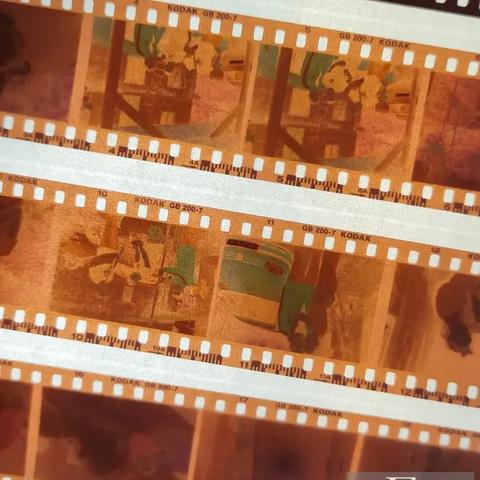
Revolog Snovlox 100 is a black and white negative effect film from the Austrian workshop Revolog, a 135 cassette of 36 frames, ISO 100. It develops in a standard black and white process with no special requirements of the lab.
What the effect looks like
Snovlox is the black and white relative of Volvox: instead of green dots it adds white marks of varying size, like snowflakes. The effect behaves the same way — clear against dark areas, merging into bright ones.
How it is made
The effect is applied to the film BEFOREHAND, before it ever reaches the cassette: the workshop pre-exposes every roll by hand and only then cuts and loads it. The pattern therefore sits under the image rather than over it, and no two rolls repeat. You shoot it exactly like an ordinary film — nothing extra is required.
What to shoot on it
Winter subjects, the city at night, dark interiors. It is the only black and white film in the range, and therefore the only one you can develop at home in an ordinary black and white developer.
Exposure controls the effect
Exposure is the main control over the effect, and it works against intuition: UNDERexposure makes the pattern stronger, OVERexposure weaker. The reason is simple — the pattern already sits on the film at a fixed density, so the less light the scene gives, the more it outweighs the image. For a subtle effect rate it at ISO 50; for a pronounced one shoot at box speed or a little darker.
Processing
It develops in any standard black and white developer at the usual ISO 100 times. The effect needs no special regime and does not change with the developer — it is already on the film.
How it compares
Within the Revolog range each film is its own pattern rather than a variation on one: Kolor gives colour gradients, Texture bubbles, Volvox green dots, Tesla lightning, Kosmos stardust, Streak scratches, while 460 nm and 600 nm shift colour with no pattern at all. Technically they behave identically, so choose purely by the effect you want. Comparing them with ordinary film misses the point: on sharpness and grain they lose to any ISO 400, and that is not what they are bought for.