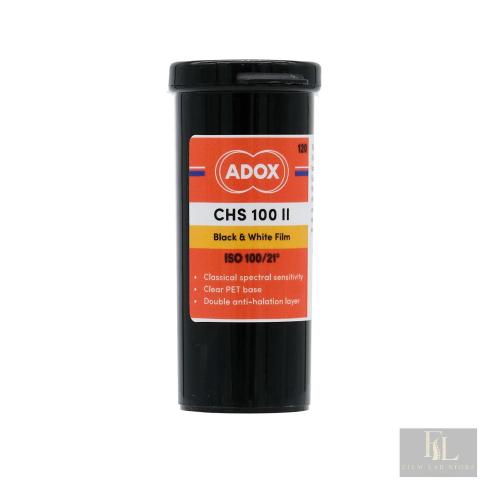
The same SPUR UFG emulsion, in a 120 roll — twelve 6×6 frames. Box speed ISO 40, a working range of 40 to 80, and a push to 160 in the dedicated SPUR UFG-1 developer.
What medium format adds
A film resolving 287 line pairs per millimetre already sits at the limit of what the lens can deliver. On a 6×6 frame, roughly four times the area of 35 mm, that reserve turns into print size: an enlargement at which grain still never shows up.
Why the developer is not optional
The emulsion was made for aerial photogrammetry. In ordinary developers it yields neither sharpness nor a usable curve — a dedicated two-component developer, UFG-1, was built for it, and without that there is little point in buying this film.
What to shoot on it
Landscape, architecture, still life, studio — anything shot from a tripod and printed large. The spectral sensitisation reaches into the red, so with a red filter the film stands in for an infrared stock.
Processing and scanning
Standard black and white processing in SPUR UFG-1; take the times from the maker’s sheet. Scan without software sharpening.
How it compares
In medium format this is close to a one-off: document films of this resolution usually exist in 35 mm only. The alternative is an ordinary ISO 100 in 120 — simpler and cheaper, but with visible grain at a big enlargement.