Film in 2026: why people want not a perfect image again, but a real process
In 2026, photography officially turns about two hundred years old: the first permanent photographic image by Nicéphore Niépce is usually dated to 1826 or 1827. And strangely enough, right now, when every phone has a camera and artificial intelligence can create a “photograph” without a camera, light, or a person in front of the lens, film no longer looks outdated — it looks unexpectedly modern.
- Not because everyone suddenly wanted “retro”.
- Not because grain became a trendy filter.
- And not because old cameras automatically take better pictures.
Film is returning because the modern image has become too easy. It can be created instantly, corrected automatically, smoothed out, redrawn, generated, and presented as reality. In such an environment, photography once again faces a simple question: did this really happen?
A film frame answers differently. It has a physical trace. Light really did hit the emulsion. The negative really did pass through chemistry. The result did not appear instantly, but through a process: shooting, developing, drying, scanning, interpreting color.
This exact chain is becoming valuable again today.
Perfect images have stopped being convincing
The modern digital image is often technically flawless. A smartphone pulls up the shadows by itself, smooths skin, intensifies the sky, increases sharpness, and makes the frame “pleasant”. AI goes further: it can create a person who never existed, an interior that never existed, a portrait without a model, and an advertising shot without the object.
The problem is not that this is bad. The problem is that viewers increasingly do not understand where photography ends and simulation begins.
Getty Images wrote in its research that almost 90% of consumers want to know whether an image was created using AI, and 98% consider authentic images and videos important for trusting a brand. This is not a narrow problem for photographers. It is a broader shift: people increasingly care about understanding where an image comes from.
The digital industry is responding with technologies for verifying image provenance. Google added support for C2PA Content Credentials in Pixel 10 and Google Photos, while Sony is developing solutions for digital signatures and video provenance verification in professional cameras.
But film has its own, rougher and more understandable way of speaking about the origin of an image: the negative.
It does not automatically make a photograph “truthful”. A frame can still be staged, selected, cropped, and interpreted. But the negative preserves a physical connection between light, moment, and material. In an age of endless generated images, this matters again.
Film is not a filter. It is a physical event
Film does not have to compete with digital photography in sharpness, speed, or convenience. That is a pointless contest: digital photography is faster, cheaper per frame, and technically more flexible.
Film’s strength lies elsewhere.
It forces the photographer to work with limitation. A cassette has 36 frames, sometimes 24; medium format has even fewer. There is no screen to check immediately after every shot. You cannot make a thousand duplicates and choose later. You have to think in advance about light, exposure, distance, movement, and gesture.
This changes the psychology of shooting itself.
- The photographer checks less and looks more.
- The model waits less for endless takes and feels the moment better.
- Mistakes do not always become defects — sometimes they are exactly what gives the frame character.
- Waiting for development gives the image weight again.
Film photography does not simply look different. It is produced differently. And that is visible in the result.
Why this is especially important after AI
AI made obvious something people used to think about less: photography is not only an image, but also trust in the process.
If an image looks perfect, but it is unknown who made it, where it was shot, and whether it was shot at all, it begins to function like an illustration. It may be beautiful, but its connection to reality becomes weak.
Film brings resistance back to photography.
- It requires material.
- It requires time.
- It requires development.
- It requires decisions at every stage.
- It requires accepting that the result cannot be fully controlled.
That is why film today is perceived not as an escape into the past, but as a response to an overly smooth digital present. Digital Camera World, discussing 2026 photography trends based on Aftershoot data, describes the general shift this way: less technical perfection, more humanity, emotion, and living imperfection.
Film fits this demand perfectly. Not because it is magical. But because it is physical, slow, and not fully obedient.
The film market did not die — it restructured itself
If film were only nostalgia, the market would have long ago turned into a clearance sale of old stock. But in 2025–2026, something else is happening: new films, new cameras, new packaging, and new experiments are appearing.
According to Market Growth Reports, the global photographic film market in 2026 is estimated at roughly $613 million and may grow to $723 million by 2035. This is not explosive growth, but it is not the death of the format either. It is a stable niche market.
Interest from younger generations is especially noticeable. Different market reviews estimate the share of young buyers differently, but the general conclusion is the same: film is actively bought not only by those who remember it from childhood, but also by people aged 18–34 who grew up in a digital environment.
This is an important point. For many young photographers, film is not a memory of the past. It is a new experience: tactile, slow, limited, and therefore more deliberate.
Kodak is becoming a visible player again
One of the important signals of 2026 is Kodak’s activity. Eastman Kodak is expanding direct distribution of photographic film, bringing large formats and 100-foot bulk rolls for self-loading back into the range. A recent Digital Camera World article discusses the expansion of the Ektacolor Pro, Ektapan, and Tri-X lines in 4×5, 8×10, and bulk roll formats.
This matters not only for large-format photographers. It is a signal to the market: film remains alive enough for a manufacturer to do more than just residual support and actually expand its offering again.
Yes, some names and rights around Kodak, Kodak Alaris, Portra, and T-Max remain complicated. So this should not be presented as a simple story of “Portra disappeared and became Ektacolor”. It is more accurate to say it carefully: Eastman Kodak is developing its own still film line under new/historic names and expanding formats.
For photographers, this means one thing: the market is not frozen. It is changing.
Harman is making color film interesting again
Another strong story of recent years is Harman Technology. The company, known primarily through Ilford and Kentmere, is actively developing color film.
Harman Phoenix II is an ISO 200 color negative film for the C-41 process, released as a development of the first Phoenix. Harman emphasizes that the new version has become more predictable, gained improved detail rendering, and become easier to scan, while retaining its experimental character.
And in March 2026, Harman introduced Switch Azure 125 — an experimental color film in 35 mm and 120 formats. Its idea is not accurate reproduction of reality, but deliberate color shifting: familiar scenes become strange, the sky may shift toward pink-orange tones, and everyday life turns into a surreal image.
This is very telling. New film in 2026 is not simply trying to copy the “classic Kodak look”. It is becoming an experimental material. Film is interesting again not only because it is old, but because it can be strange, new, and unpredictable.
Scanning is no longer just “digitization”
Film has one paradox: most modern film photographs are still viewed on a screen.
This means the final result is created not only in the camera and not only in the developer. It passes through a scanner. Through color interpretation. Through decisions about how much grain, contrast, density, base tint, and emulsion character to preserve.
That is why scanning is not a secondary technical service. It is part of the image.
The same film can look different depending on exposure, process, scanner, and manual correction. This is especially visible with new experimental films like Harman Phoenix II and Switch Azure, where color interpretation becomes part of the creative result. Reviews of Switch Azure separately emphasize that the result depends not only on the emulsion itself, but also on further processing and scanning.
Therefore, a modern lab is not just a place where “a roll is developed”. A good lab helps preserve the character of the material instead of killing it with automation.
For FilmLabStore, this is an important position: development and scanning are not an add-on to film, but part of the authorial process. If a person shoots film for its character, it is important to carry that character carefully through to the final file.
Ukraine: film as a slow gaze
In Ukraine, film has a separate meaning. It exists not only as a style, but also as a way of recording life in a situation where reality often changes faster than one can fully comprehend it.
A film frame requires a pause. It does not encourage an endless stream. It forces you to choose a moment, accept limitation, and then wait for the result.
In the Ukrainian context, this is especially noticeable: photography has become a way to preserve personal memory, the urban environment, the body, closeness, everyday life, anxiety, and presence. Not everything has to be frontline reportage or a major historical document. Sometimes it is more important to photograph a room, a person by a window, an empty street, a portrait of a friend, a body in soft light, an ordinary day that later turns out not to be so ordinary after all.
The Ukrainian publication Mezha wrote about analog photography as a way to return materiality, grain, and resistance to the digital age. Re/visions also considers the return of film photography as a slower and more thoughtful way of looking at the world.
This does not mean that film is “truer” than digital in every way. But it is definitely slower. And slowness today is already a position.
Why film works especially well in portraiture and nude photography
Film feels the human being well.
Not because it automatically makes skin beautiful. That is a myth. Film can also be harsh, rough, contrasty, and unsuccessful. But in portraiture, it creates a different dynamic between photographer and model.
- When there are few frames, the shoot becomes more attentive.
- When there is no instant preview, the model fixates less on “how did I turn out”.
- When the result comes later, more trust appears inside the process.
- When the photographer works with film consciously, they think more about light, gesture, and state, rather than about an endless series of duplicates.
In nude and boudoir photography, this is especially important. A good shoot there is not built on displaying the body, but on boundaries, consent, light, plasticity, trust, and privacy. Film can help remove digital aggression: less sharpness, less of the feeling of “shot for control”, more air and corporeality.
Film nude does not have to be “vintage”. It can be modern, minimalist, cold, intimate, documentary, or almost abstract. The main thing is that it feels like an event, not like a set of files.
New cameras prove that analog is not only flea-market hunting
For a long time, film photography survived on old cameras. Canon, Nikon, Minolta, Olympus, Pentax, Zenit, Kyiv, Mamiya, Bronica — all of this still works, gets repaired, bought, and sold.
But now new cameras are appearing too.
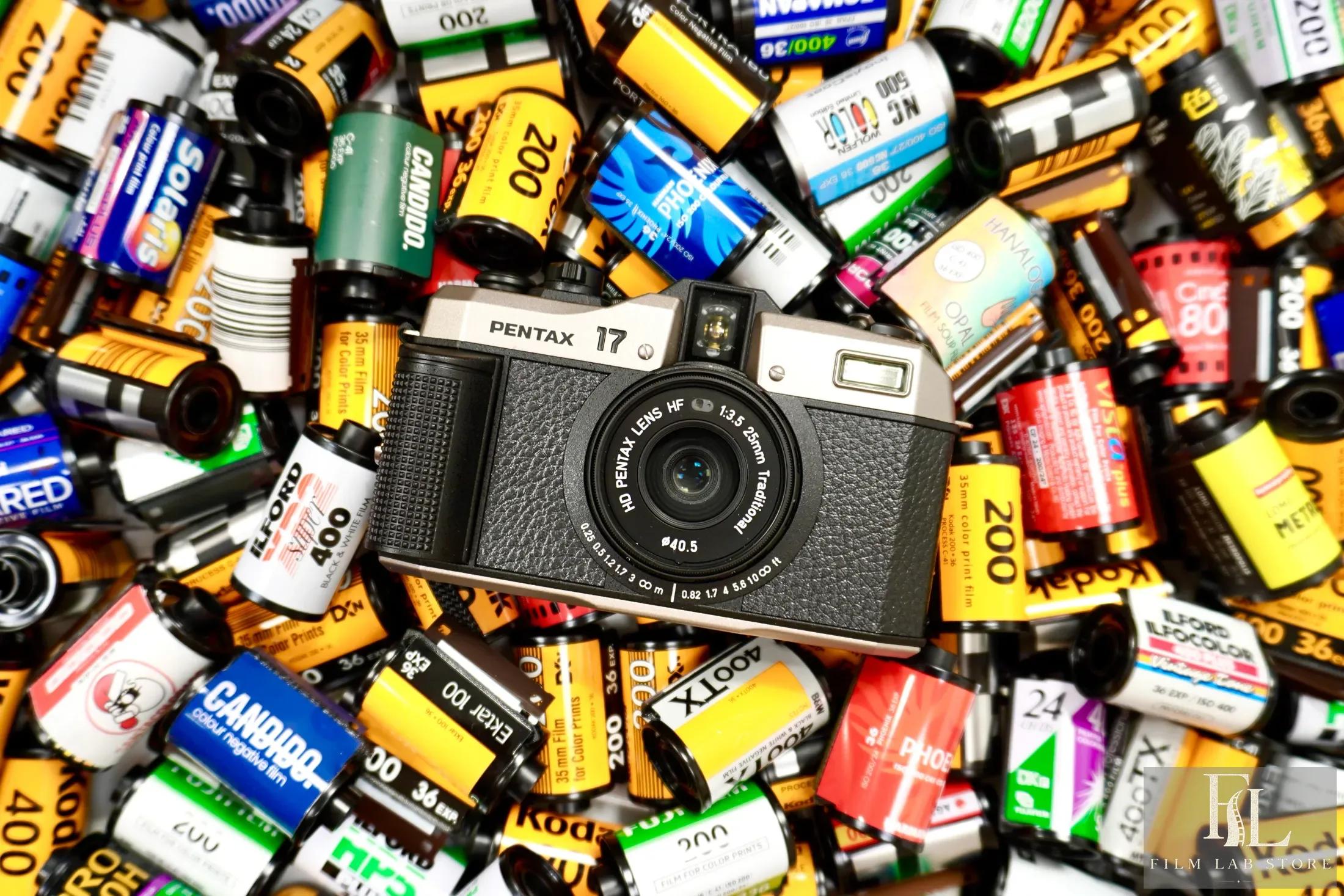
The Pentax 17, released in 2024, became one of the most noticeable new film releases of recent years: the half-frame format gives up to 72 frames on a standard 36-exposure cassette, which lowers the cost per frame and makes film more accessible for beginners.
The Kodak Snapic A1 is another example of a new simple 35 mm camera: an inexpensive model with a 25 mm glass lens, automatic winding, flash, OLED counter, and double exposure mode. Kodak describes it as a simple full-frame 35 mm film camera with automatic functions, while The Verge noted a price of around $99 and a focus on beginners and fans of creative effects.
These are not cameras for every task. They will not replace professional mechanical cameras or medium format. But they show that the analog market is again creating new entry points.
Film is ceasing to be only a vintage hunt. It is becoming a living ecosystem again.
Film will not defeat AI. And it should not
It would be foolish to oppose film and AI as two armies. AI will remain. Digital photography will remain. Most film shots will still be scanned and published online. Modern analog photography is almost always hybrid: a physical negative plus a digital file.
But that is exactly why film matters.
It reminds us that photography is not only a result, but also an origin. Not only an image, but also a path. Not only a file, but also material. Not only “how it looks”, but also “how it was made”.
- AI can create an image without an event.
- Film requires an event.
- Someone was in front of the camera.
- The light was exactly like that.
- The frame was chosen.
- The film was developed.
- The scan was made.
- The result appeared not instantly, but through work.
In 2026, that sounds almost radical.
Conclusion: the real value of film lies in inconvenience
Film is alive not because it is convenient. It is inconvenient.
- You have to buy it.
- Load it.
- Shoot it.
- Not ruin it.
- Develop it.
- Dry it.
- Scan it.
- Wait.
- Sometimes be disappointed.
- Sometimes be surprised.
But it is exactly this inconvenience that gives photography weight again.
In a world where an image can be created in seconds, speed is no longer the valuable thing — process is. In a world where a picture can be perfect without a camera, a frame that truly passed through light, material, chemistry, and time becomes valuable.
- Film is not an escape into the past.
- It is a way to return physical presence to photography.
- It does not cancel AI.
- It does not cancel digital.
- It simply leaves room for another type of image — slow, imperfect, material, and human.
And it seems that this is exactly the kind of image many people are missing now.
If you want to try film not as a filter, but as a real process, start simple: choose a roll, shoot it without rushing, and then send it for development and scanning.
At FilmLabStore, you can choose photographic film, find a film camera, or discuss shooting on film — from the idea to the developed and scanned result.