One roll of Harman Griffin 200 in 35 mm, three meter settings: ISO 200, 160 and 125. Autumn in Kyiv, a portrait against a brick wall and a few night shots with flash. The second roll, in 120, I shot entirely at ISO 200.
This roll came with a backstory, and its name was Phoenix. Whenever someone asked me how to shoot that Harman film, I answered without thinking: “Give it an extra stop.” At box speed Phoenix never looked quite right to me, so I always added light and told everyone else to do the same. I got so used to it that I stopped thinking about it. So there I was, loading a 35 mm roll of Griffin 200, still carrying the Phoenix correction in my head.
But I didn't hand the whole roll over to an old habit. I made a deal with myself: the first fourteen frames at ISO 200, and then we'd see.
Griffin 200 is Harman's new colour negative film. So far it has come out as a limited experimental batch, and the official launch is running late. I wrote more about that in “HARMAN Griffin 200: where is it, and when is the announcement?”.
Griffin 200 at a glance
Spec | Harman Griffin 200 |
|---|---|
Type | Colour negative film |
Formats | 35mm (36 exp) and 120 (12 exp) |
Speed | ISO 200, can be shot at ISO 200–400 |
DX code | ISO 200 (35mm cassette) |
Processing | Standard C-41 |
What's new | Better colour and contrast, wider latitude, stronger UV protection, less halation |
Where Griffin comes from: three years of Harman colour experiments
Harman Photo is the British factory behind ILFORD and Kentmere films.
Harman cannot put the ILFORD name on colour film, a restriction left over from the break-up of the old company in the mid-2000s. So its colour films carry the Harman Photo brand.
Phoenix 200 (December 2023). The first colour film Harman designed and made entirely at its Mobberley factory, from emulsion to cassette. Harman itself called it quirky and experimental: high contrast, visible grain, punchy colour and strong halation around light sources.
Red 125 (2025). A redscale film based on Phoenix that deliberately shifts the frame towards red and orange.
Phoenix II (July 2025). Redesigned layers and new dyes: more neutral contrast and colour, finer grain, easier scanning. It was still a limited edition, though, and halation still showed up in contrasty light.
Switch Azure 125 (March 2026). An experiment with swapped colour layers: blues turn orange and yellows turn azure. I wrote about it separately: “One negative, different colours”.
Phoenix 125 (August 2026). The original Phoenix brought back and re-rated to ISO 125 after photographers' feedback. Now the ISO on the box is real and honest.
Each time, Harman said the sales would fund research into the next colour films. Going by the same description, Griffin is the first of them meant as a versatile everyday film.
What changed compared with Phoenix
According to a preliminary description that circulated before the launch, Griffin was designed from the ground up. HARMAN hasn't officially confirmed these specs yet, so treat them as promises, not a datasheet:
Less halation. Halation was the thing Phoenix reviews mentioned most: Hamish Gill (35mmc) wrote about “fairly serious halos around points of light”, and James Tocchio (Casual Photophile) about red halos like CineStill's. Some people liked that, but in everyday shooting it got in the way.
Better colour and contrast. Phoenix was deliberately contrasty and punchy. Griffin is meant to give a more even image and still look like film.
Wider exposure latitude. Phoenix wanted plenty of light. Griffin is designed for light that changes through the day.
Stronger UV protection.
The 35 mm roll: starting at ISO 200
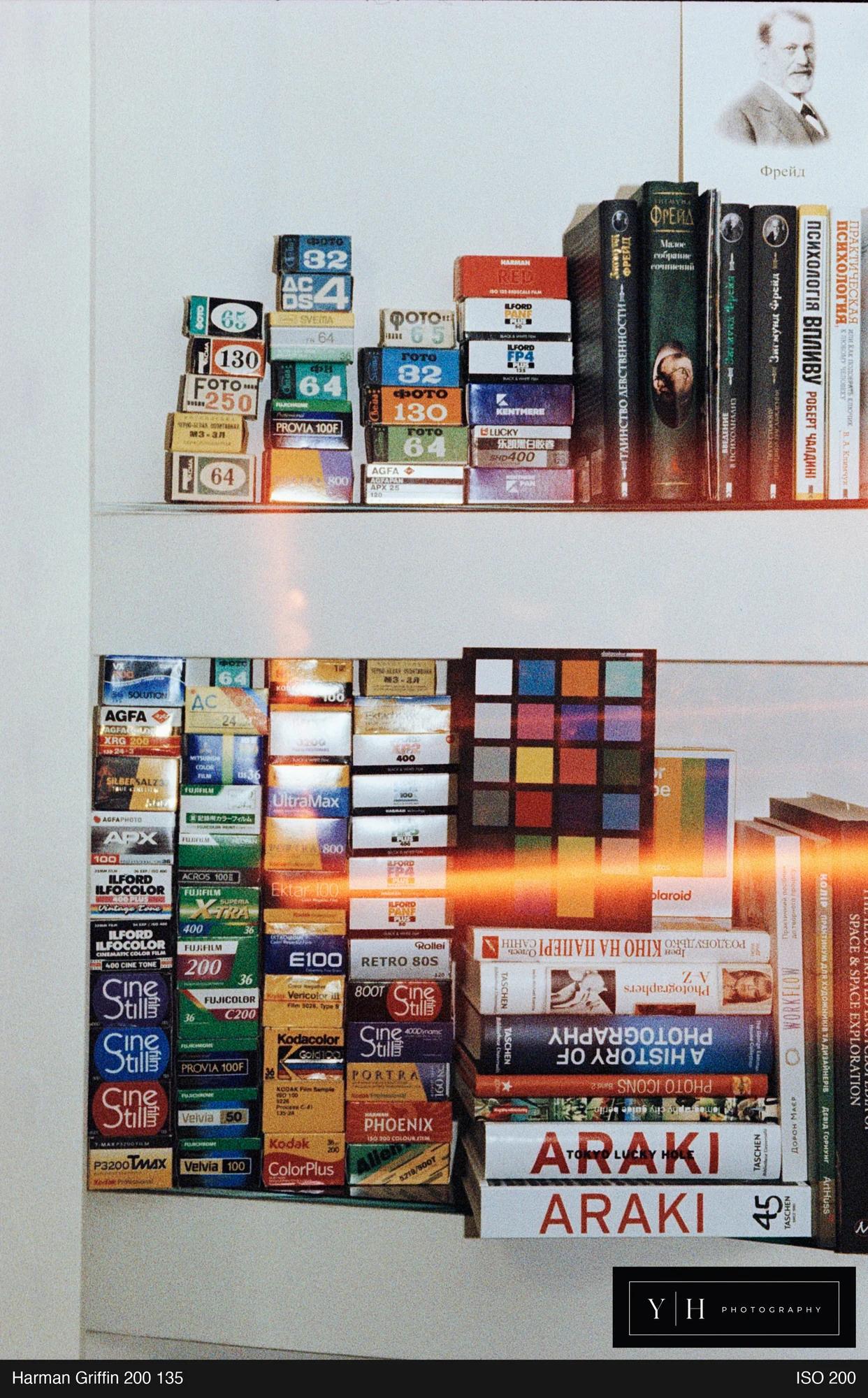
I started at home, with a shelf. The first frame went on a SpyderCheckr colour chart, and the whole shelf came along with it: film boxes mixed in with books. The chart makes it easy to check later whether the colour drifted in scanning. An orange streak of light leak runs across the frame. This is the very first, technical frame of the roll, the so-called frame zero, so a leak here is normal. And I like it: frames like this always have a special vibe.
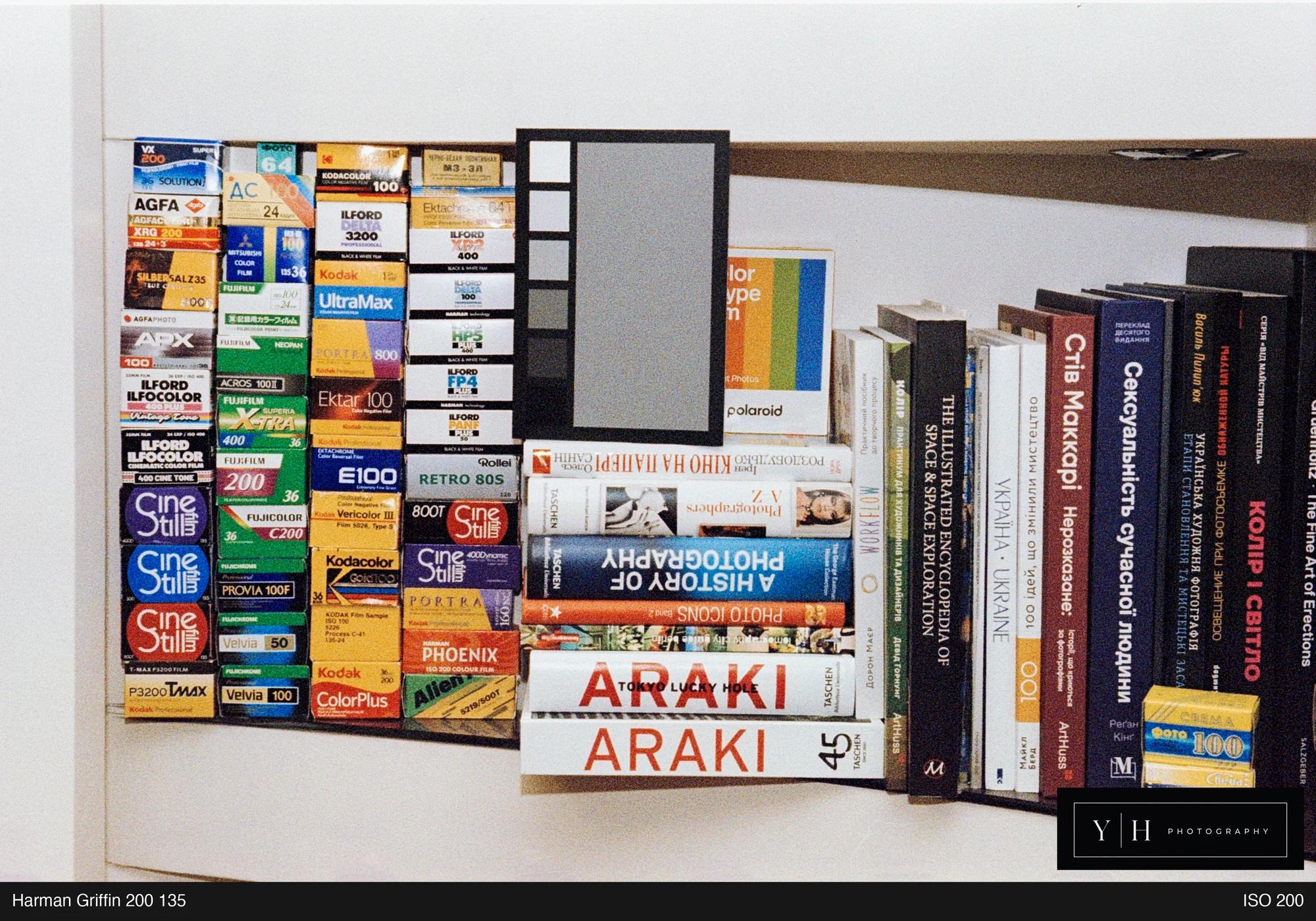
For frame two I moved closer, and the leak is gone. Small boxes stand packed side by side, like books that each got only a spine. Next to them are actual Araki books. Here you can check the colour without the chart: open the scan, look up, and see exactly which red the name on the spine is printed in.
Then I went down to the water.
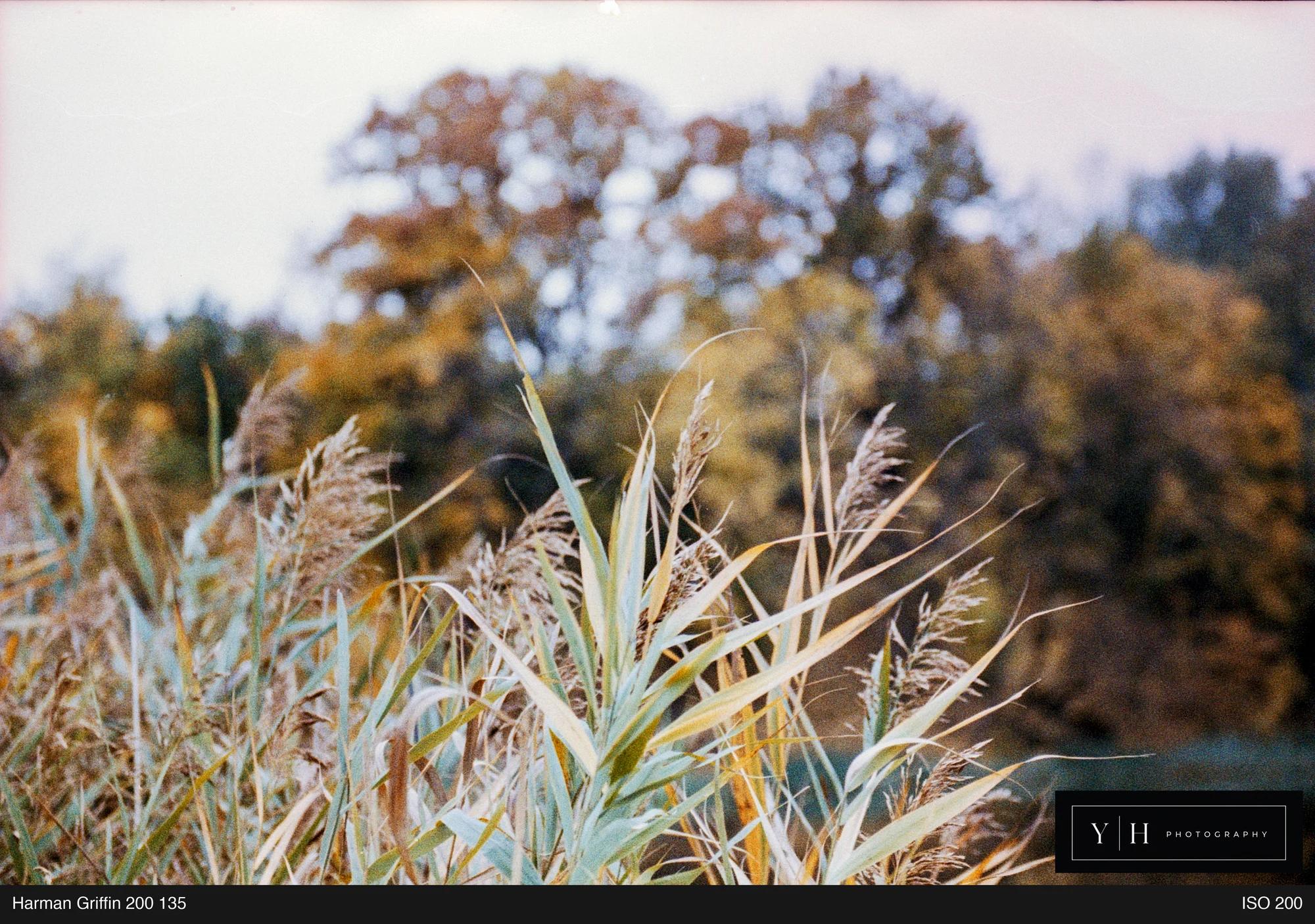
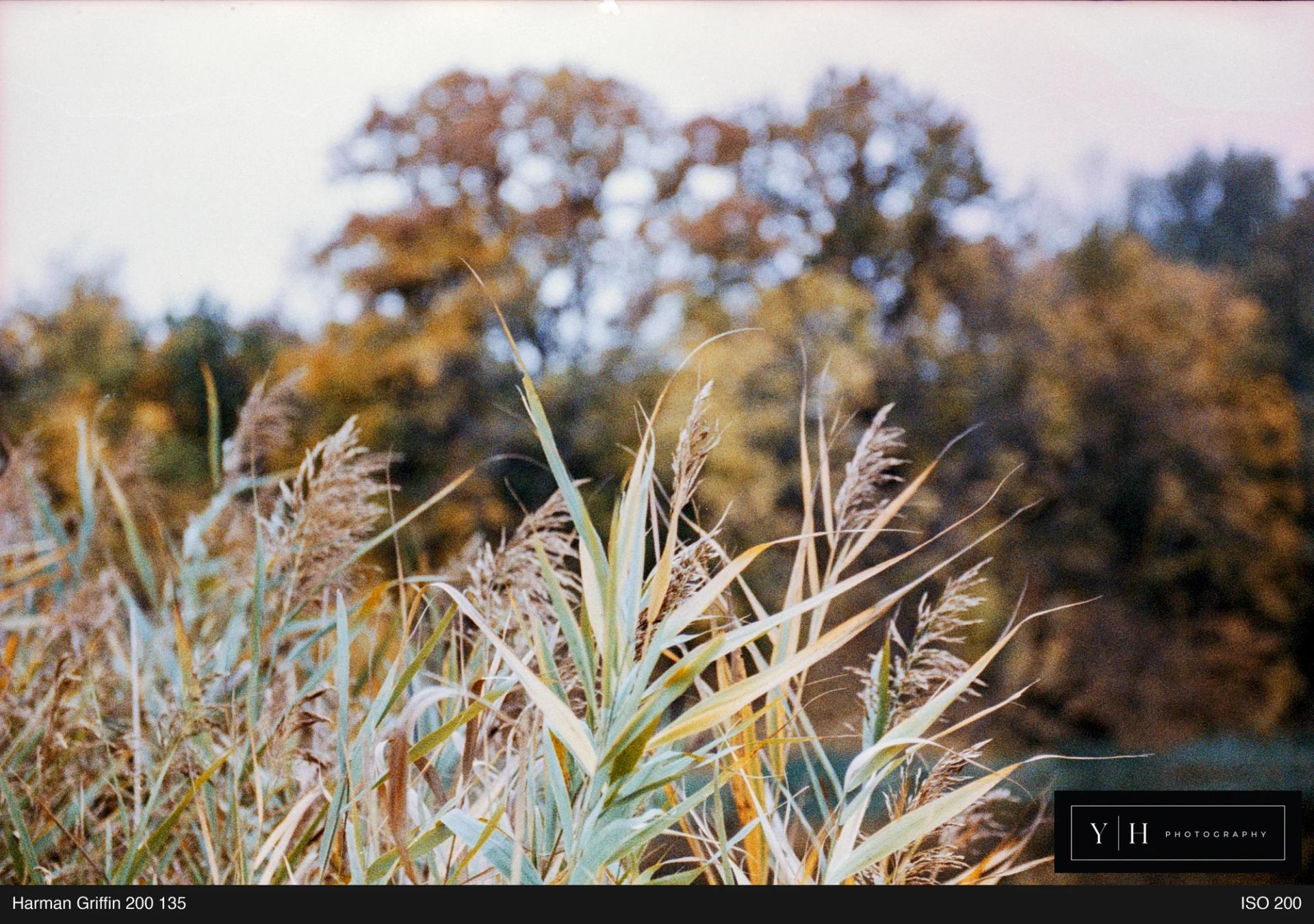
At a glance, frame five is just dry reeds. Look a little longer and you notice a green stripe along one leaf. The edge of another has already turned yellow, and a third catches so much light that all that's left of it is a thin white line. I think those half-dried leaves are what made me like Griffin's colour. On the far bank autumn has finished painting the trees; here it seems to have dropped the job halfway.
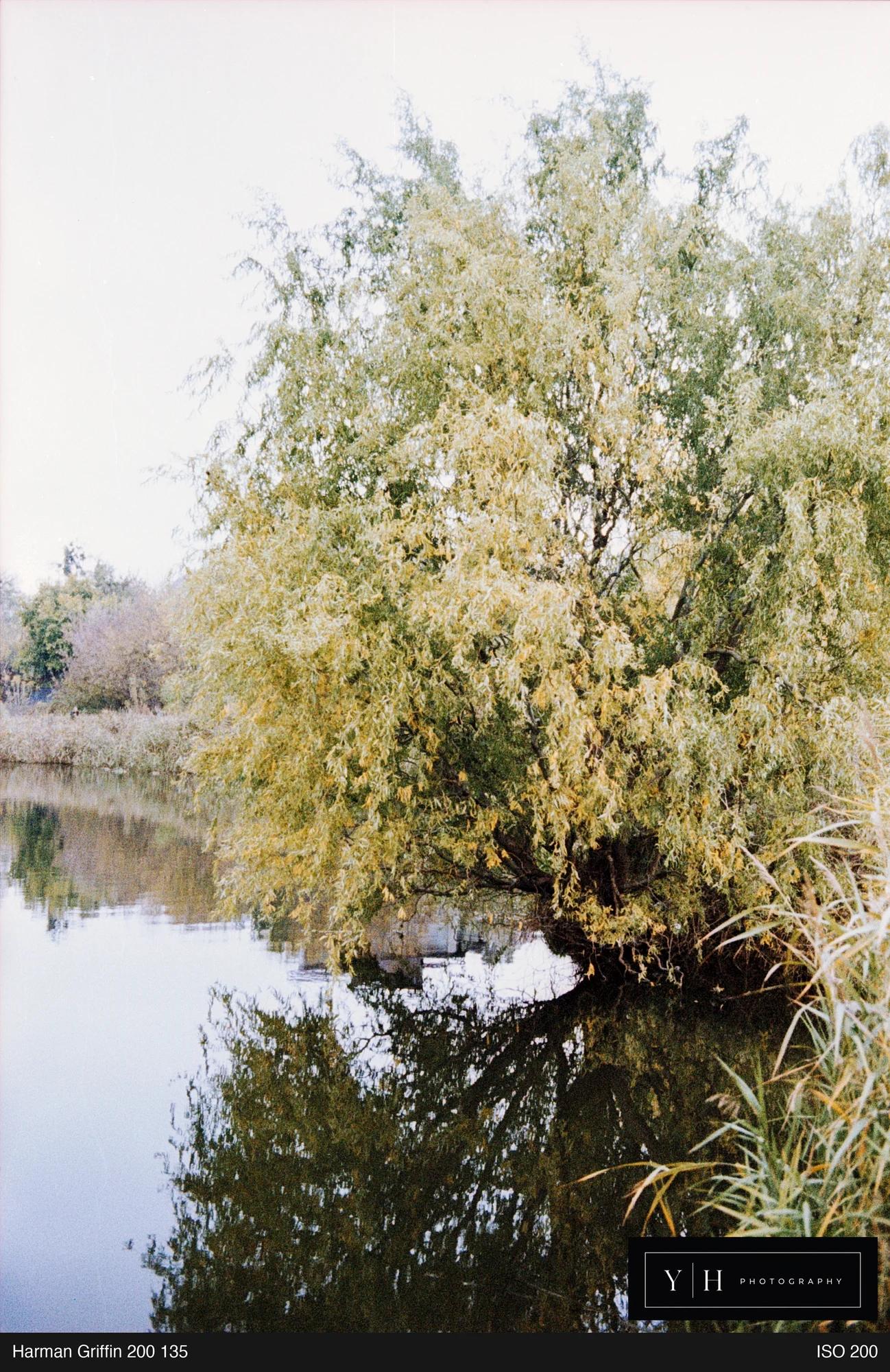
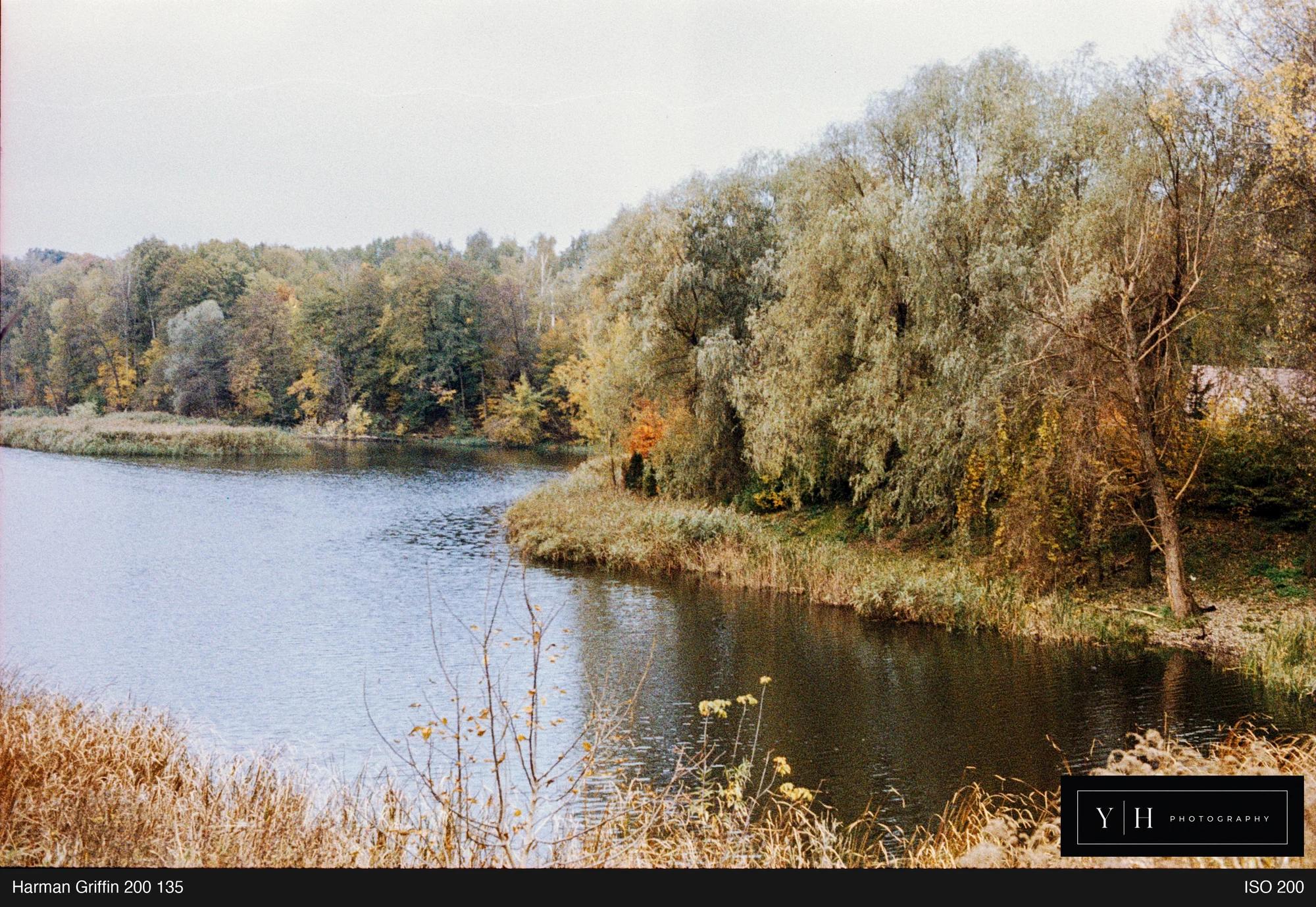
The willow in frame six hangs right down to the water. Its crown is light, yellow-green, while the reflection beneath it is dark and dense, yet you can still make out single branches in it.
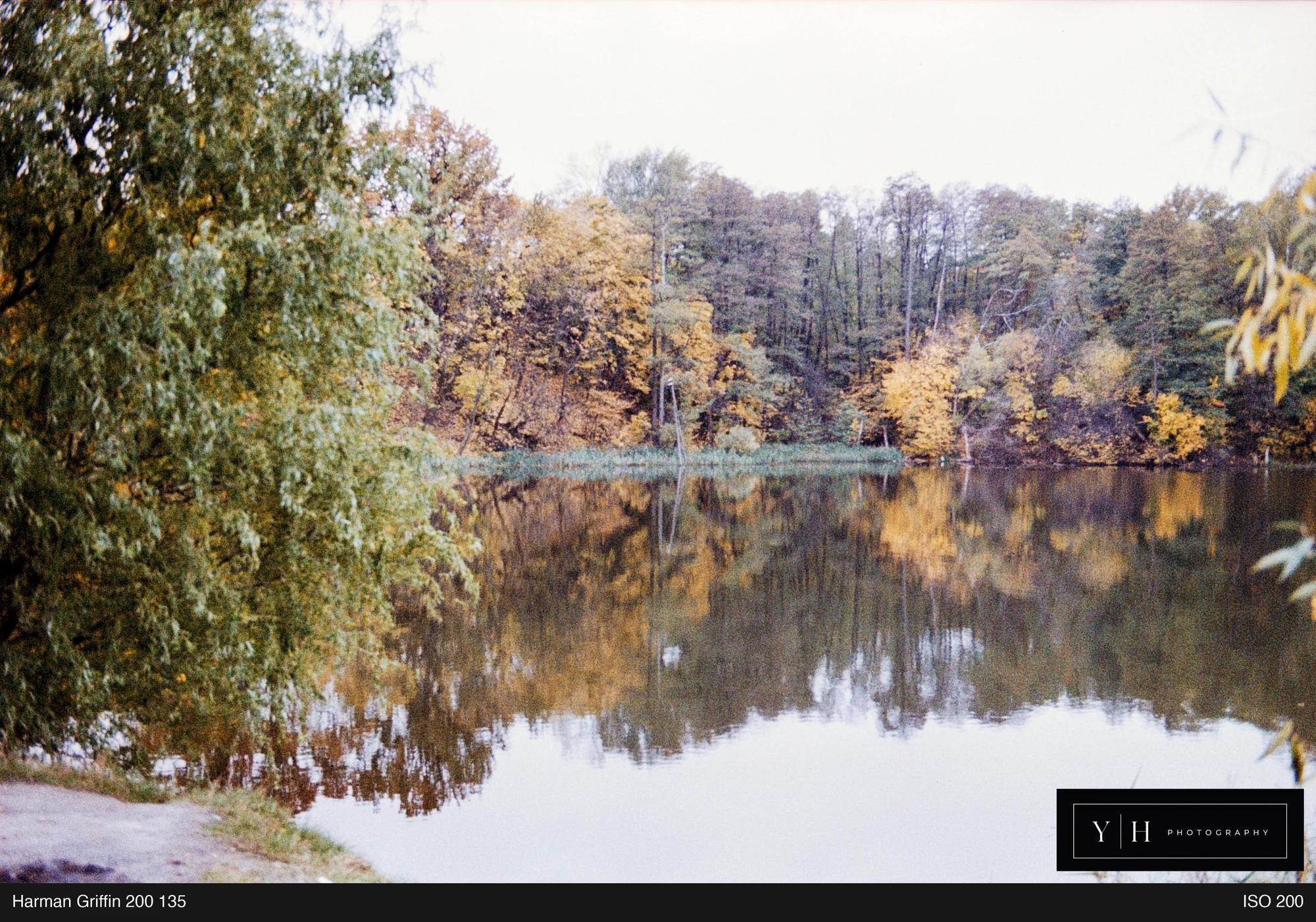
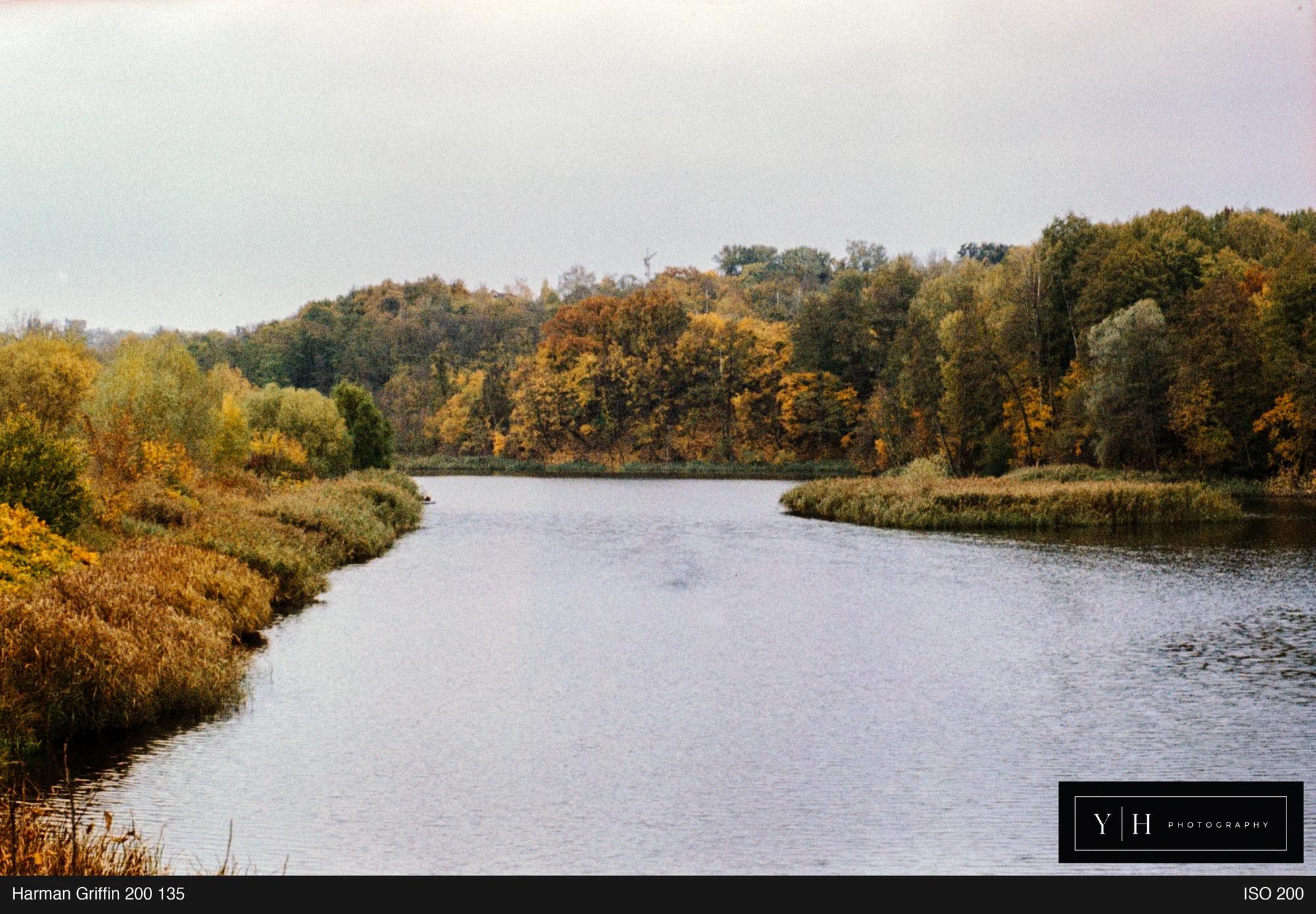
The shoreline frames are my favourites. Griffin kept the yellows and rusts calm, and the grey sky stayed grey.
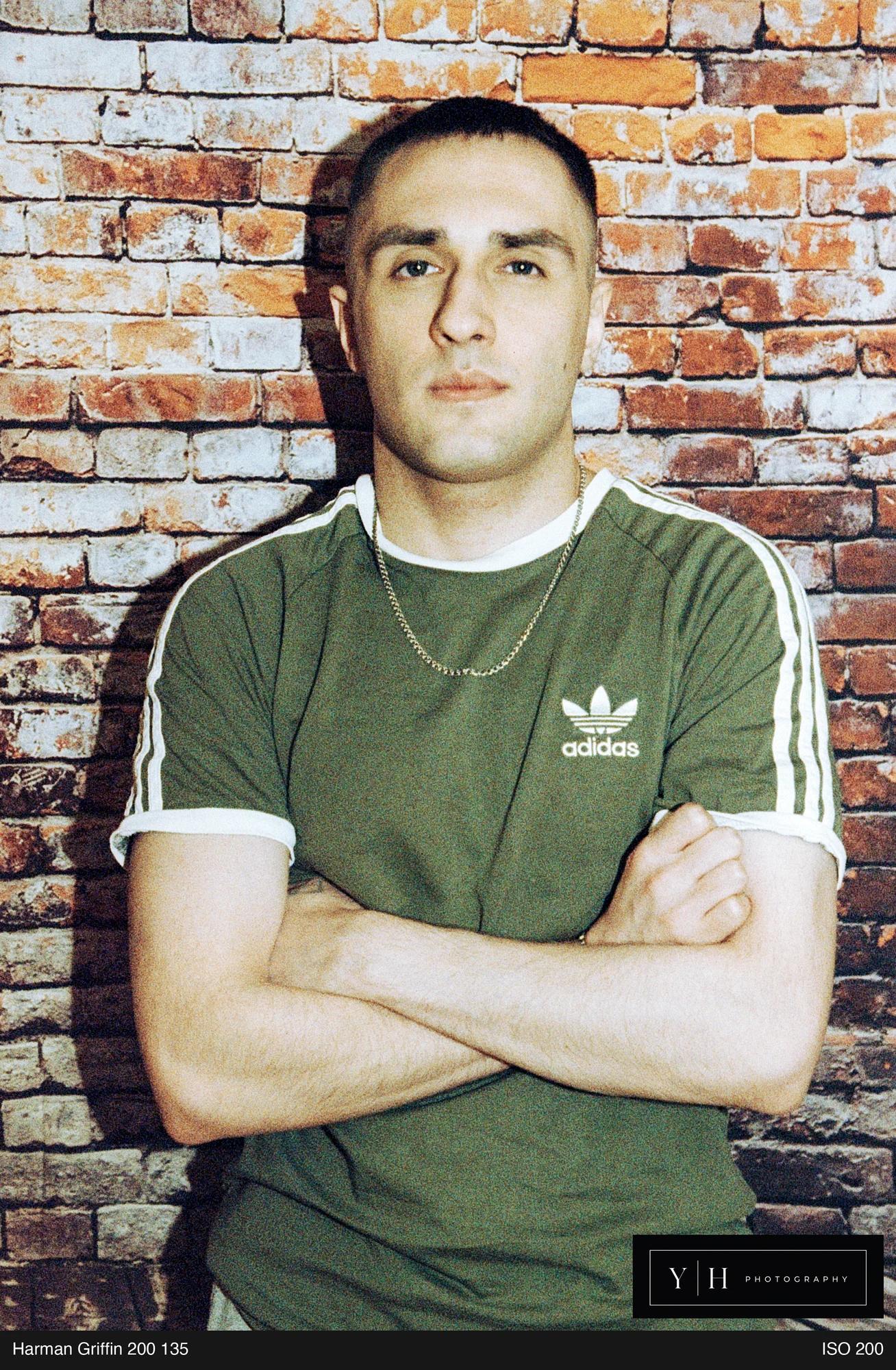
With people I'm less impressed. In the portrait against the brick wall I like how the green T-shirt came out, but I see yellow in the face. Of the first fourteen frames, the one I'd actually print is the reeds.
Another third of a stop: ISO 160
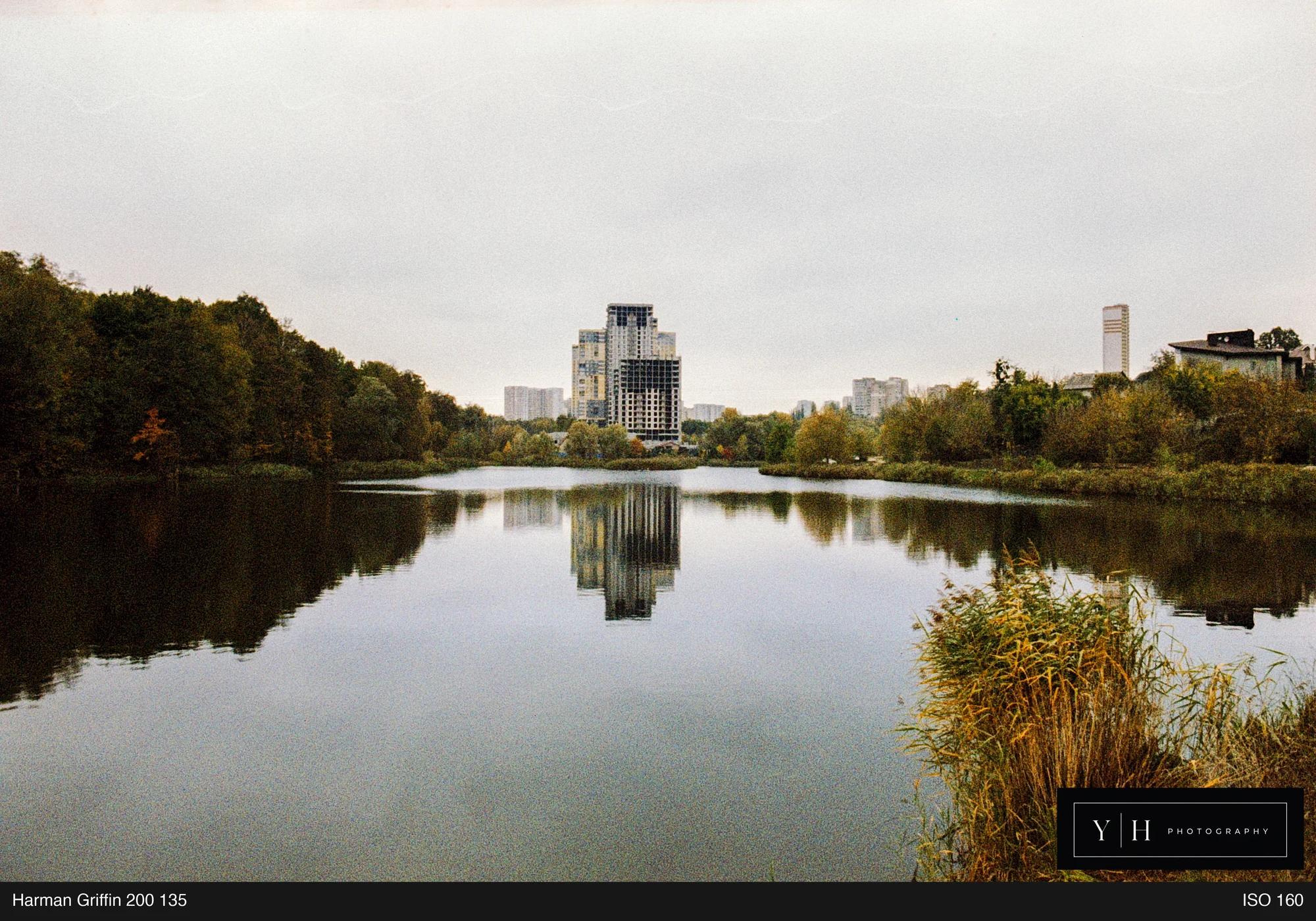
At frame fifteen I set the meter to ISO 160. That's only a third of a stop more, and I kept it there up to and including frame twenty-six. This part of the roll has a building on the far bank that I like to look at from the bottom edge of the picture. Down there, in the reflection, it wavers a little. Raise your eyes, find the same building on the shore, and now it stands perfectly still.
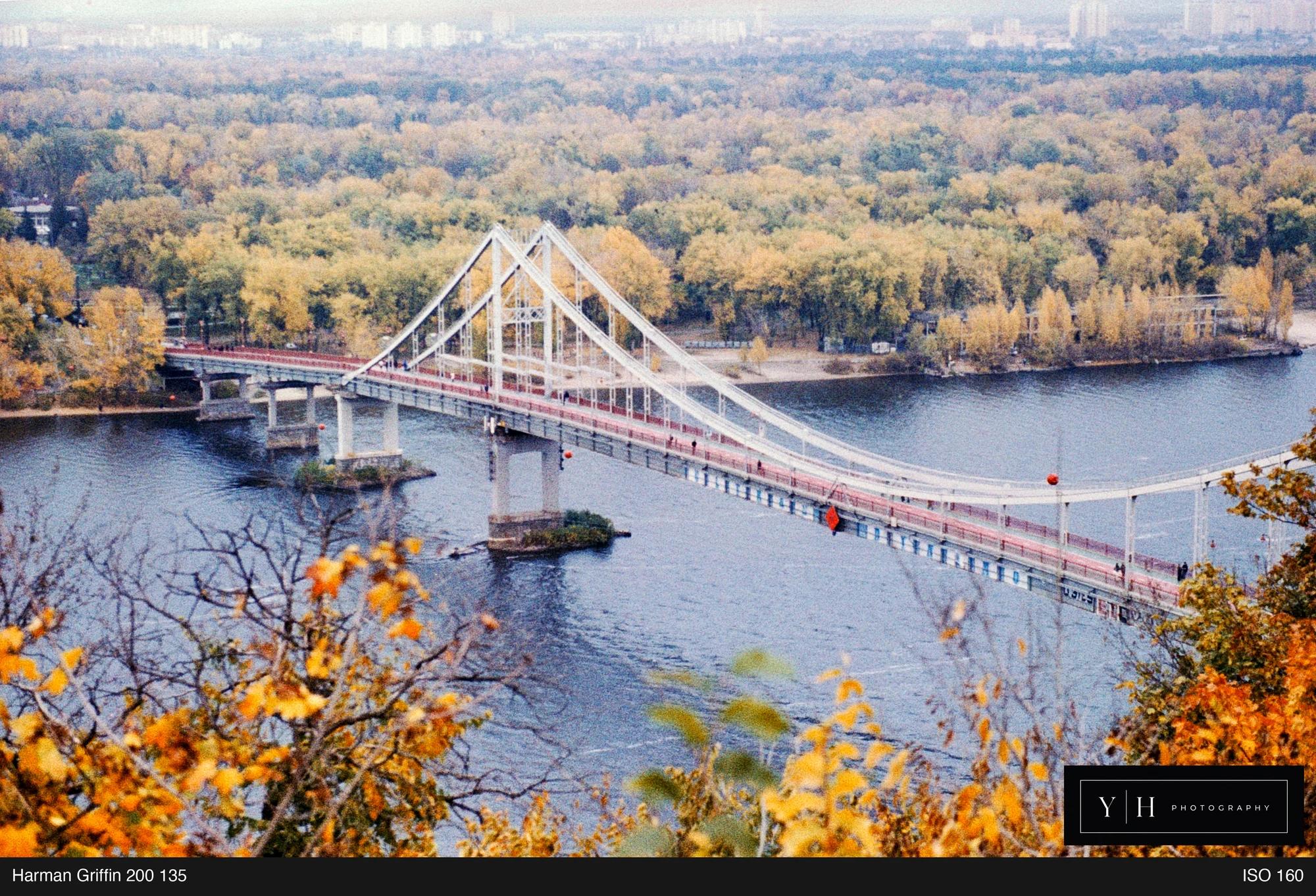
On the bridge, your eye catches on people. From a distance the whole picture seems to hang on the white pylons and cables. Then you notice tiny pedestrians along the railing, each small enough to cover with a fingertip. And suddenly you understand how long that span is.
The last frames, with flash: ISO 125
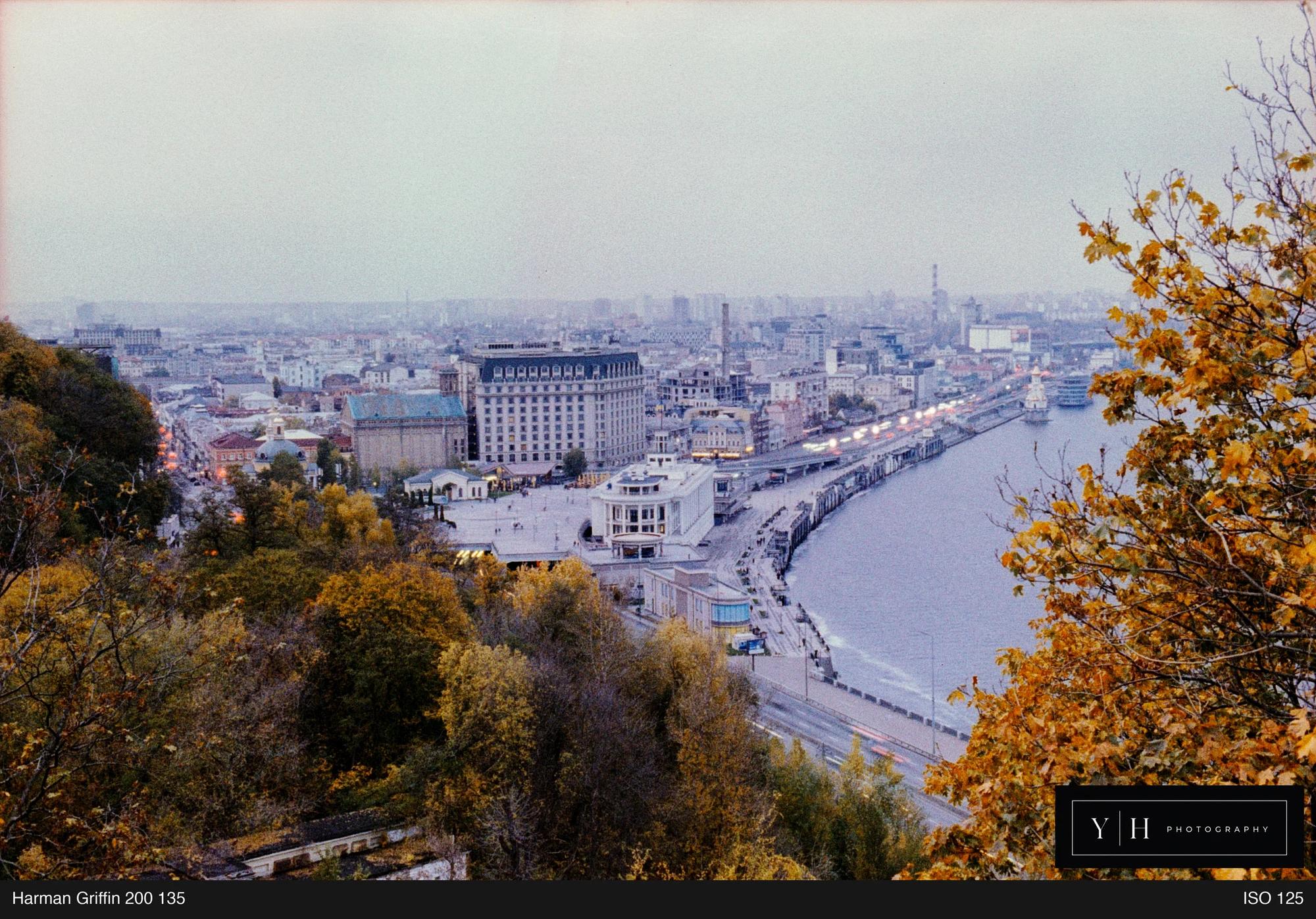
From frame twenty-seven I set ISO 125. Now Griffin was getting two thirds of a stop more light than at box speed. The view of the embankment at dusk doesn't say much about it. The distant buildings are pale, but the haze itself ate a fair amount of colour there, while the leaves at the right edge are still rusty orange.
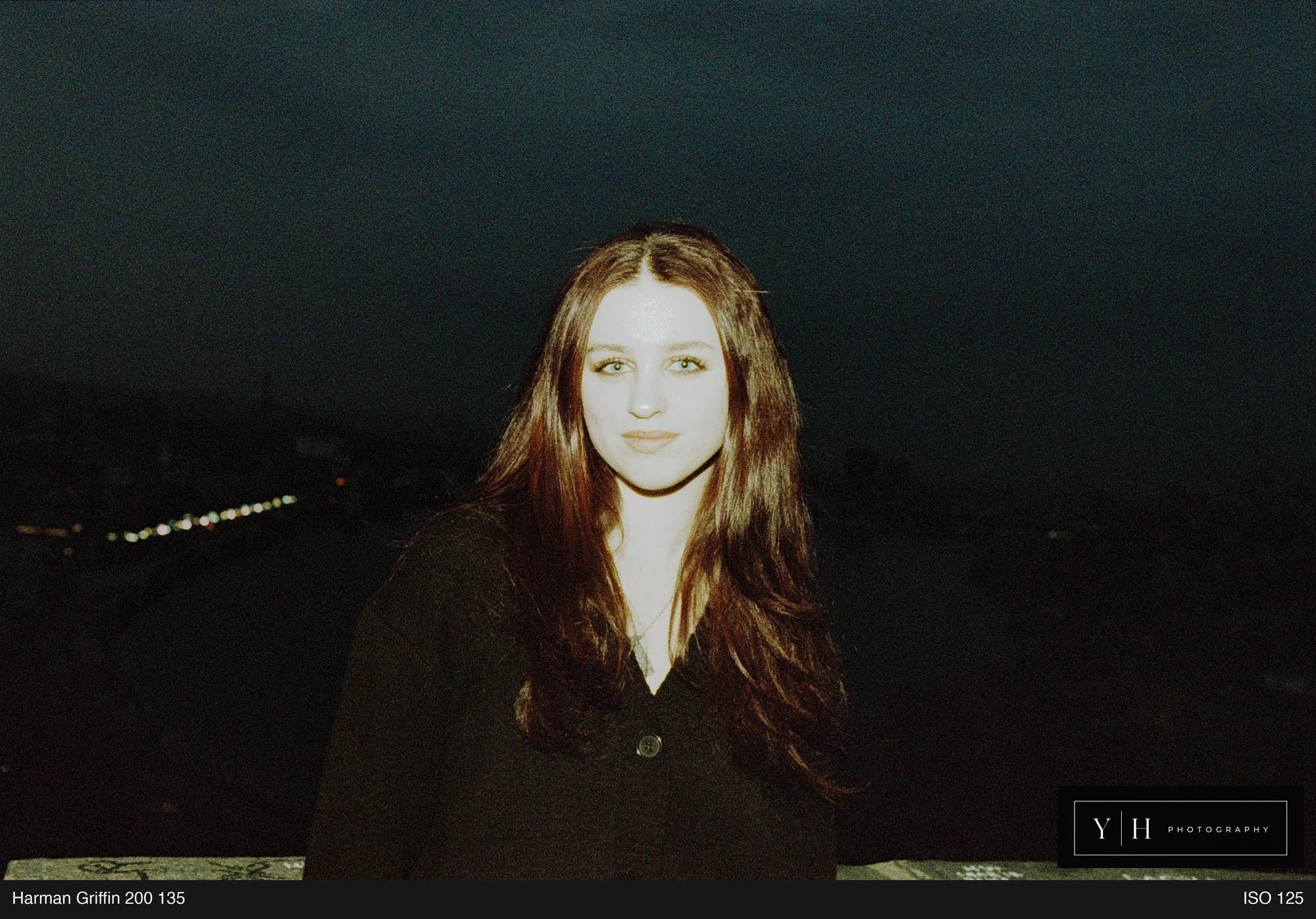
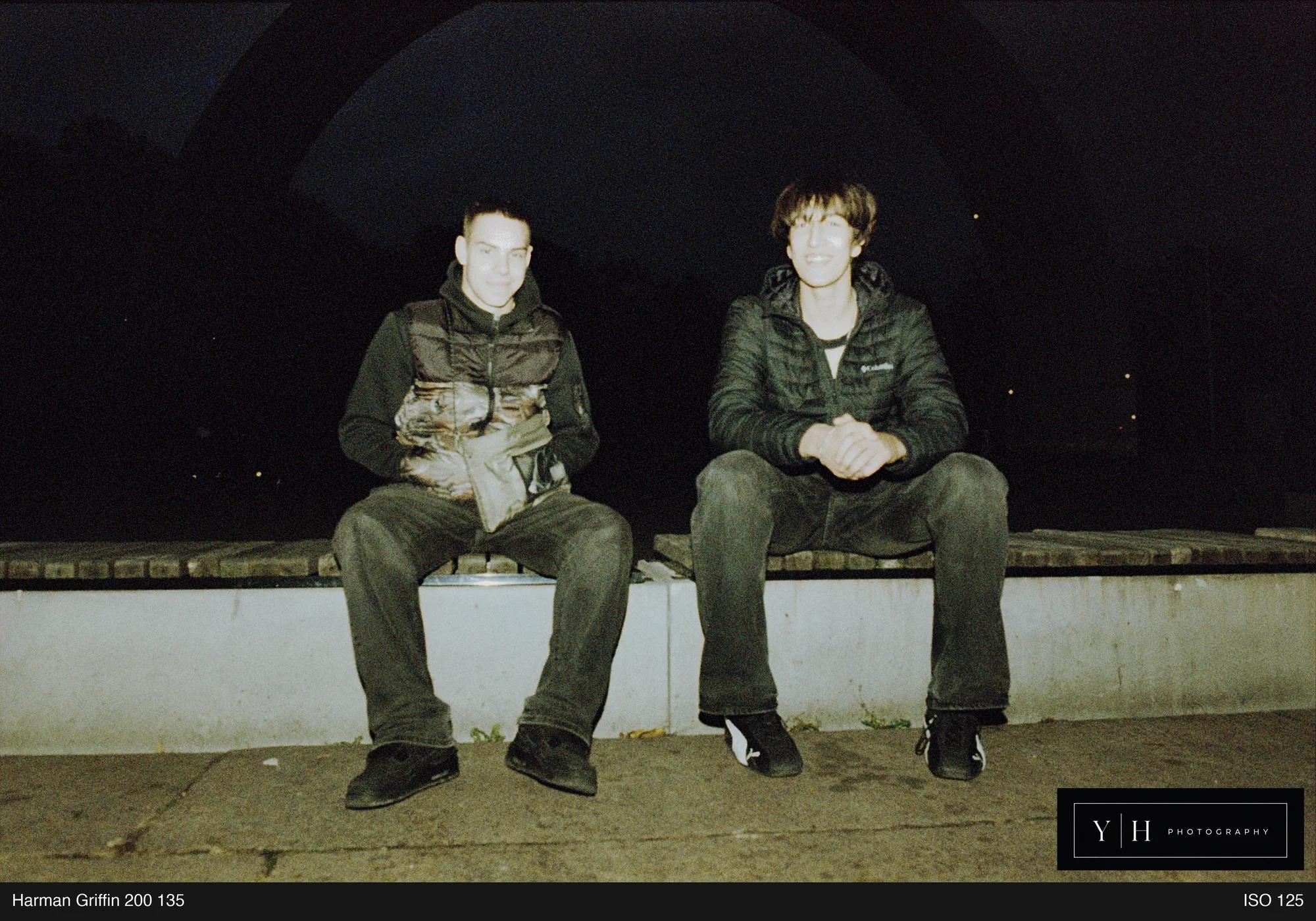
Then it got dark. In the night portrait a thread of lights runs far behind her shoulder. A few red strands still show along the edge of her hair, while the flash landed on her cheek so heavily that it nearly erased its roundness. Next come two guys on a bench: you can count the folds on their dark jackets, but their faces came out almost white. That is where I regretted dropping the ISO to 125. So please don't judge the film by these frames: they are overexposed.
The 120 roll: portraits at ISO 200
With the 120 roll I decided to stop arguing with the meter. I set ISO 200 on the first frame, clicked the dial into place and promised myself I wouldn't touch it until the roll was finished. A square 6×6 frame, a grey October day, one person in front of the camera. There are eleven frames here, and each opens at full size when you click it, so check for yourself.
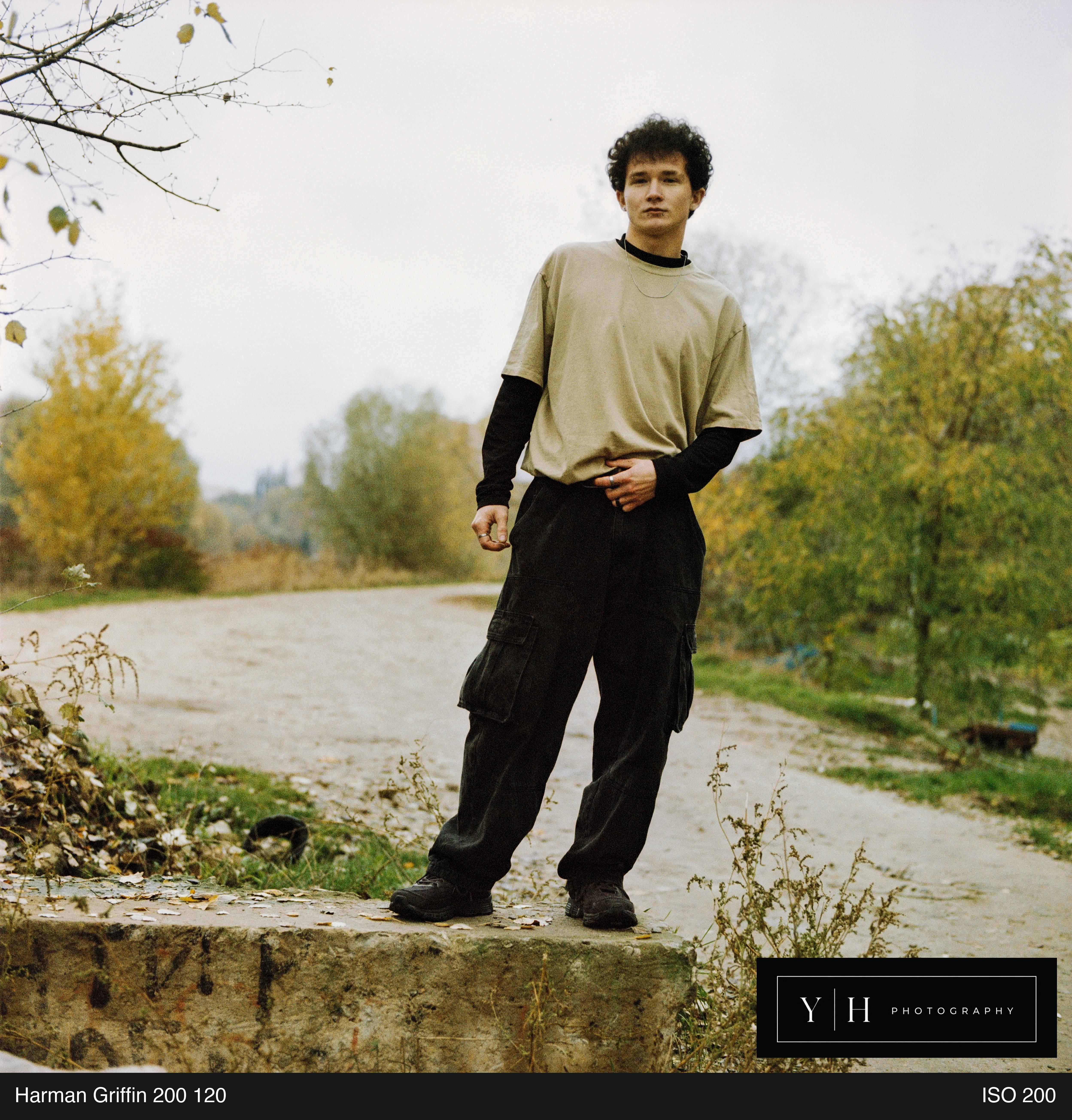
We started by a concrete block at the edge of a path. It was about eight degrees, and he stood there in a T-shirt over a long-sleeve top, pretending he was warm. I told him film can't show who's cold. He didn't believe me.
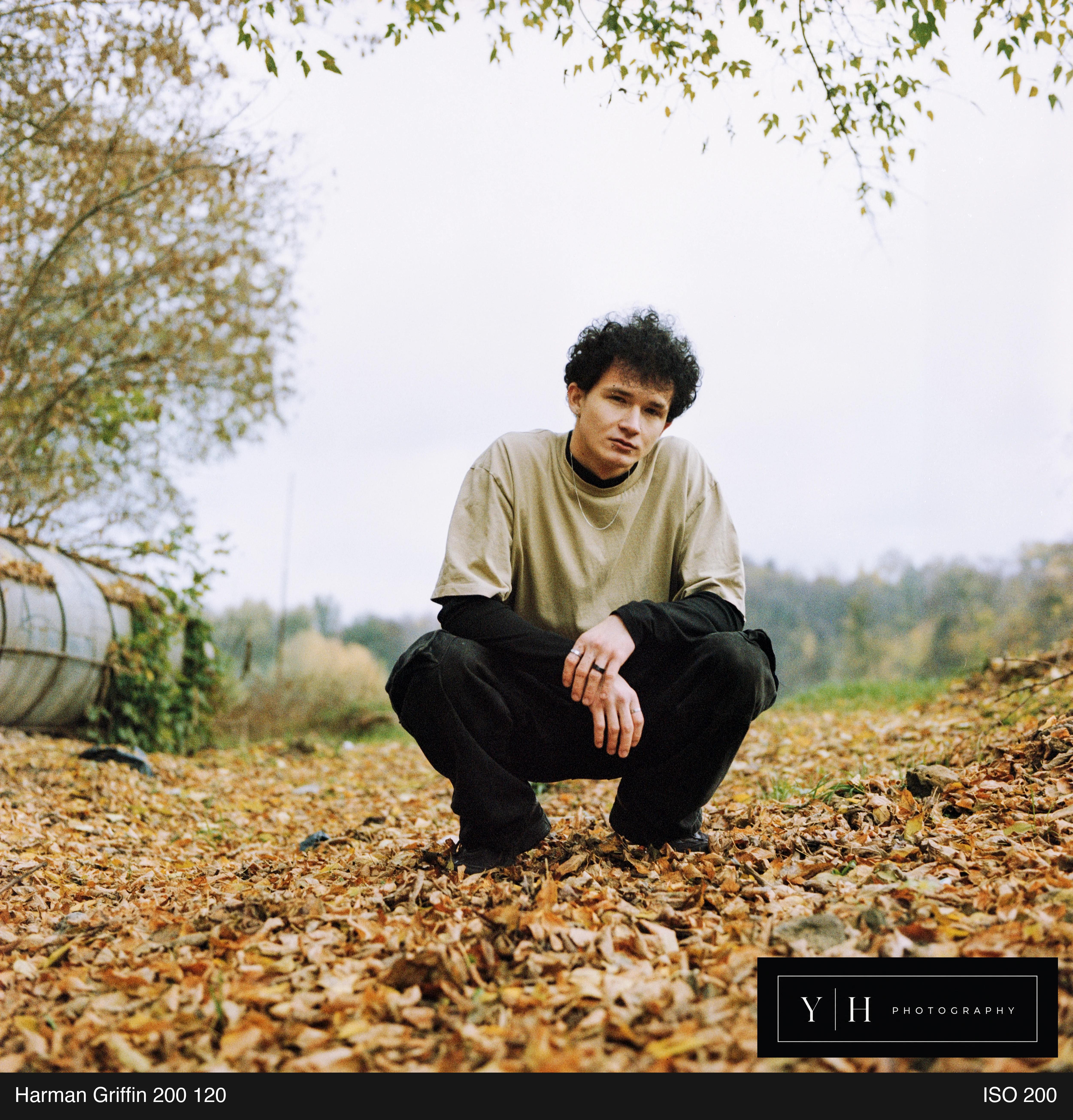
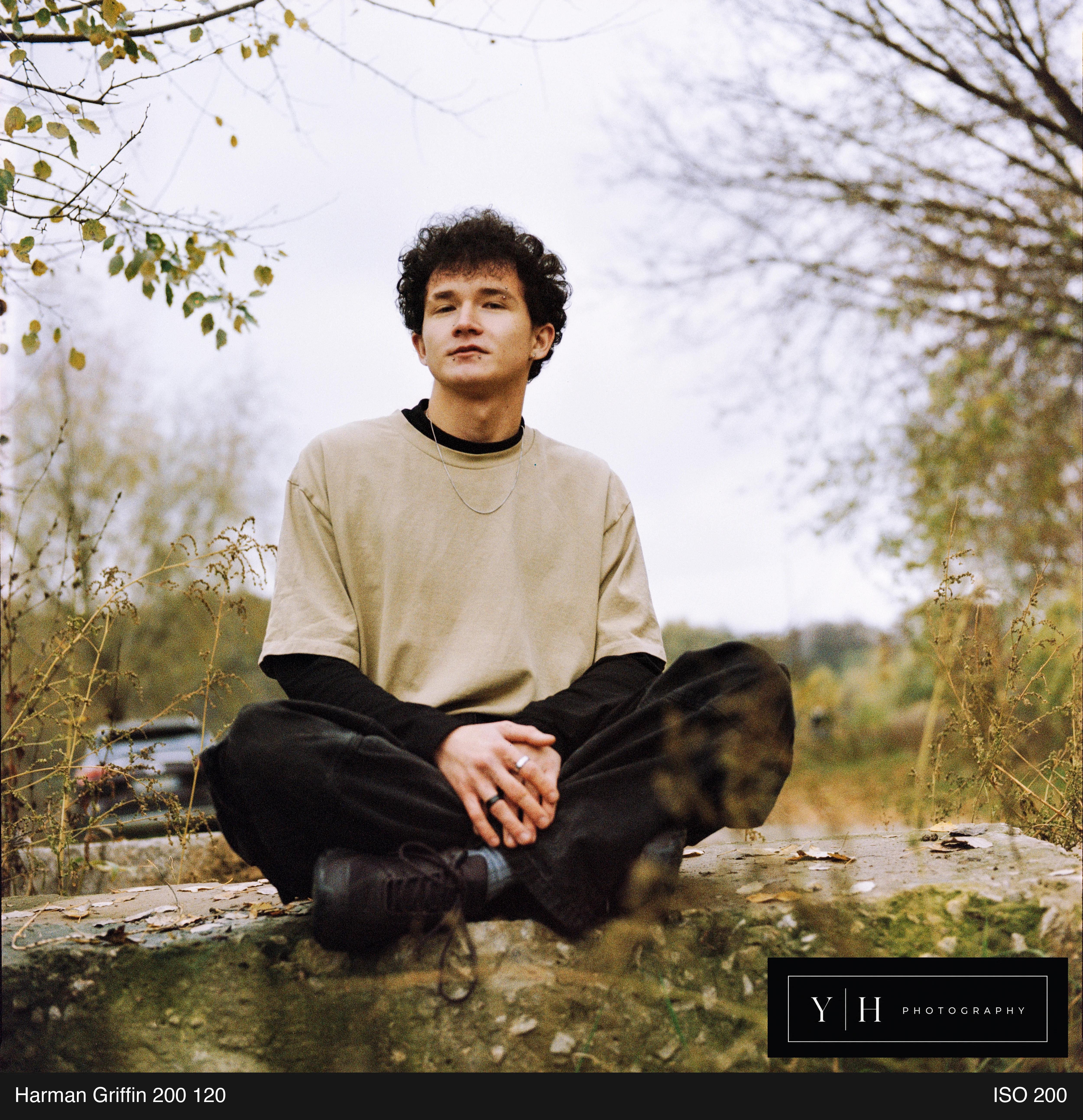
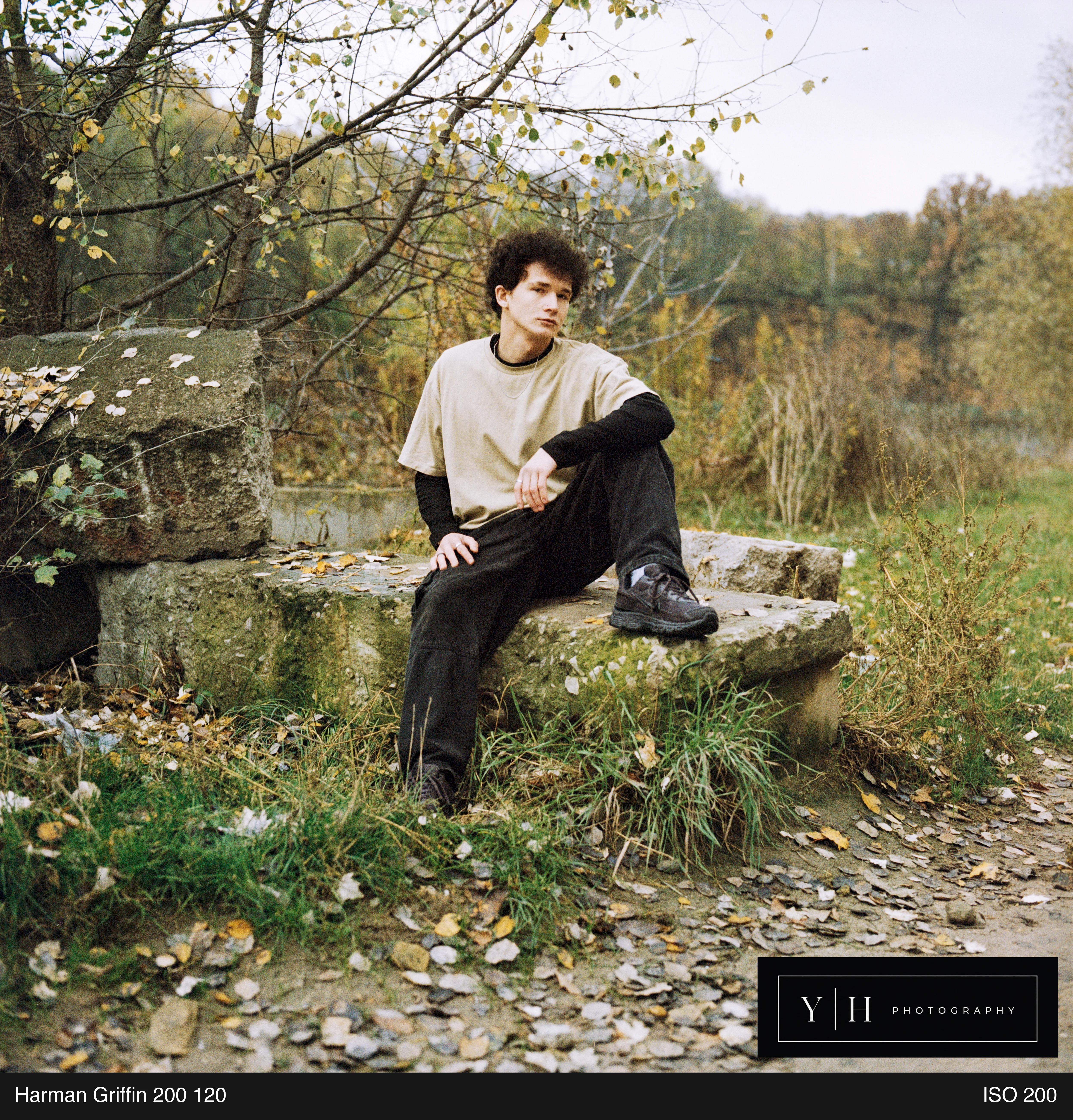
Then came the sitting frames. First crouching, right in the wet leaves, then cross-legged on a concrete slab, then on the stones by a path. The leaves on 120 came out as calm as they did on 135: yellow stayed yellow, with no lemon tint.
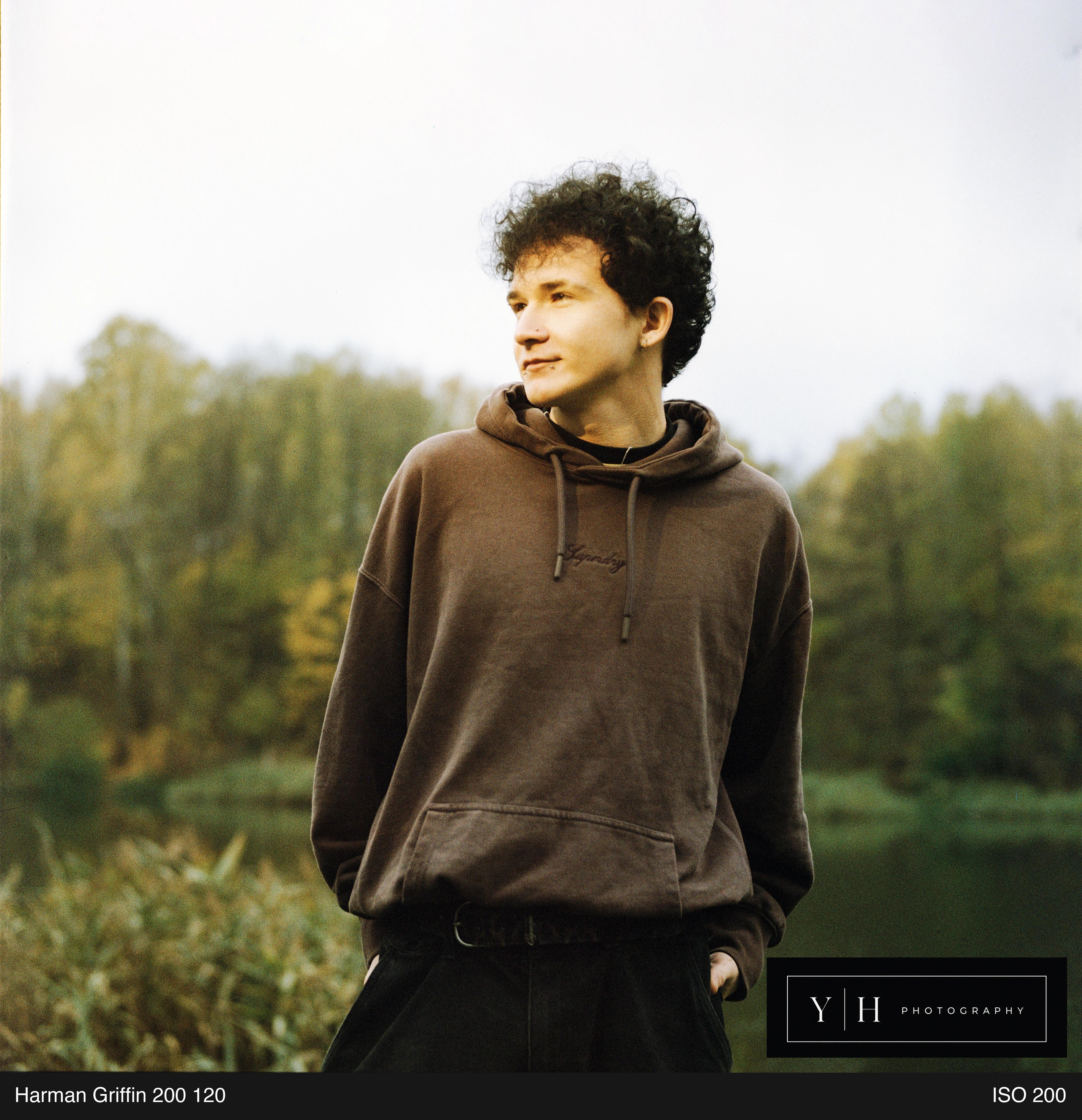
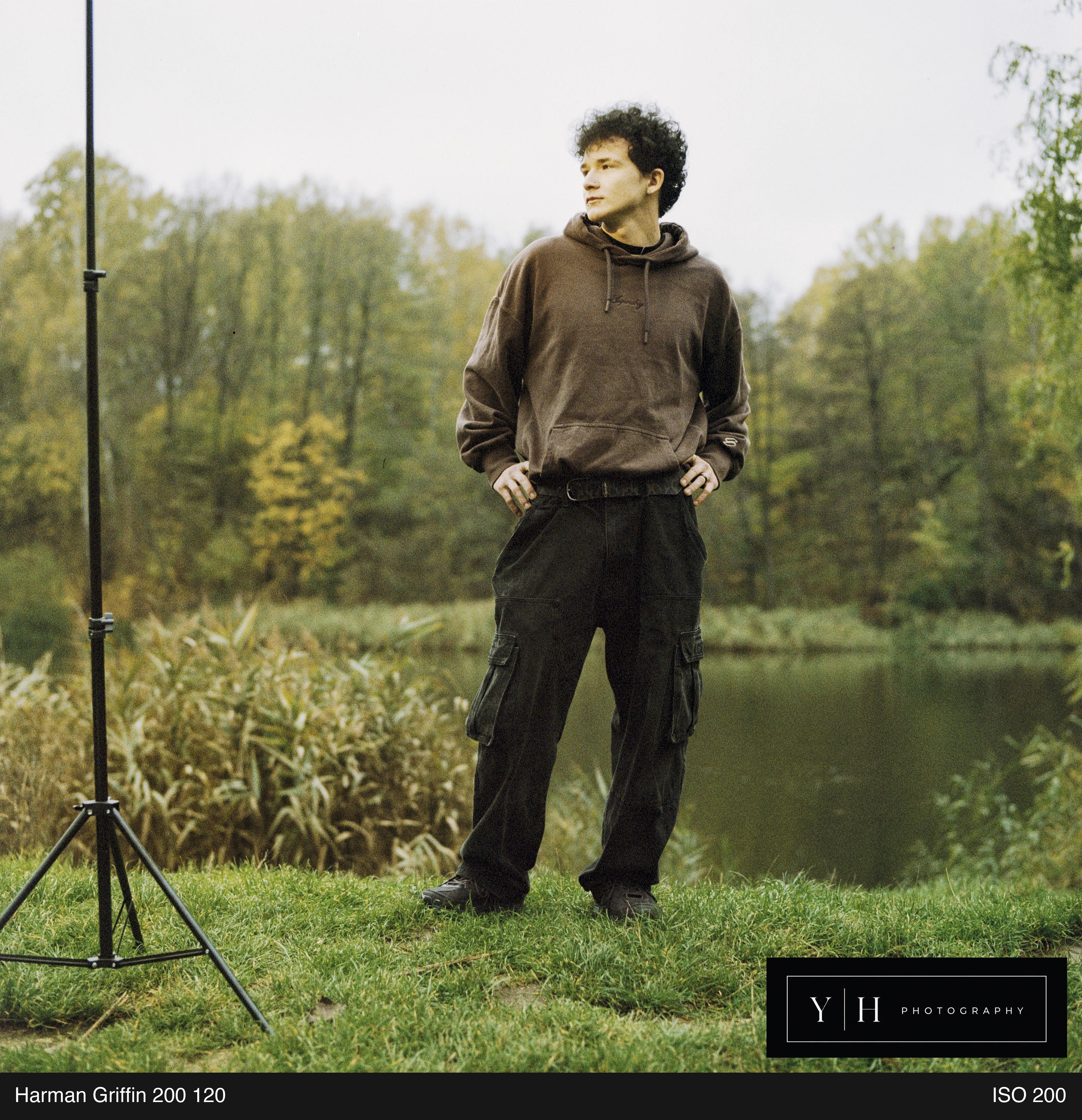
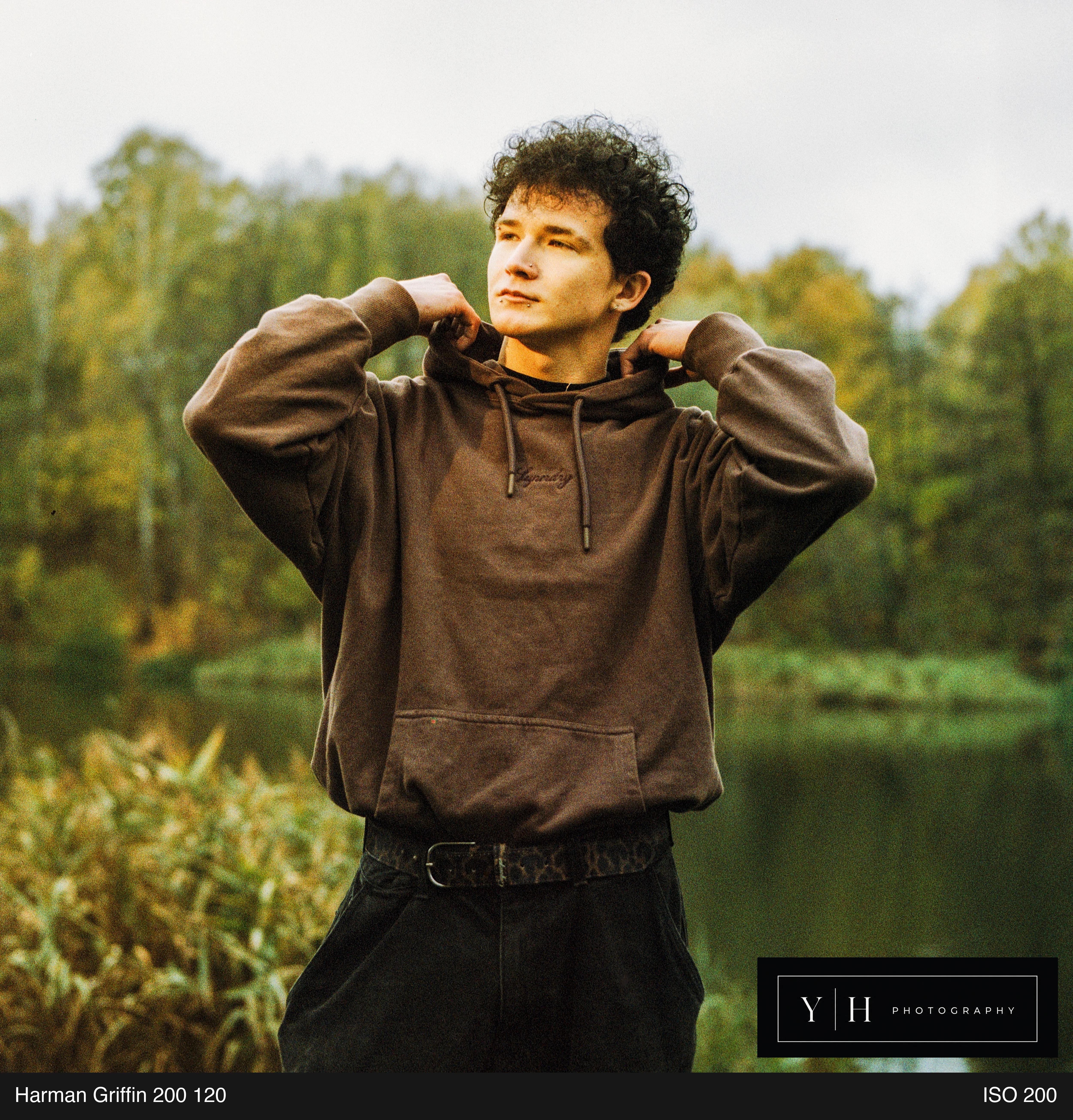
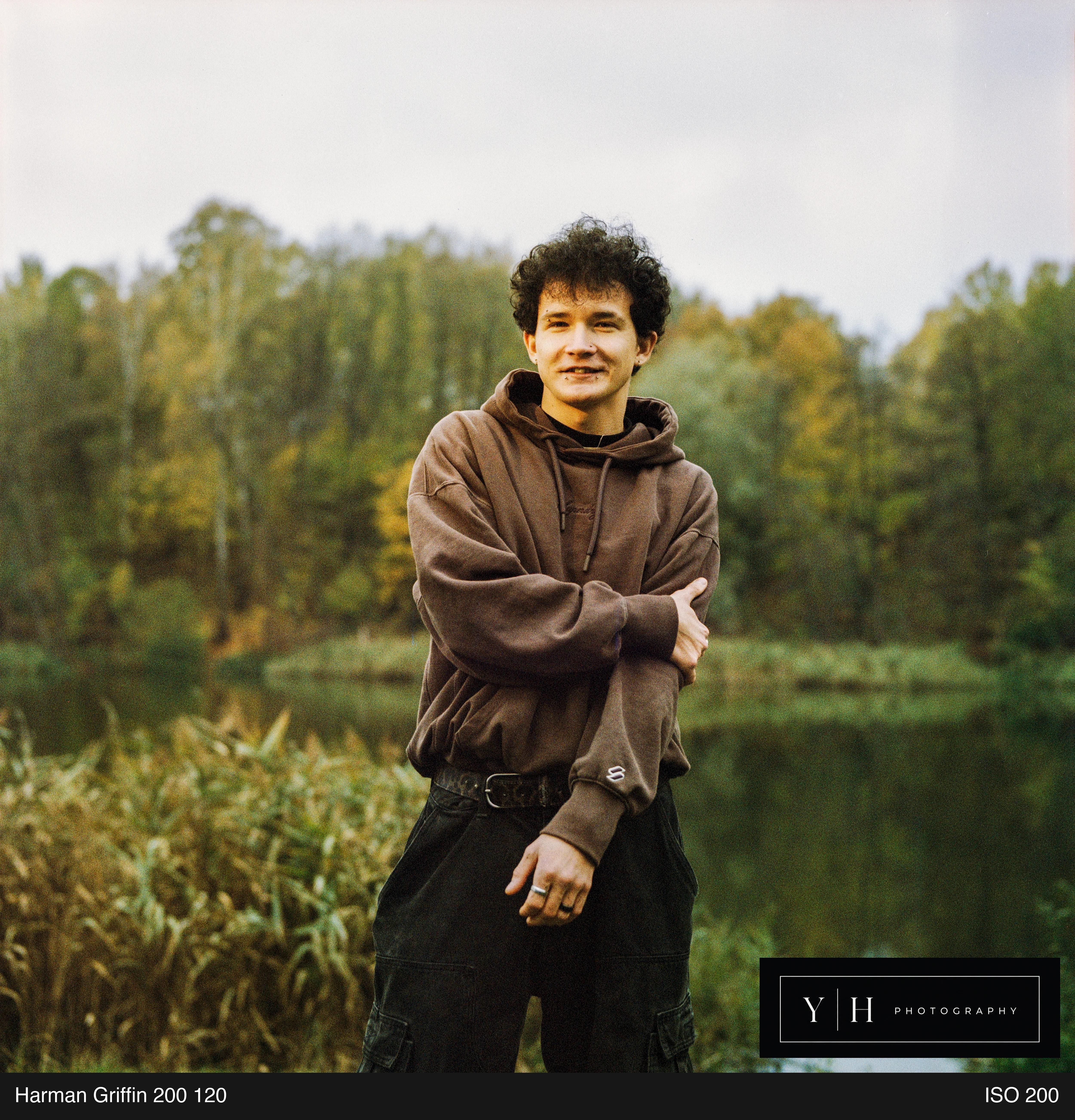
For the second half he pulled on a brown hoodie, and things got noticeably more cheerful. By the water I set up a stand with a photo lamp and switched it on to warm up the face. I forgot to move the stand out of the frame, so in the full-length shot by the water it sticks out on the left. The face here is warm, without the yellow I complained about in the brick-wall portrait. Where he's smiling, he's actually laughing at me: I'd asked him not to smile for the third time.
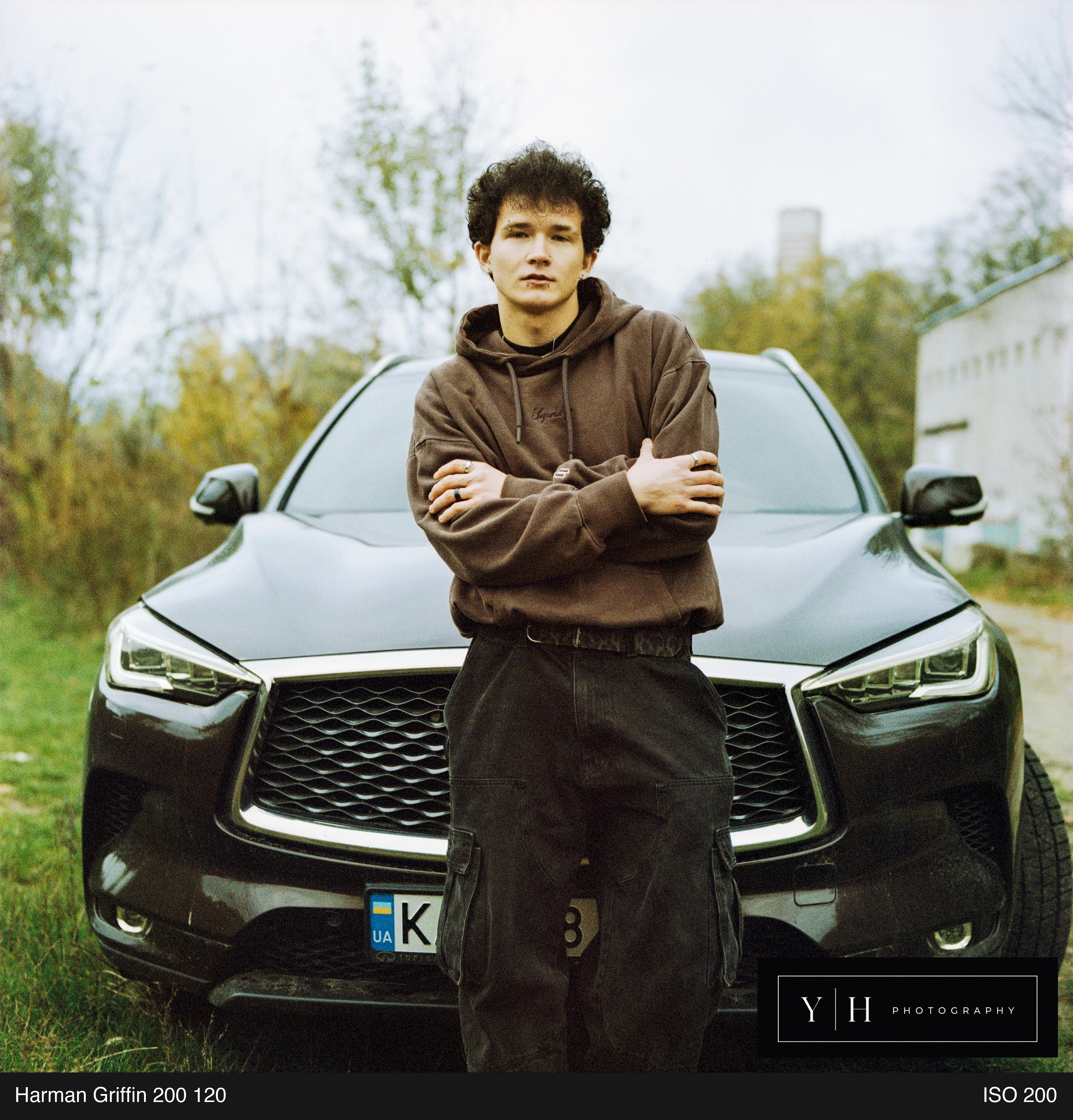
The car had been parked right there the whole time, and not shooting it would have been odd. He leaned on the bonnet and crossed his arms. The dark body didn't sink into black, and you can make out the grille cell by cell, in overcast light.
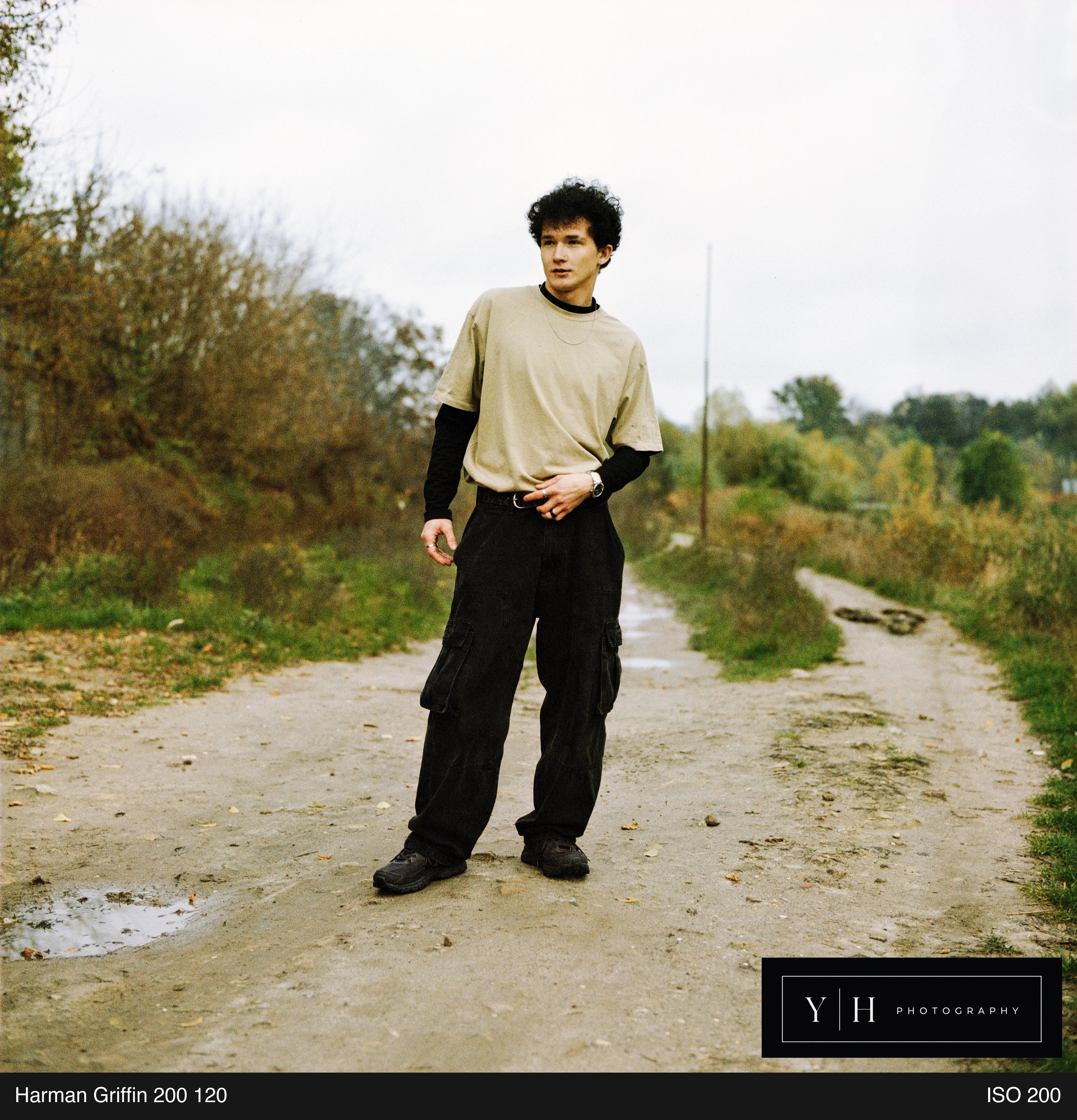
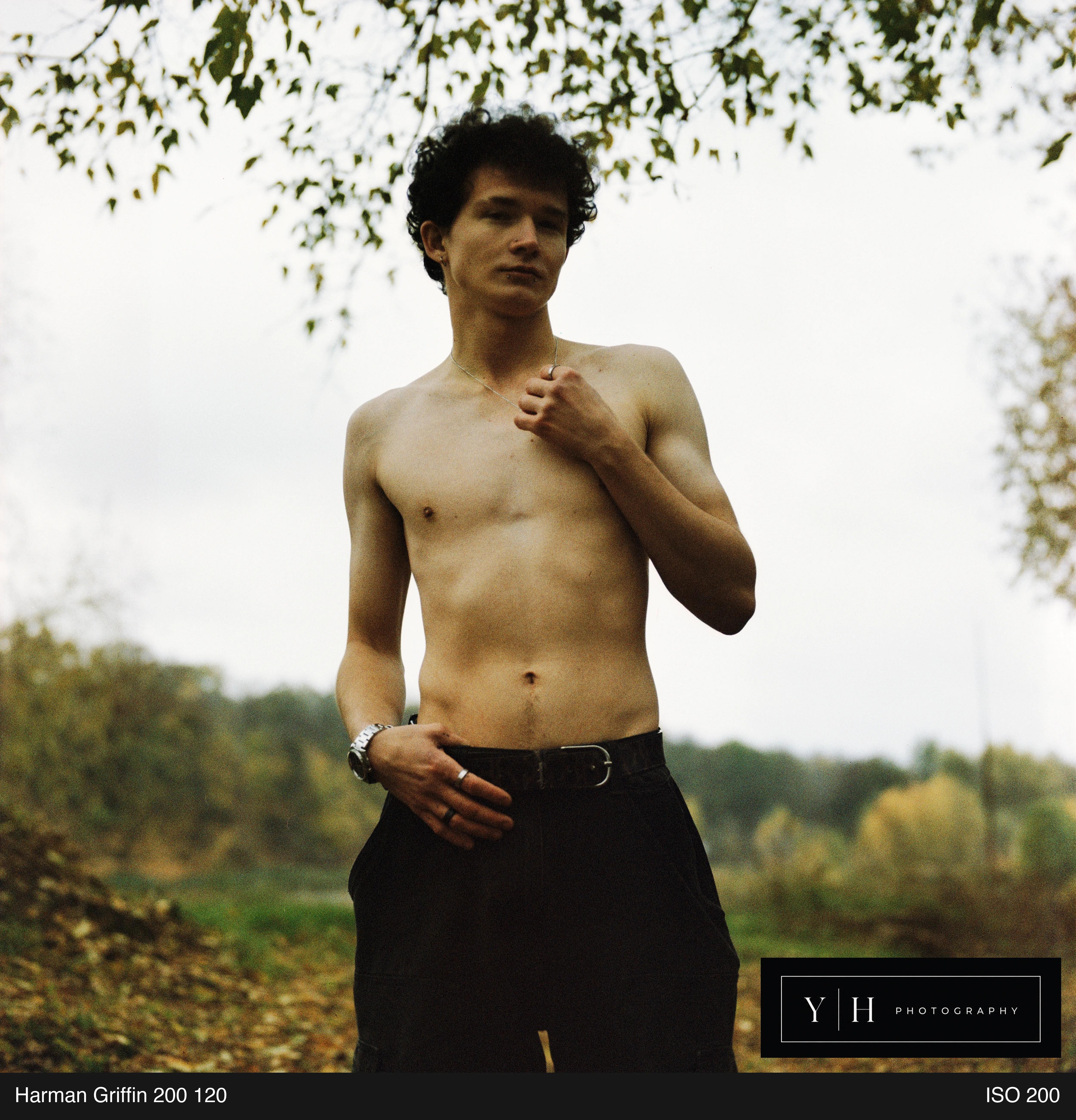
For the last frame I asked Sasha Baytimerov, who posed for the whole roll, to take his T-shirt off: I wanted to show how the film renders skin when there is more of it in the frame. “Shoot quickly, before I freeze,” he said. I did. Last frame, ISO 200.
What I took away
I didn't reshoot the same people with the same flash at ISO 200. How much of this is the extra two thirds of a stop and how much is the flash, there's no telling now. But scrolling back to the start of the scans, I stopped at the reeds in frame five again. There's exactly as much light on the thin leaves as I wanted, and at that point I hadn't corrected anything yet.
After Phoenix, I didn't expect Griffin to hold its 200 this confidently. That is how I shot the 120 roll, at box speed from start to finish. And if anyone asks me how to expose it, that's what I'll say: “Set it to 200.”
I really liked this film, and I'd happily keep shooting it. If Griffin lands in the same price range as Kodak Gold, Harman will have a great alternative on its hands, with unusual colour rendering and an interesting vibe. Now I'm waiting for full-scale production.
Griffin is developed in standard C-41. I can develop and scan your roll; details are on the film development and scanning page.
Author: Yevhen Hrushko