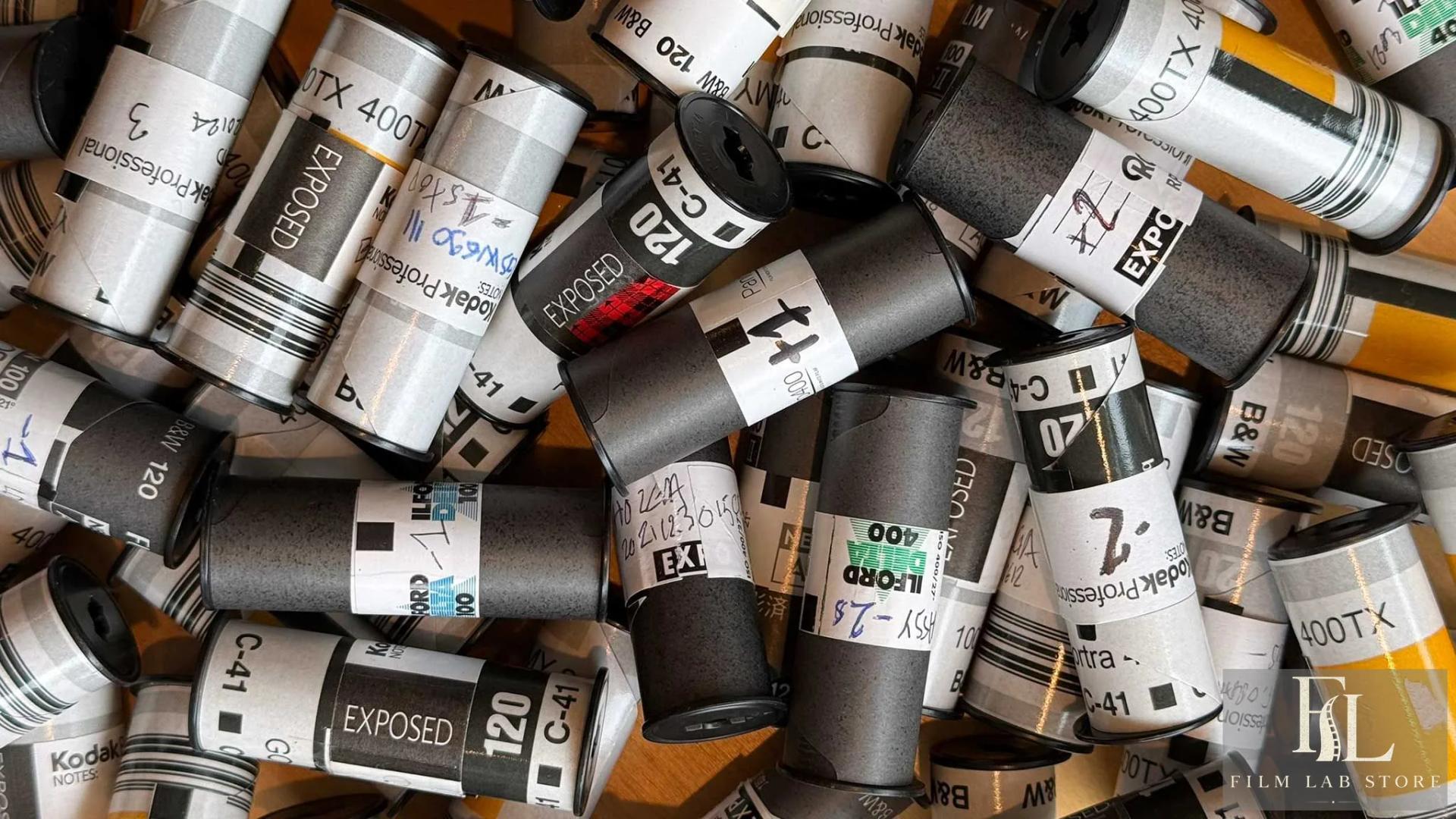
The box of ILFORD HP5 Plus says ISO 400, yet photographers routinely shoot it at 800, 1600 and even 3200. Does that mean turning the ISO dial is all it takes to make the film more sensitive?
No.
This is where the main confusion around Push and Pull begins. The film's ISO does not physically change. The photographer changes how the film is exposed and then — if that is the intention — how it is developed.
The most important idea in this article:
Push does not turn ISO 400 into a genuine ISO 800 or 1600. Shooting at a higher EI means the film receives less light. Altered development can raise the density and contrast of an image already recorded, but it cannot create shadow detail if too little light reached the film in the first place.
Push and Pull — the short answer
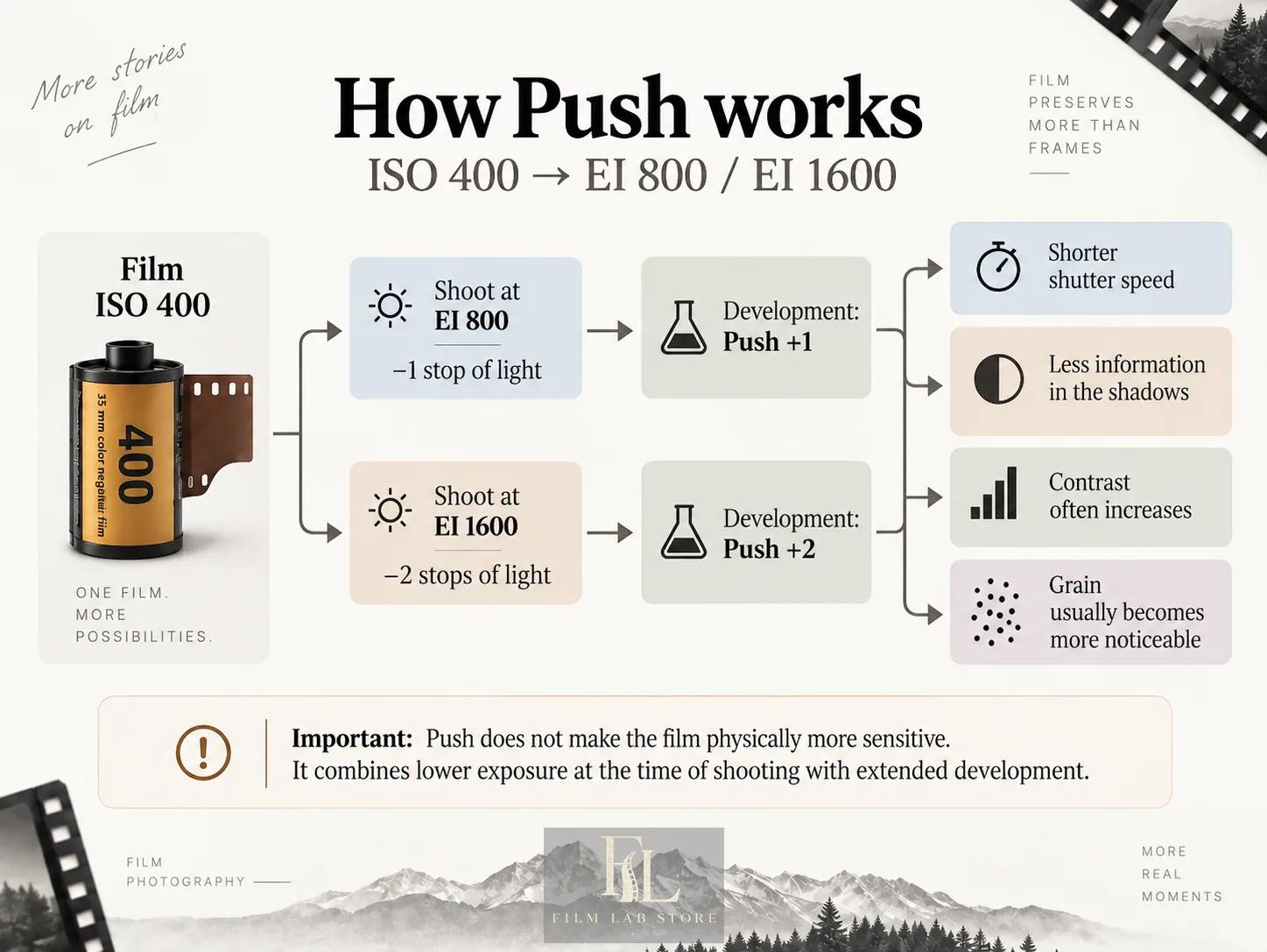
Push +1 usually means the film is exposed one stop below its rated exposure and then developed accordingly. For example, ISO 400 shot at EI 800.
Push +2: ISO 400 → EI 1600.
Push +3: ISO 400 → EI 3200.
Pull −1 is the reverse: ISO 400 shot at EI 200, giving the film one stop more light, after which development is shortened or otherwise altered.
Shooting ISO 400 at EI 800 is not automatically a Push, though. If the film is then developed normally, what you have is primarily one stop of underexposure. Likewise ISO 400 shot at EI 200 and developed normally is one stop of overexposure, not necessarily a Pull.
◆
What Push processing is
Say the camera is loaded with ISO 400.
At EI 400 the meter suggests:
f/2.8, 1/125 s.
Set EI 800 and, under the same light, the camera may pick:
f/2.8, 1/250 s.
You gained a faster shutter speed, but the film received roughly half the light — that is −1 stop.
At EI 1600:
f/2.8, 1/500 s.
Now the film has received about a quarter of the original exposure: −2 stops.
After shooting, the matching development regime is applied — Push +1 or Push +2, for instance.
In everyday speech a photographer will say:
«I pushed HP5 to 1600.»
More precisely, this means:
HP5 Plus ISO 400 was exposed at EI 1600, that is −2 stops, and then developed with a Push +2 regime.
What Pull processing is
Pull works the other way round.
Shoot ISO 400 at EI 200 and the meter gives the film roughly twice the light: +1 stop.
But extra exposure on its own does not make it a Pull.
For example:
ISO 400 → EI 200 + standard development
is primarily one stop of overexposure.
A full Pull combines that extra exposure with shortened or otherwise altered development.
In black-and-white work Pull is useful less as a «too sunny outside» mode and more as a contrast-control tool. ILFORD, for instance, lists a shorter development time for Delta 400 at EI 200 than at EI 400 in one particular combination with DD-X.
ISO and EI are not the same thing
Two terms are enough here.
ISO is the standardised sensitivity of the material.
EI, Exposure Index is the sensitivity the photographer uses to calculate exposure.
The same physical roll of ILFORD Delta 400 remains an ISO 400 film whether the photographer exposes it at EI 200, 800, 1600 or 3200. What changes is the amount of light reaching it, not the emulsion.
So the technically correct phrasing is:
«ISO 400 shot at EI 800»
rather than:
«I turned an ISO 400 film into ISO 800.»
If you want to dig into choosing a film speed specifically, FilmLabStore already has a separate guide: «Film ISO: how to choose 100, 200, 400 or 800».
What Push +1, +2 and +3 mean
| Rated speed | EI when shooting | Change in exposure | With matching processing |
|---|---|---|---|
| ISO 100 | EI 200 | −1 stop | Push +1 |
| ISO 100 | EI 400 | −2 stops | Push +2 |
| ISO 200 | EI 400 | −1 stop | Push +1 |
| ISO 200 | EI 800 | −2 stops | Push +2 |
| ISO 400 | EI 800 | −1 stop | Push +1 |
| ISO 400 | EI 1600 | −2 stops | Push +2 |
| ISO 400 | EI 3200 | −3 stops | Push +3 |
| ISO 400 | EI 200 | +1 stop | Pull −1, if development changes |
| ISO 400 | EI 100 | +2 stops | Pull −2, if development changes |
The key point: every doubling of the EI cuts the exposure by roughly one stop.
Underexposure is not yet a Push
This is an important distinction.
If you accidentally shot ISO 400 at EI 800 and then sent it for normal development, the result is a film underexposed by one stop.
A Push does not begin at the ISO dial; it begins with the pair:
altered exposure + matching change in processing.
Kodak TRI-X is a good example. Kodak's technical documentation described a case where roughly one stop of underexposure could be developed normally, albeit with some loss of shadow detail. That shows clearly why «underexposure» and «push processing» are not synonyms.
What extended development actually does
Simplified, a film's characteristic curve can be pictured as three regions.
The toe is the lower part of the curve. This is where the weakest exposures sit — above all, the deep shadows.
The middle section holds most of the image's midtones.
The upper region corresponds to stronger exposures and the highlights.
As development time increases, the density and contrast of already-exposed areas can rise. But extra development is not extra light exposure.
From this follows the central limitation of Push.
Why Push does not bring back lost shadows
Suppose ISO 400 is shot at EI 1600.
That is −2 stops.
The film receives roughly a quarter of the exposure it would have had at EI 400.
The darkest parts of the scene already give the film very little light. After further underexposure, some of those differences can become so faint that the material simply records too little information.
Longer development cannot travel back in time and add those photons.
Put simply:
a developer can develop more strongly what the film recorded. It cannot add light that was never there during the exposure.
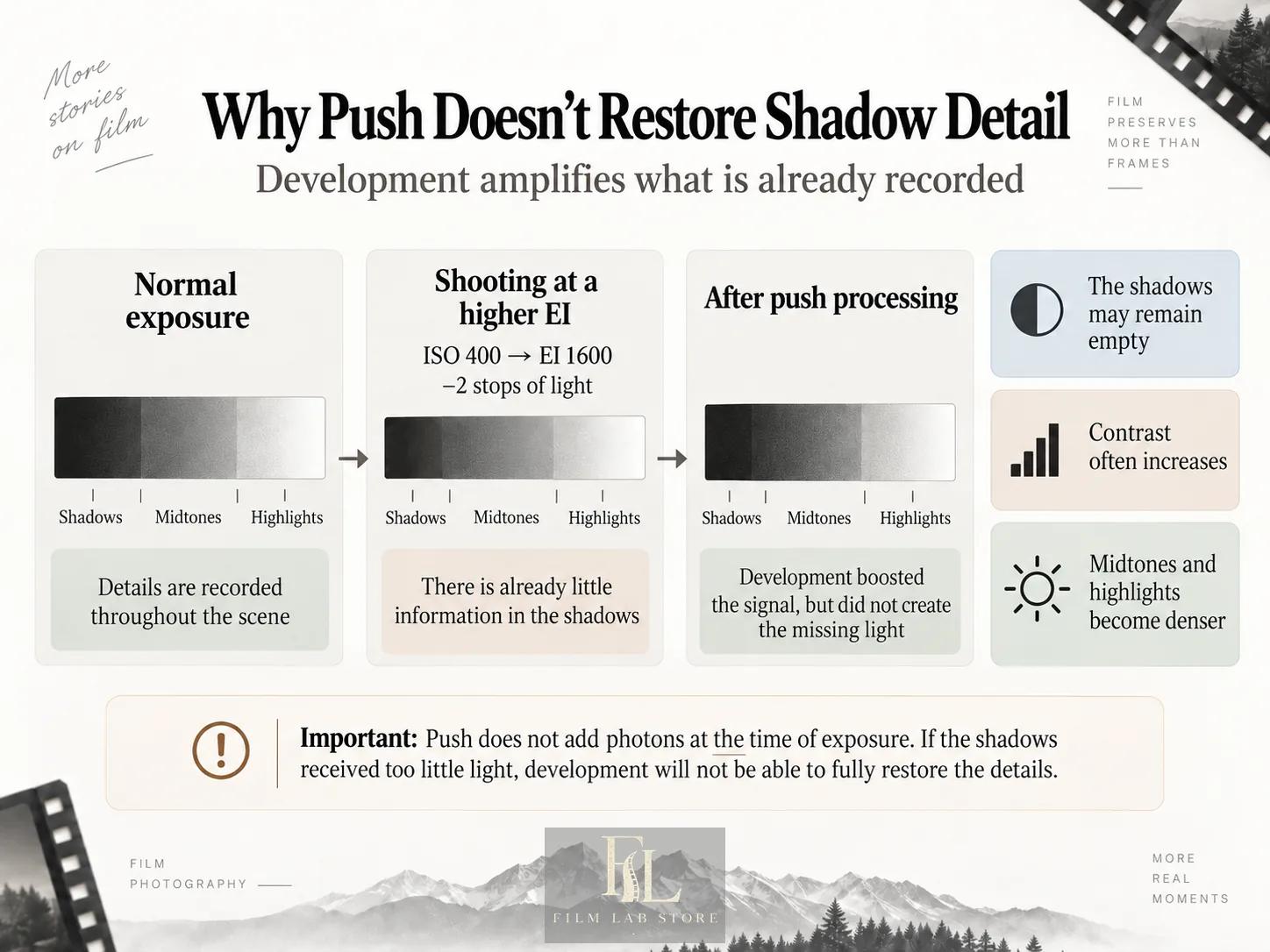
For TRI-X, Kodak explicitly notes further loss of shadow detail under heavy underexposure with Push, alongside increased contrast and graininess.
What happens to midtones and highlights
Midtones usually respond more strongly to extended development than the deepest shadows do.
That is why a pushed negative, once developed and scanned, can look far more «normal» than the original underexposure would suggest.
Highlights, too, can gain additional density under longer black-and-white development.
As a result, a heavily pushed negative can have both:
weak, nearly empty deep shadows and quite dense highlights.
This is exactly why Push deserves particular caution in scenes that hold very deep shadows and strong light sources at once.
How Push affects contrast
For traditional black-and-white photography, «Push raises contrast» has a solid technical basis: both Kodak and ILFORD show contrast rising as development time increases.
The better phrasing, though, is:
Push usually increases contrast in conventional black-and-white processing.
Rather than:
Push always increases the contrast of any film.
C-41, ECN-2 and E-6 are different chemical processes, and the behaviour of a conventional black-and-white negative cannot simply be carried over to them.
Push and grain
«Push increases grain» is a little too blunt.
For TRI-X, Kodak does note increased graininess — visually the grain becomes more noticeable.
That does not mean Push should be explained as a physical «enlargement of the silver crystals».
It is safer to say:
with Push, grain often becomes more noticeable.
How much more depends on:
the film, the developer, the chosen EI, the contrast, the density of the negative, the degree of enlargement and how it is scanned.
Is sharpness lost
Not necessarily.
Push can indeed degrade shadow detail, but that is not the same as an across-the-board loss of sharpness.
Higher contrast can even make edges look crisper. At the same time the grain becomes more visible and faint shadows separate less well.
So the claim:
«Push always makes a photograph less sharp»
is too crude.
Why a good scan does not undo underexposure
A modern scan can change the look of a thin negative considerably.
The scanner and the inversion software can adjust:
- overall brightness;
- the curve;
- contrast;
- colour;
- the black point;
- the midtones.
As a result, an underexposed negative can look perfectly normal once scanned.
But there is a fundamental limit:
if the film did not record the differences in the deep shadows, no software can restore the original scene information.
It can make the image brighter. It cannot create detail that is not on the negative.
◆
When Push is genuinely needed
Push earns its place when you are one or two stops short and cannot — or would rather not — find them any other way.
Typical cases: shooting outdoors in the evening, a concert, a theatre, indoor reportage, people in motion, a no-flash rule, or a film already in the camera that cannot be swapped quickly.
For instance, if EI 400 gives:
f/2.8, 1/60
then EI 800 brings you closer to:
f/2.8, 1/125.
For a moving person that can be a genuinely meaningful difference.
But Push is not free sensitivity. You buy a faster shutter speed at the cost of less shadow exposure and possible changes in contrast and grain.
When it is better not to Push
Before underexposing a film, it is worth asking whether that stop can be found another way.
Open the lens:
f/2.8 → f/2
and you gain roughly +1 stop of real exposure with no change to development.
The price is less depth of field.
Change the shutter speed:
1/125 → 1/60
and again you gain about +1 stop.
The price is a greater risk of blur.
Use flash and you physically add light to the scene.
Push adds no light at all.
If a suitable faster film is available, using it is sometimes the wiser choice. But claiming that a film with its own ISO 800 is always better than ISO 400 at Push +1 is wrong too: different emulsions differ in tonality, grain, latitude and overall character.
Pushing black-and-white film
It is for traditional black-and-white film that manufacturers publish the most detailed official documentation.
| Film | Rated speed | What could be confirmed |
|---|---|---|
| ILFORD HP5 Plus | ISO 400 | official extended development up to EI 3200 |
| ILFORD Delta 400 | ISO 400 | practical EI range of roughly 200–3200 with matching tables |
| Kodak TRI-X 400 | ISO 400 | Kodak's current public recommendation — push to EI 1600 |
| Kentmere Pan 400 | ISO 400 | the current datasheet gives times for EI 400 and 800 |
| ILFORD Delta 3200 | standardised ISO around 1000 | designed for use at roughly EI 3200 and across a wide EI range |
| ILFORD XP2 Super | ISO 400 | EI roughly 50–800 with standard C-41, no push required |
ILFORD HP5 Plus
HP5 Plus is one of the clearest examples of a push-friendly film.
ILFORD officially allows extended development up to EI 3200.
So the usual schemes:
HP5 400 → EI 800 → Push +1
HP5 400 → EI 1600 → Push +2
HP5 400 → EI 3200 → Push +3
all have manufacturer support.
The exact development time, however, cannot be derived from the number of stops alone. It depends on the particular developer and processing regime.
ILFORD Delta 400
For Delta 400, ILFORD lists a practical range of roughly EI 200–3200 together with tables for various developers.
It is a good illustration of how flexible a particular emulsion can be.
But the conclusion should be exactly:
Delta 400 has that range.
Not:
any ISO 400 film pushes easily to 3200.
For Kentmere 400, for instance, the official documentation only goes up to EI 800.
Kodak TRI-X 400: an interesting discrepancy between documents
TRI-X is a particularly interesting case.
The current Kodak Professional page states a maximum pushability of EI 1600.
An older Kodak technical publication from 2016, however, discussed heavier underexposure — up to three stops — with a warning about further loss of shadow detail and rising contrast and grain.
In practice, for 2026 it is sensible to treat EI 1600 as the manufacturer's current public recommendation and the older data on heavier pushing as historical technical context rather than a present-day Kodak recommendation.
Kentmere Pan 400
The Kentmere Pan 400 datasheet gives official figures for EI 400 and EI 800.
So Kentmere 400 → EI 800 is a well-supported example of Push +1.
EI 1600 or 3200, though, cannot be presented as manufacturer-recommended regimes on the strength of that document.
Delta 3200: why «3200» does not always mean ISO 3200
ILFORD Delta 3200 is a fine example of why it helps to keep ISO, box speed and EI apart.
According to ILFORD's technical documentation its standardised ISO speed is roughly ISO 1000, while the material is designed for use at about EI 3200 with matching development. The manufacturer also describes a wide practical EI range.
So the number on the box is not always to be read as:
«Here is the material's physical ISO and nothing else.»
XP2 Super: a different EI with no Push at all
ILFORD XP2 Super shows the opposite case.
It is a chromogenic black-and-white film of ISO 400, developed in C-41.
The manufacturer allows it to be shot across roughly EI 50–800 while recommending standard C-41 processing for the whole range.
In other words:
a different EI ≠ automatically a Push.
It is one of the clearest illustrations in the whole subject.
Which developers are used for pushing
For ILFORD materials the official documentation gives the strongest support to ILFOTEC DD-X and Microphen where high practical speed is the goal.
For some films there are official high-EI tables for ID-11/D-76 and other developers as well.
The main rule:
there is no single «best developer for pushing» outside the context of a particular film, EI and desired result.
In particular, the popular claim:
«Rodinal is the best developer for pushing»
finds no support in ILFORD's official documentation: for high EI values the manufacturer's data back DD-X and Microphen far more strongly.
Push +1 is not «add 20% to the time»
That is a dangerous simplification.
Development time depends on:
the film + the developer + the dilution + the temperature + the agitation + the EI + the contrast you want.
So there is no universal:
Push +1 = +20%
or
Push +2 = +40%
rule.
The official HP5 and Delta tables show different time changes for different developer combinations.
When developing at home, always look up the table for your own combination.
Can colour C-41 film be pushed
Yes — altered Push/Pull processing of C-41 exists as a laboratory practice.
But important limits follow.
No reliable current manufacturer tables could be found that would allow a universal statement such as:
Gold 200 Push +2 — do it this way
or:
UltraMax 400 Push +2 — here is the result you get.
The same applies to current exact regimes for EKTACOLOR/Portra and a number of other materials.
So the technically correct advice is:
C-41 can be pushed, but the specific EI and regime must be checked for the specific emulsion and the specific lab.
The regime for one colour film cannot be carried over to all the others.
What about CineStill 800T and 400D
CineStill 800T is very often shot at raised EI values, but no current official manufacturer table with exact EI 1600/3200 regimes could be confirmed.
So I will not turn a widespread practice among photographers into the claim:
«CineStill officially recommends 800T at 3200 following this scheme.»
Here it is better to follow the manufacturer's current instructions and your lab.
Can Kodak VISION3 and ECN-2 be pushed
Kodak does emphasise the good latitude of some VISION3 stocks and the material's tolerance of underexposure.
But underexposure latitude and push processing are different things.
The fact that VISION3 tolerates a degree of underexposure is not an official instruction to:
«shoot 250D at EI 500 and Push +1 in ECN-2.»
No current primary documentation could be found for exact altered ECN-2 regimes with VISION3 50D, 200T, 250D and 500T.
Exact ECN-2 push recipes are therefore deliberately left out here.
This matters especially for modified AHU/remjet-removed versions of motion-picture stock: they cannot be assumed sensitometrically identical to the factory cine process.
Can E-6 be pushed
Push processing of reversal film has a long history, but slide film is far more demanding about exposure than negative film.
No current manufacturer tables could be obtained for specific modern regimes with Ektachrome E100, Velvia and Provia.
So it is better to settle on the principle:
E-6 can be processed with an altered regime, but the specific Push/Pull must be agreed against the instructions for that film and that lab.
Do not carry black-and-white push recipes over to E-6.
When Pull is needed
For an ordinary beginner, Pull comes up far less often than Push.
Its most interesting use is controlling the contrast of a black-and-white negative.
In a very contrasty scene, for example, a photographer can:
give the shadows more exposure,
and then shorten development to limit the density built up in the highlights.
This is related to the idea of N− development in the Zone System, though equating the Zone System with everyday Push/Pull outright would be wrong.
If the goal is simply to shoot ISO 400 at f/2 on a bright sunny day, it is usually easier to:
use ISO 100–200, an ND filter or a faster shutter speed.
Can the ISO/EI be changed mid-roll
You can turn the ISO dial at any moment.
The film itself does not change because of it.
For example:
frames 1–12 shot at EI 400,
13–24 at EI 800,
25–36 at EI 1600.
All of those frames sit on one continuous strip of film.
In normal development the whole roll gets one and the same processing regime.
Hence the rule for ordinary 135 or 120:
one roll → one development regime.
Shooting different frames at different EI values is a legitimate experiment, but a lab cannot normally develop frame 5 as Push +2 and frame 20 normally.
What to do if you set the wrong ISO by accident
The whole ISO 400 roll shot at EI 800
Do not panic.
That is only −1 stop.
For some materials Push +1 makes sense. For some films ordinary development can give an acceptable result too.
TRI-X is a good example: Kodak described normal processing being possible after one stop of underexposure, albeit with some loss in the shadows.
A few frames shot at 800, the rest at 400
Do not automatically push the whole roll for the sake of a few frames.
Tell the lab what happened.
A compromise has to be chosen for the whole film.
ISO 400 accidentally shot at EI 200
It received +1 stop of exposure.
That does not mean it must be pulled.
Many negative materials tolerate extra exposure well. XP2 Super is a particularly telling official example of a wide EI range under standard processing.
What you must tell the lab
If the film was shot with a Push or a Pull, the lab needs five pieces of information.
| What | Example |
|---|---|
| Film | ILFORD HP5 Plus |
| Box speed | ISO 400 |
| Actual EI | EI 1600 |
| Processing wanted | Push +2 |
| Whole roll shot this way | Yes |
A good way to put it:
«ILFORD HP5 Plus 400, the whole roll shot at EI 1600, Push +2 please.»
A bad one:
«Just develop it a bit more.»
A lab cannot reliably tell from the cassette which EI you set when shooting.
Practical examples
| Situation | Decision | What you get | What to watch |
|---|---|---|---|
| HP5 400 in the evening, one stop short | EI 800 / Push +1 | a faster shutter speed | less shadow exposure |
| HP5 400 at a concert | EI 1600 / Push +2 | +2 stops of freedom | more compromise in shadows, contrast and grain |
| Delta 400 indoors | EI 800–1600 | official high-EI regimes exist | use the table for your developer |
| Kentmere 400 | EI 800 | an official regime exists | no official data found above EI 800 |
| XP2 Super | EI 200–800 | standard C-41 | a good example of EI flexibility without pushing |
| TRI-X 400 shot at 800 by accident | possibly normal development or Push +1 | depends on your goal | not necessarily a disaster |
| Part of the roll at EI 400, part at 1600 | one compromise regime | different frames respond differently | the lab cannot develop frames separately |
| Expired film | not an automatic push | depends on its condition | age alone is no reason to push |
| An f/1.4 lens | open the aperture instead of pushing | more real exposure | less depth of field |
| An f/5.6 zoom, a moving subject | pushing may help | a faster shutter speed | the shadows get less light |
A simple decision tree
Not enough light.
→ Can you open the aperture by one stop without losing depth of field you need?
Yes: you may not need a Push.
→ The lens cannot be opened further. Can you lengthen the shutter speed without blur?
Yes: you may not need a Push.
→ No. Is there a suitable faster film?
Yes: compare it against pushing the film you already have.
→ Is the film already loaded, or do you want that film's character specifically?
Check whether the manufacturer publishes a regime for the EI you need.
→ There is one?
Shoot the whole roll at a single EI and develop by the matching table.
→ No official data?
Better to agree the regime with your lab or run a test than to follow a one-size-fits-all recipe from the internet.
Common myths about Push and Pull
| Claim | Verdict | What actually happens |
|---|---|---|
| Pushing raises the film's ISO | No | what changes is the EI, the exposure and the processing |
| ISO 400 at Push +1 becomes a real ISO 800 | No | it remains ISO 400 shot at EI 800 |
| Pushing brings back lost shadows | No | light exposure that never happened cannot be created in development |
| Pushing always makes the grain physically larger | Not accurate | increased visual graininess is confirmed, but not that explanation |
| Pushing always raises contrast | It depends | well supported for conventional black-and-white, not for every process |
| Any ISO 400 film can be pushed to 3200 | No | the ranges depend heavily on the emulsion |
| In low light you always need to push | No | sometimes aperture, shutter speed, flash or a faster film is better |
| Colour C-41 cannot be pushed | No | pushing C-41 exists, but the regime is film-specific |
| Underexposure and pushing are the same thing | No | a push includes a decision about processing |
| Overexposure and pulling are the same thing | No | extra exposure alone is not yet a pull |
| You can change EI every frame and the lab will fix it | No | an ordinary roll gets one processing regime |
| The lab will see for itself that a push is needed | No | the EI has to be told |
| Push +1 = add 20% to the time | No | there is no single formula |
| Rodinal is the best developer for pushing | Unconfirmed | ILFORD's official data support DD-X/Microphen more strongly |
| Pushing rescues expired film | Unconfirmed | not to be used as general advice |
| A native ISO 800 film is always better than ISO 400 pushed +1 | It depends | different emulsions and different trade-offs are being compared |
Common beginner mistakes
The most painful mistake is shooting HP5 Plus at EI 1600, handing the film in as ordinary ISO 400 and saying nothing.
The second is believing that any move of the ISO dial is automatically a Push.
The third is changing EI several times on one roll and expecting the lab to compensate for each frame separately.
The fourth is hoping that very long development will restore shadow exposure that was never there.
And the fifth is using a formula like «+20% time per stop» without checking the table for your particular film and developer.
FAQ
What is push processing?
A process in which the film is usually shot at a higher EI, receiving less exposure, and then given matching altered development.
What does Push +1 mean?
One stop. For example, ISO 400 shot at EI 800.
What does Push +2 mean?
Two stops. For example, ISO 400 → EI 1600.
What happens if I shoot ISO 400 at 800?
The film receives roughly one stop less light. Developed normally, that is −1 stop of underexposure. Developed with matching altered processing, it is a Push +1.
Does ISO 400 become a genuine ISO 800 after pushing?
No. The material's physical sensitivity does not change because you set EI 800.
Can ISO 400 be shot at 1600?
Some films, yes. HP5 Plus and Delta 400, for instance, have official high-EI recommendations. For any given film, check the datasheet.
Is shadow detail lost?
Underexposure raises the risk of losing shadow detail. Extra development cannot create exposure that never happened.
Does pushing increase grain?
It is usually more accurate to say that the grain becomes more noticeable. The exact result depends on the film and the developer.
Can colour C-41 be pushed?
Yes, the practice exists in labs, but the regime must be determined for the specific film and lab.
Can ECN-2 be pushed?
VISION3 is confirmed to tolerate underexposure well, but no current universal Kodak recipes for pushing in ECN-2 could be confirmed. Do not invent them from ordinary push logic.
Can E-6 be pushed?
Pushing E-6 exists as a practice, but the exact regimes must be checked against the specific material and lab. For modern Ektachrome, Velvia and Provia, no sufficient set of current manufacturer tables could be found.
Can I change the ISO mid-roll?
You can change the EI while shooting, but an ordinary roll still receives a single development regime.
What should I tell the lab?
The name of the material, its box ISO, the actual EI and the Push/Pull you want. For example: «HP5 Plus 400, whole roll at EI 1600, Push +2.»
Which is better: ISO 800 or ISO 400 pushed +1?
There is no universal answer. A faster film and a pushed slower one can differ in shadows, grain, contrast and overall character.
Can expired film be pushed?
Being expired is not in itself a reason to push. The condition of old film depends on the emulsion, its age and how it was stored.
Conclusion
Push is not a way to magically raise a film's sensitivity.
It is a deliberate trade-off between exposure and processing.
When ISO 400 is shot at EI 800, the photographer gains one stop of more workable shutter speed or aperture — while the film itself receives one stop less light.
Altered development helps raise the density and contrast of the recorded image, but it cannot restore shadows that were underexposed.
So before pushing, it is worth asking yourself a simple question:
do I really need that extra stop?
If you can find it with a wider aperture, an acceptable shutter speed, a flash or a different film, you may not need a push at all.
But when the light is low, the motion must stay sharp, flash is not an option and the film is already in the camera, Push becomes a genuinely useful and predictable photographic tool.
And one last practical rule:
if you shoot with a Push or a Pull, always tell the lab the actual EI.
For example:
ILFORD HP5 Plus 400, whole roll shot at EI 1600, Push +2.
That way the lab knows not only which film is in the cassette, but what exposure it actually received.