Polaroid
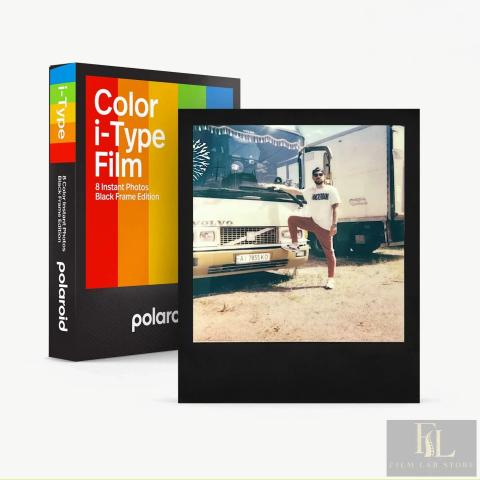
Polaroid Color i-Type Black Frame — colour pack of 8 photos for Polaroid i-Type cameras
€18.46
A concentrate kit for developing colour negative film in the C-41 process at home — enough for 10–12 rolls. Developer, bleach and fixer in three bottles, from which you make up 500 ml of working solution. They dilute with ordinary tap water: buffering and the sequestering of calcium and iron are already built into the formulas, so no distilled water is needed.
Three concentrates — developer, bleach and fixer — packed as 50 + 50 + 100 ml in a zip-lock bag, with a printed instruction sheet. They make up 500 ml of working solution. The bleach and the fixer are separate solutions here rather than a combined blix, so you run and control each stage independently.
The kit is rated for 10–12 colour films. Where you land in that range depends on how you work: the minimum tank volume and rotated solutions get you closer to the upper figure, generous filling closer to the lower one. Per roll that works out at roughly 60–75 UAH of chemistry.
This is the kit’s main practical difference: the solutions are formulated from the outset to be mixed with running tap water. Buffering and sequestering agents that bind the calcium and iron in mains water are already part of the formulas. Those ions are exactly what produces haze, sludge and stains on the negative when colour chemistry is mixed with whatever water is at hand — here you do not have to hunt down a canister of distilled water to get a repeatable result.
C-41 is a standardised process: the colour developer runs at 38 °C, and temperature accuracy matters more here than in any black-and-white workflow. The bleach and the fixer are far more tolerant. Take the actual times, the sequence and the tolerances from the instruction sheet in the kit — it is written for these concentrates specifically. Push processing is a matter of extending the time in the developer, and at home you control that yourself instead of agreeing it with a lab.
A tank with a reel, an accurate thermometer, measuring vessels and a water bath to hold 38 °C. All of that lives in the darkroom equipment and accessories sections. Film for the C-41 process is in the film catalogue.
C-41 is the process for colour negative still film. Motion picture film that still carries its remjet layer should not go into it until that layer is washed off — it contaminates the solutions and the reel. Film with the remjet already removed at the factory develops in C-41 like an ordinary negative, though the colour rendition differs from native ECN-2.
No. Slide film needs the E-6 process, with a different set of solutions and a mandatory reversal step. In C-41 a slide film gives a negative with shifted colours, not a positive.
The shelf life of the diluted solutions is given in the instruction sheet, and it also depends on how you store them. The general C-41 rule: the colour developer oxidises fastest, so keep it in a tightly closed, air-free bottle and do not mix more than you intend to use soon.
If you would rather not develop it yourself, or you need a finished scan, we also offer colour film development and scanning.