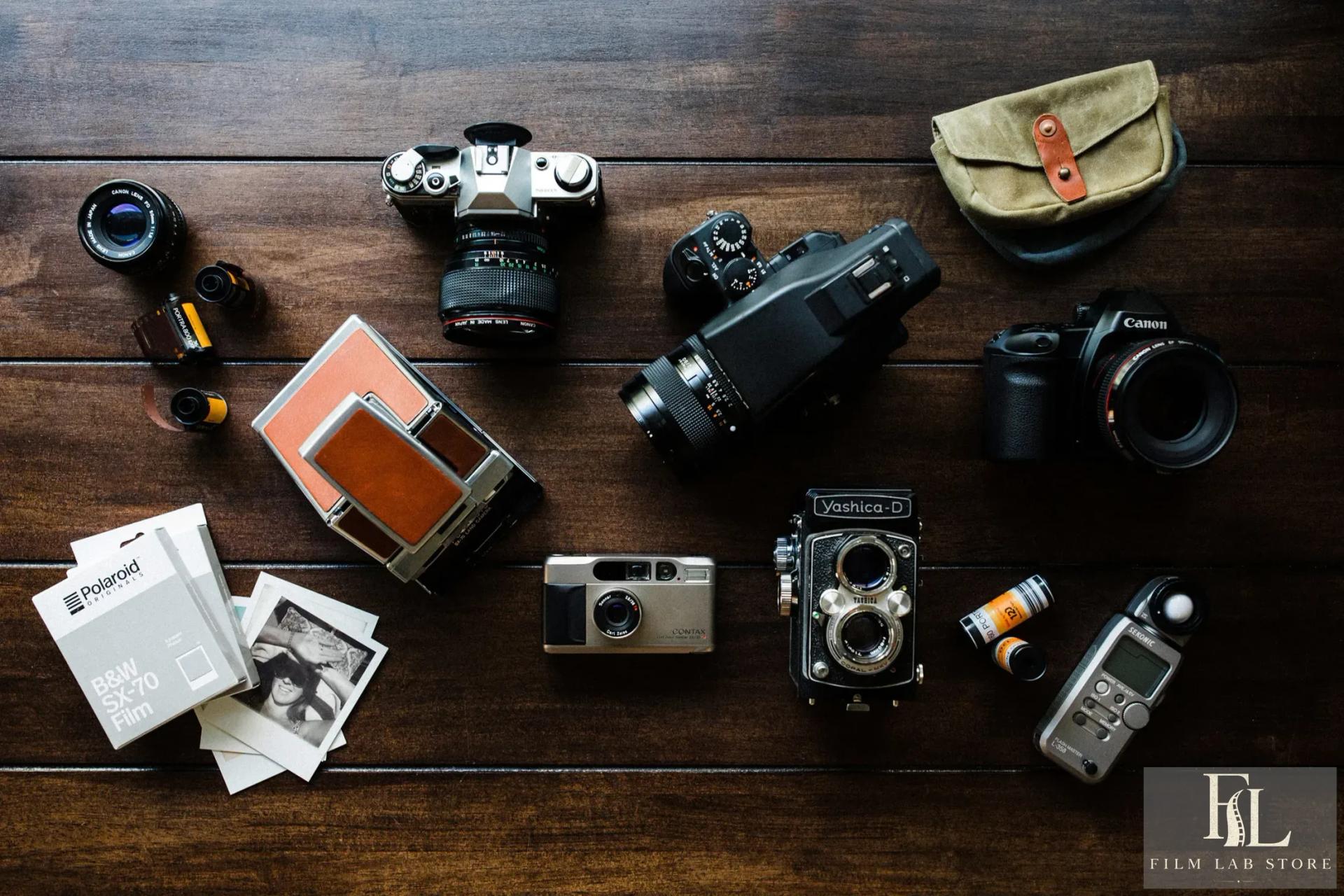
How to choose your first film camera
If you have absolutely no experience with film, start with an affordable 35mm autofocus SLR. Cameras such as the Canon EOS 300 or Nikon F80 are lightweight, feature modern automatic functions and have affordable interchangeable lenses. Don’t overpay for ‘iconic’ brands: the most expensive mechanical bodies are often no better than later, cheaper models. Shoot your first 10 rolls on ISO 200–400 negative film (Kodak Gold 200, UltraMax 400 or Ilford HP5 Plus) and don’t rush into buying a medium-format or rangefinder camera — they are heavier, more expensive and require experience.
What types of film cameras are there?
| Camera type | Format | Pros | Cons |
|---|---|---|---|
| 35 mm SLR / point-and-shoot | 36×24 mm | The most accessible format: it’s easy to find film, a service and affordable cameras. SLRs allow you to control exposure and change lenses | The smallest frame size of all formats |
| Medium format (120) | 6×4.5 / 6×6 / 6×7 cm | Significantly better image quality, with greater clarity and detail | A bulkier and heavier camera; more expensive film and development; a slower workflow |
| Long-range cameras | 35 mm | Compact and quiet, ideal for street photography and travel | Most budget models do not have interchangeable lenses; parallax at close range |
| Mechanical SLRs | 35 mm | Transparent mechanics and manual controls help you understand exposure; many models operate without batteries | Manual focus; iconic models (AE-1, K1000) are often overrated |
| Autofocus SLRs | 35 mm | Modern exposure meters, autofocus and affordable lenses — the best way to get started for those who don’t want to waste shots due to mistakes | Less of a 'retro vibe', plastic casing |
| Instant (Instax) | Instax Mini/Wide/Square | Minimal friction: instant results without scanning | They do not allow full control over exposure; the film is expensive and only available in the Instax format |
Start with a 35mm SLR – it offers the perfect balance between learning and convenience. Save the medium format for when you’re absolutely sure you want a different pace and larger negatives.
How a beginner can narrow down their choices
Before buying a camera, ask yourself three questions: what is your budget, what do you want to photograph, and how much do you want to learn about manual settings? The trend for analogue photography in 2025–2026 has driven up prices for iconic models, so real value is more important than the name.
- Budget. In the entry-level segment, opt for simple compact or AF SLR bodies. In the mid-range, look for better ergonomics or a first step into medium format. If you have a larger budget, spend it on the camera’s condition and after-sales service, rather than on the brand.
- The purpose of the shoot. For travel and everyday use — a lightweight 35mm camera; for street photography — a compact SLR or rangefinder; for portraits and staged shots — medium format.
- Weight and size. The Canon EOS 300 weighs around 335 g, the Nikon F80 around 515 g, the Pentax 645 around 1.28 kg, and the Mamiya RB67 is even heavier. If you want a camera that you can take everywhere with you, go for a lightweight model.
- Availability of the film and the service. Don’t buy a camera that uses an obscure film format if there’s no photo lab or shop nearby where you can buy film.
Autofocus isn’t a ‘cheat’; it’s a way to minimise wasted shots when you’re starting out: AF cameras help you avoid botched shots whilst you’re learning. Choose manual focus deliberately once you know you prefer a slower approach.
Recommended models
What follows is not a ‘list of the most fashionable models’, but a practical list of potential first-time buyers’ choices. The indicative prices reflect the broad range on the second-hand market in 2025–2026 (in US dollars).
| Model | Type | Overview | Approximate price | Pros | Cons |
|---|---|---|---|---|---|
| Kodak Ektar H35 | half-frame compact | fixed lens, minimal controls | ≈$50 | the cheapest option, twice as many frames | hardly teaches classical exposition |
| Olympus Stylus (mju) | point-and-shoot | autofocus, pocket-sized | ≈$100 | simple, compact, fast | limited control |
| Pentax K1000 | mechanical SLR | Manual control, K-mount, no battery for the shutter | ≈$100+ | ideal for learning | cult status drives up the price |
| Canon AE-1 / AE-1 Program | mechanical SLR | Manual focus + shutter priority mode, FD mount | ≈$150+ | a good balance between control and automation | Popularity drives up prices; electronics become outdated |
| Nikon FE2 | mechanical SLR | Manual focus, Nikon F-mount | <$200 | robust system, excellent ergonomics | more expensive than 'non-pre-owned' AF bodies |
| Canon EOS 300 | AF SLR | autofocus, EF mount, automatic modes | low to medium | lightweight, wide range of EF lenses | plastic casing, less retro-style |
| Nikon F80 | AF SLR | autofocus, Nikon F-mount | average | advanced automation, full-size F-mount | less popular, but more practical |
| Pentax 645 | medium-format SLR | 6×4.5 cm, interchangeable lens, 645 A-mount | upper secondary | a large negative without being overly bulky | heavier and more expensive than 35 mm |
| Mamiya RB67 Pro-S | medium-format SLR | 6×7 cm, modular system | ≈$300 | huge negative, excellent quality | very heavy; not suitable for everyday wear |
The most practical choice for beginners is the Canon EOS 300 or Nikon F80: minimal technical complexity. For hands-on learning — the Pentax K1000 or Canon AE-1, but without paying a premium for the ‘legendary’ status. Your first medium format camera — the Pentax 645 or Mamiya 645; it’s best to leave the RB67 for later.
Which film and photo lab should I choose?
| ISO | When to use | Recommended films |
|---|---|---|
| ISO 100–200 | Bright sunlight, travel, scenes with even lighting | Kodak Gold 200 — a classic colour negative film for daylight conditions |
| ISO 400 | A versatile start: a mix of conditions when you don’t want to worry about lighting | Kodak UltraMax 400 — an all-weather option; Ilford HP5 Plus — a best-selling black-and-white film with a wide dynamic range |
| ISO 800+ | Evenings, interiors, concerts, poor lighting | More expensive and grainier; save this for the second step |
To begin with, avoid slide film (E-6): it requires precise exposure, is more expensive and is less forgiving of beginners’ mistakes.
FilmLabStore offers 135 and 120 film formats, as well as developing and scanning services. Go to film catalogueto select a material, or to the development and scanning sectionto book the service.
How to check a second-hand camera
Condition is more important than a model’s romantic name: even the ‘king of beginners’ is worthless if it’s mouldy or the trigger is sticking. Before buying, make sure to:
- Check the lens. It must be clean and free from mould, cloudiness, separation or major scratches.
- Check the sun visor and the battery compartment. The foam must not crumble, and the contacts must not turn green.
- Clean the bolt and the feed mechanism. Go through all the settings, check the mirror return and ensure the rewinding is smooth.
- Assess the risks associated with medium-sized enterprises. Check the condition of the backrests, bellows and swivel seats, and the brightness of the shaft.
- Record a test video. Load up some cheap film, shoot a few different scenes, develop the film and assess the results — it’s cheaper to spot any issues this way than during an important shoot.
Checklist: what to check before buying
- A lens free from mould or fog.
- The battery compartment is intact and free from corrosion.
- The sun visors and seals are in good condition, particularly on the bonnet.
- The shutter operates smoothly at all shutter speeds without any lag.
- The film is rewinding; the counter and rewind mechanism are working.
- The light meter is working (if required).
- For medium-sized venues: live backdrops, a dark slide and rotating stages.
- There is a test video, sample frames or confirmation from the service.
Useful links
- Film catalogue — colour and black-and-white films in 135 and 120 formats.
- Development and scanning — C-41, black and white, cross-process.
- Camera catalogue — refurbished second-hand cameras with a description of their condition.
- What to do with old film you've found — a guide to safe handling.
Frequently Asked Questions
Which is the best film camera for beginners?
For most beginners, the most practical place to start is with a later-model 35mm autofocus SLR: the Canon EOS 300 or the Nikon F80. They are lightweight, feature modern automatic functions and offer access to a wide range of lenses. If you want to learn manual focus, go for the Pentax K1000 or Canon AE-1, but don’t overpay.
Which to choose: a manual SLR or an autofocus camera?
Manual — if you want to learn the ropes properly or prefer a slower process. Autofocus — if you want less technical hassle and more time shooting. For a first camera, the AF option is often more practical.
Is the medium format suitable for a beginner?
Medium format isn’t the first step: it’s heavier, more expensive and less forgiving of mistakes. Start with 35mm and move on to 120 once you’ve shot at least 10–20 rolls.
Which film should I choose for my first time?
Kodak Gold 200, Kodak UltraMax 400 or Ilford HP5 Plus. For your first attempt, use colour or black-and-white negative film with an ISO of 200–400. Avoid slide film when you’re just starting out.
Where can I get my film developed in Kyiv?
At FilmLabStore, you can order the development and scanning of colour (C-41) and black-and-white film. Place your order on the website or message me on Telegram.
How can you tell if a second-hand camera is in working order?
Check the lens (for mould and fogging), the battery compartment (for corrosion), the light seal, the shutter operation at various shutter speeds, and the film advance. The best thing to do is to shoot a test roll straight after purchase.
What is CLA and is it necessary?
CLA (Clean, Lubricate, Adjust) — cleaning, lubricating and adjusting the camera. Recommended for any second-hand equipment over 20–30 years old. After a CLA, the camera becomes significantly more reliable.