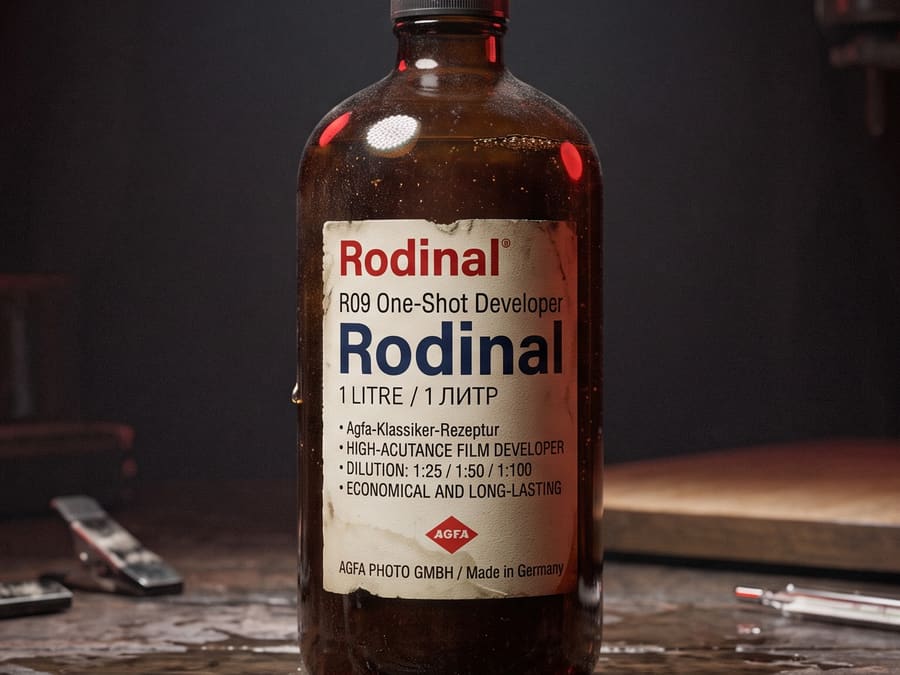
A Few Things About Rodinal
Practical Tips for Working with "Rodinal" Developer: Storage, Dilution, Temperature, and Common Misconceptions About Push Processing and Expired Film.
"Rodinal" is one of the most popular "everyday" developers among amateur photographers, and it's easy to see why: it's affordable, easy to measure out, and simple to use. To prepare the working solution, there’s no need to heat the water or monitor its temperature with a thermometer, dissolve the dry ingredients in a strict sequence, or let the finished solution settle and filter it—simply measure out the required amount of concentrate with a syringe, add it to a jar of room-temperature water, stir gently, and develop immediately. After development, the solution is simply poured out—there’s no need to store partially used developer for long periods, find a container for it, or keep track of how much film has already been processed. But Rodinal, like any developer, has its own peculiarities.
Storage of the Concentrate
Like any developer, the concentrate must be stored away from air. If you transfer part of the solution from a large bottle, you should use a smaller container for the remaining concentrate to minimize the air space above the solution. The relationship between shelf life and the air head is nonlinear: with a large air head, the concentrate can spoil in as little as 10 days, while with almost no air head, it can be stored for about a year. Frequent decanting also accelerates spoilage—this is due to oxygen in the air, which oxidizes the developer.
Storage Temperature
Store the concentrate in a dark, cool (but not cold!) place, ideally at +12…+18°C. Storing it near 0°C or at subzero temperatures is incorrect—the components of the developer will begin to crystallize. High storage temperatures are just as harmful as low ones.
Rodinal — a single-use developer
The “shelf life” of the prepared working solution does not exceed one hour, so it must be mixed immediately before development. After processing a single roll of film, the solution becomes heavily depleted and saturated with bromides and iodides: its developing power drops sharply, and fogging increases. It will not be possible to develop a second roll of film in the same solution without a loss of quality.
Misconceptions About Puse and Expired Film
Rodinal is a moderately leveling, inexpensive developer with fine grain. Contrary to popular belief, it is not well suited for push processing or for processing expired or fogged film. For push processing, it is better to use “Microphen,” AKFF, or X-TOL; for expired film, use developers containing potassium bromide, such as ST-2.
Dilution
The standard dilution ratio for the concentrate is 1:35. To achieve specific properties, the dilution ratio can be adjusted within the range of 1:25 to 1:50, or even as high as 1:100. At a 1:25 dilution, development is more active, resulting in a higher-contrast image; at a 1:50 dilution, the developer acts more gently, producing lower contrast. Dilutions of 1:75, 1:100, and 1:200 are typically used in alternative photography or for developing positive materials.
Water and Cooking Temperature
It is highly recommended to use distilled or desalinated water for the working solution—as a last resort, you can use boiled water, but the results will be inferior. The water temperature during preparation should be 20°C.
Agitation and Development Time
When developing by hand, agitate continuously for the first minute, then shake the tank every 30–40 seconds. The average development time at a dilution of 1:25 is about 7 minutes; at 1:50, it is 10 to 14 minutes.
Concentrate consumption
You'll need at least 10 ml of concentrate per film. For dilutions of 1:35 or higher, you'll need a tank with a larger capacity than the standard one.
Rodinal is not an original Agfa formula
The formula belongs to Agfa, but the company has never disclosed its actual composition. All published recipes (including those on this site) are analogues—perhaps very close to the original, but not the original itself; judging by reviews, the original Rodinal has a longer shelf life than its analogs—it likely contains a preservative that is absent from the published recipes. When stored properly, the analogs retain their properties perfectly for up to 6 months.
A sign of a developer’s freshness and suitability is its color: it should be clear, ranging from a barely noticeable cherry hue to the color of strong coffee, but not brown (the fresher the solution, the lighter it is). You can also check its suitability by its smell: fresh developer smells like pleasant grass, while spoiled developer smells like unpleasant ammonia.