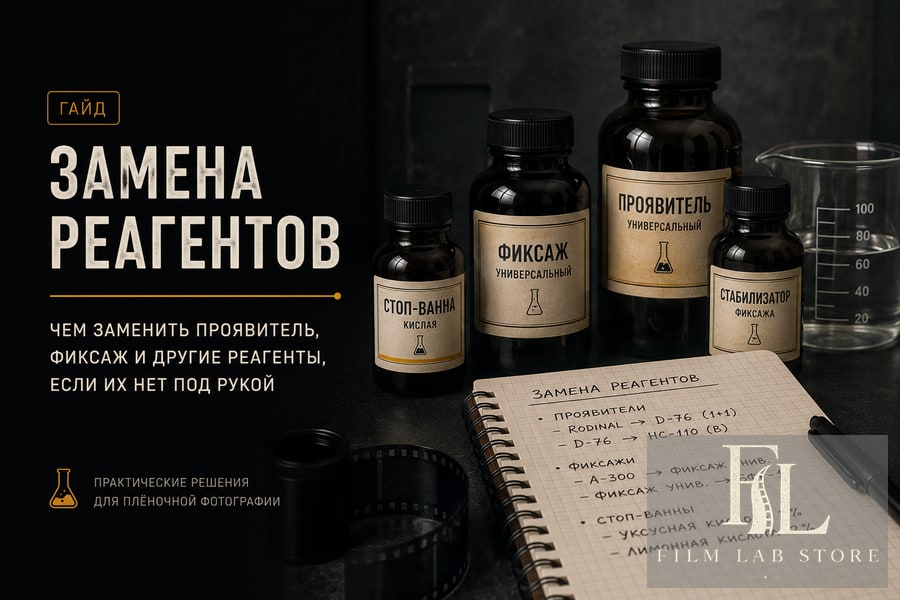
Interchangeability of reagents
What can and cannot be substituted in a developer formula—from the developing agent to the antifoggant.
Virtually any black-and-white developer consists of four types of substances: a developer (reducing agent), a fixer, an accelerator, and an anti-haze agent. The development process is based on the reduction of exposed silver halide to metallic silver—hence the name “reducing agent” for the developing agents. Below is a collection of reference coefficients and rules that allow you to properly substitute reagents in a formula without disrupting the developer’s balance.
Properties of Developing Agents
Every developing agent has six characteristics you should know before substituting it: molar mass (M); the mass corresponding to 0.05 moles of the substance—this is exactly how much reducing agent is contained in a “normal” developer; solubility in 1,000 mL of water at 15°C (P); optimal working amount per liter (O); action type (X: N — normal, E — vigorous, M — low-activity); and how the substance is used in the formulation (I: S — alone, S! — only alone, V — in combination with another reducing agent, V! — only in combination, B — both ways).
Method: M 344.24, mass per 0.05 mol — 17.2 g, solubility 48 g/L, optimum 6 g/L, normal behavior; used in combination with other reducing agents.
Hydroquinone: M 110.05, 5.5 g per 0.05 mol, solubility 58 g/L, optimum 6 g/L, normal behavior, used in combination.
Phenidone: M 165, low-activity; used exclusively in combination with another developer.
Phenidone B (Dimezone): It has the same type of effect as phenidone—it is low-potency and is used in combination with it.
Glycine “Photo”: M 167.08, 8.35 g per 0.05 mol, solubility approximately 2.3–1.7 g/L (data in sources are inconsistent), low activity, used in combination with other substances.
Amidol: M 197.01, 9.85 g per 0.05 mol, solubility 300 g/L, optimum concentration 4 g/L, highly reactive; used exclusively on its own.
Pyrocatechin: M 110.05, 5.5 g per 0.05 mol, optimum concentration 6 g/L, low activity, used alone.
Para-aminophenol (the base of Rodinal): M 145.45, 7.25 g per 0.05 mol, solubility 360 g/L, optimum concentration 5 g/L, low reactivity.
Pyrogallol: M 126.05, 6.3 g per 0.05 mol, optimum 5 g/L, normal behavior; used both on its own and in combination with other compounds.
Para-phenylenediamine: M 181.05, 9.05 g per 0.05 mol, low activity; used both on its own and in combination with other agents.
Molar formula of a “standard” developer
A developer that enhances a specific property of photographic material (such as light sensitivity, resolution, or contrast) has the following basic molar composition per 1 L of solution: developing agent — 0.05 mol; anhydrous sodium sulfite—0.2 mol; anhydrous sodium carbonate—0.2 mol; potassium bromide—0.04 mol. This ratio serves as a convenient starting point when you need to adjust the formula for a different set of reagents.
Replacement of Preservatives
Unlike the developing agent, the fixing agent (most often sodium sulfite) can be replaced with analogs—but the weight must be adjusted accordingly. The conversion factors per 1 g of substance are as follows: anhydrous sodium sulfite = 1; crystalline sodium sulfite = 2; potassium metabisulfite = 1.76; sodium bisulfite = 0.82. And conversely: 1 g of crystalline sodium sulfite corresponds to 0.5 g of anhydrous sodium sulfite, 0.56 g of potassium metabisulfite, and 1.21 g of sodium bisulfite. An important rule: if sodium sulfite is replaced with sodium bisulfite or potassium metabisulfite, the amount of alkali in the recipe must be increased by 50%, since these salts have an acidic reaction.
The standard amount of sodium sulfite required for normal preservation of the developing agent (per 1 g of reducing agent): amidole — 2.6 g; metol — 3 g; para-aminophenol — 4.1 g; hydroquinone — 4.6 g; pyrocatechol — 4.6 g.
Replacing Throttles
The most common catalysts are carbonates of alkali metals (soda ash, potash), caustic alkalis (caustic potash, caustic soda), as well as phosphates and borates. It is not possible to fully substitute carbonates for caustic alkalis even at equal molar concentrations—alkalis must be replaced with alkalis, and carbonates with carbonates.
Substitution coefficients (per 1 g of substance): caustic soda = 1.000; caustic potash = 0.714; ammonia = 0.834; anhydrous soda = 0.755; crystalline soda = 0.280; anhydrous potash = 0.580; crystalline potash = 0.460. That is, 1 g of caustic soda is equivalent to 1.4 g of caustic potash, 0.867 g of ammonia, 1.325 g of anhydrous soda, 3.575 g of crystalline soda, 1.725 g of anhydrous potash, or 2.174 g of crystalline potash.
Anhydrous soda, heptahydrate and decahydrate (crystalline) soda, and potash are also interchangeable: 1 g of anhydrous sodium carbonate is equivalent to 2.19 g of heptahydrate sodium carbonate, 2.70 g of decahydrate sodium carbonate, and 1.3 g of potassium carbonate.
If you need to substitute a caustic alkali for a carbonate salt (or vice versa), the calculation should be based not on the amount of alkali being replaced, but on the amount of developer in the formula—since that is what determines the required amount of accelerator.
Anti-fogging agents
An anti-fogging agent isn’t needed in every formula—it reduces fogging, but the required amount depends on both the developer’s activity and the emulsion’s tendency to fog (especially with high-speed films). The most common anti-haze agent is potassium bromide, but it may not be sufficient when working with expired materials or aggressive developers at elevated temperatures. A stronger alternative is benzotriazole (about 0.05 g per 1 L of developer) or potassium iodide.
Benzotriazole has a significant drawback: an excessive concentration sharply reduces the photosensitivity of the photographic material. The relationship is as follows (concentration in g/L → by how many times sensitivity decreases): 0 → 1; 0.05 → 1.1; 0.1 → 1.2; 0.2 → 1.7; 0.3 → 2.4; 0.4 → 4.1; 0.5 → 8.5. At a certain concentration, development ceases entirely—the threshold is specific to each photographic material, but it always exists.
Replacement of glacial acetic acid
Glacial (anhydrous) acetic acid, which is found in fixers and auxiliary solutions, is converted to weaker concentrations as follows: 1 volume of glacial acetic acid corresponds to 1.25 volumes of 80% solution, 2.5 volumes of 40% acetic acid, 3.6 volumes of 28% acetic acid, 12.5 volumes of 8% acetic acid, or 20 volumes of 5% acetic acid.