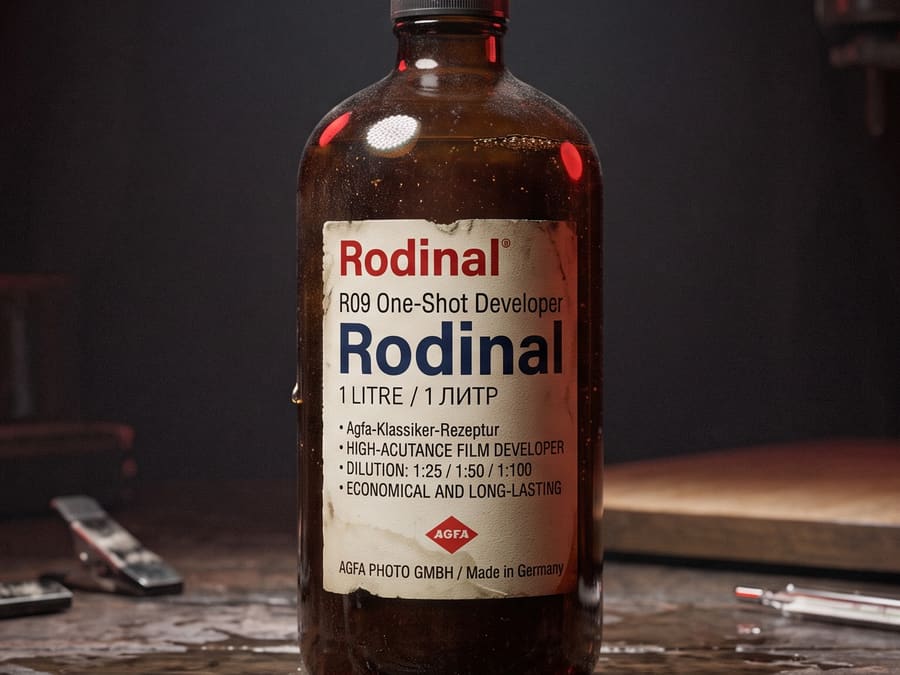
Rodinal (R09)
Maximum sharpness and a record-breaking shelf life for the concentrate.
About the Developer
Rodinal is one of the oldest developers in the world (since 1891): a p-aminophenol-based concentrate that is diluted immediately before development. p-Aminophenol has an extremely low fogging capacity, so the developer works without anti-fogging agents even on expired film and is suitable for hot climates. It produces pronounced sharpness and grain, rather than fine-grained smoothness—which is why it is prized for its characteristic “crisp” image. The concentrate retains almost all of its activity over the years: even a partially oxidized solution—the color of “strong tea”—practically does not alter its photographic properties.
Character
A highly stable concentrate with a sharp “acutance” character, pronounced grain, and high microcontrast. In terms of action, it is a sharpness-enhancing developer: the low concentration of the developing agent and alkali in the working solution enhances edge effects, resulting in increased edge sharpness on thin-layer modern emulsions. On highly sensitive, coarse-grained films, however, such developers actually accentuate the grain. It’s good for an artistic, textured, “vintage” look; not the best choice if you need the finest possible grain.
Best films
Ilford FP4+, Pan F+, ADOX CHS 100 II, Fomapan 100/200, Rollei Retro/RPX, ORWO/Svema — for a distinctive vintage look. Be careful with ISO 400 and higher if you don’t want coarse grain.
How to Use
- 1Measure out the required amount of concentrate—for example, 12 mL per 600 mL of water for a 1:50 dilution.
- 2Prepare the solution immediately before use—the working solution cannot be stored.
- 3Pour it into the tank at 20°C.
- 4Stimulation: continuously for the first minute, then 5–10 seconds every minute.
- 5Drain the developer, rinse, fix the film, and rinse it thoroughly.
Development times for different films
| Film | Breeding | Time @ 20°C |
|---|---|---|
| Ilford HP5+ 400 | 1:25 | 6–8 min |
| Ilford HP5+ 400 | 1:50 | 11 min |
| Kodak Tri-X 400 | 1:50 | ≈13 min |
| Kodak Tri-X 400 | 1:25 | ≈7 min |
Time is the starting point, according to film manufacturers. Dilution has a greater effect on contrast and grain than time: the weaker the dilution (for example, 1:10–1:20), the higher the contrast and the shorter the development time; the stronger the dilution (1:100–1:200), the softer the gradation—with a proportional increase in development time.
Pros
- One of the most stable concentrates—it can be stored for years with virtually no loss of potency
- Maximum sharpness and acutance with economical consumption (wide dilution range from 1:10 to 1:200)
- It does not require anti-fogging agents, even on expired film, due to p-aminophenol's low fogging potential
Cons
- Emphasizes grain on fast and coarse-grained films—not the best choice for a fine-grained result
- Do not store the working solution—dilute it only immediately before developing.
- The concentrate contains a caustic alkali accelerator—handle with care (protect your skin, especially your eyes)