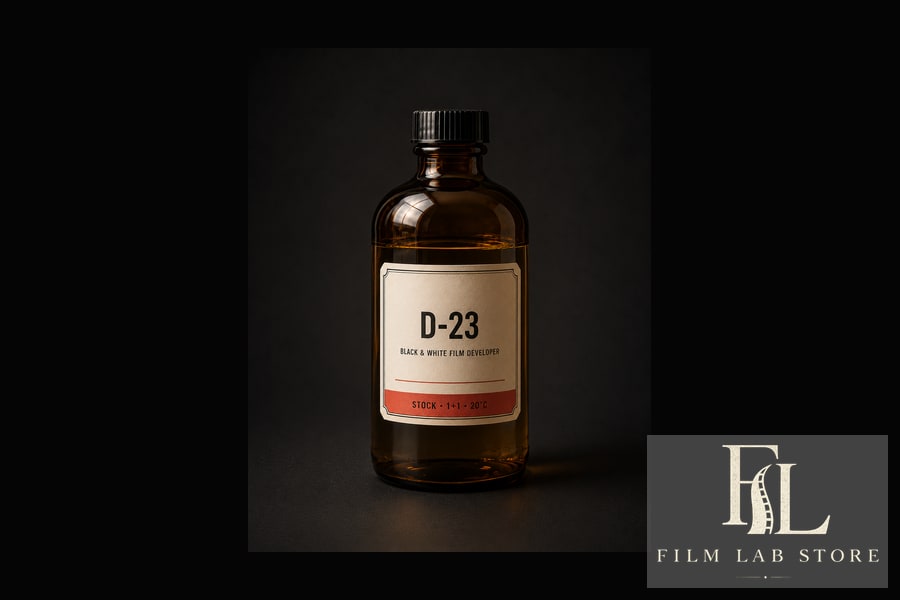
Kodak D-23
Just two ingredients—the simplest recipe for your first homemade blend.
About the Developer
D-23 was developed in 1944, and it is perhaps the simplest developer in the world: just metol and sodium sulfite, with no alkali. It produces soft, compensating contrast and very fine grain; it separates strong highlights well and allows for extended processing times without the risk of overdevelopment—Ansel Adams and Edward Weston used it. The slightly alkaline environment ensures excellent stability of the solution: its properties remain virtually unchanged during storage. This is an excellent first recipe to try when mixing your own developer from scratch.
Character
A very simple methyl sulfite developer. It is gentle, compensating, and provides good contrast control—it prevents the negative from being “overdeveloped” because the slightly alkaline medium (created solely by sodium sulfite, pH about 8.5) causes metol to act very gently. It is useful for older films and scenes with complex contrast; it can serve as a good basis for experimentation.
Best films
Old Svema/ORWO/Tasma, Ilford FP4+, HP5+, Fomapan 100/200/400, and Kentmere—films with high contrast and scenes with a wide range of brightness levels.
How to mix
- 1Heat ≈750 ml of water to 50°C.
- 2Add a pinch of sodium sulfite—this will protect the methyl from oxidation as it dissolves.
- 3Slowly add the metol, stirring until it is completely dissolved.
- 4Add the remaining sodium sulfite and stir until the solution becomes clear.
- 5Add water to make 1 liter, then let it cool to 20°C.
- 6Let the solution sit for 24 hours before using it for the first time.
Development times for different films
| Film | Breeding | Time @ 20°C |
|---|---|---|
| Kodak Tri-X 400 | undiluted | 7:30 min |
| Kodak Tri-X 400 | 1:1 | 12–13 min |
| Kodak Tri-X 400 | 1:3 | 18–20 min |
| Ilford Delta 100 | undiluted | 7:00 min |
Time is the starting point. A 1:1 or 1:3 dilution increases grain sharpness due to the lower sulfite concentration. According to the formula specifications, the average development time for roll film using an undiluted solution is 18–20 minutes at 20°C; if the temperature deviates, the time is adjusted according to the manufacturer’s table (from 220% at 13°C to 50% at 27°C).
Pros
- Just two ingredients—the simplest first recipe for making your own mixture
- Soft, with balanced contrast; it preserves highlights exceptionally well and prevents the negative from being overexposed
- The solution has excellent shelf life thanks to its slightly alkaline environment—its properties remain virtually unchanged during storage
Cons
- Long development times (18–20 minutes undiluted) compared to more active developers
- Not the best choice if you're looking for pronounced sharpness or acutance—it offers a softer sound rather than a "sharp" sound
- Slightly increases the effective sensitivity of the film
Recipe for 1 liter
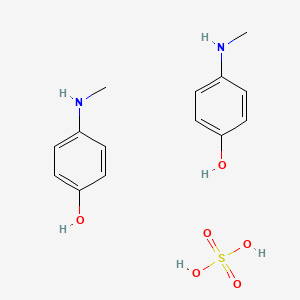
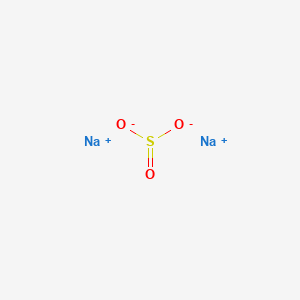
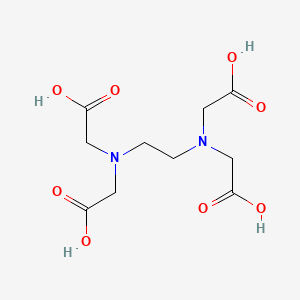
Chemical structures: PubChem (public domain)
Mixing it at home
Dissolve the methyl first (adding a pinch of sulfite to prevent oxidation), then the remaining sodium sulfite.
- 1Heat about 750 ml of distilled water to ~50 °C.
- 2Dissolve a pinch of sodium sulfite (about 1 g) — it protects the metol from oxidation.
- 3Dissolve the metol (7.5 g) completely.
- 4Dissolve the remaining sodium sulfite (100 g) and Trilon B, if you use it to soften the water.
- 5Top up with cold water to 1 litre and cool to 20 °C.
Key points
- As with D-76, the metol goes in before the bulk of the sulfite — it barely dissolves in a strong sulfite solution.
- D-23 is a soft, compensating developer: its mildly alkaline environment (created by the sulfite alone) keeps highlights from over-developing, so it copes well with high-contrast scenes.
- The more you dilute it (1:1, 1:3), the stronger the compensating effect — and the longer the development time.
Recipe variants
Two-bath (divided) D-23 — maximum compensation
The same D-23 split into two baths: the film first soaks up the developing agent in the D-23 solution, then development finishes in an alkaline bath. Highlights barely build up — ideal for scenes with a wide brightness range.
| Bath B: borax (or Kodalk) | 10 g |
| Water | to 1 L |
How to use: Bath A (the D-23 solution) — 3–4 min with gentle agitation; bath B (alkaline) — 3–4 min with almost no agitation. Do not rinse the film between baths.
- Keep agitation to a minimum in the second bath — it is the still layer of solution at the emulsion that creates the compensation in the highlights.
- The overall time depends little on the film, which makes it easy to work out a routine for unfamiliar materials.