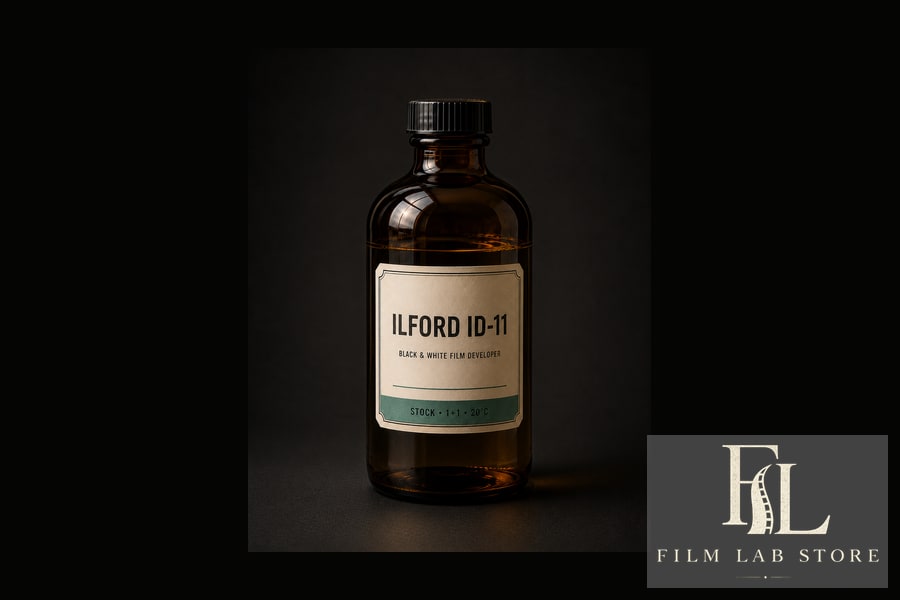
Ilford ID-11
A classic MQ powder developer that is virtually indistinguishable from Kodak D-76 in terms of composition and results.
About the Developer
ID-11 is a powder developer based on a combination of metol and hydroquinone, which Ilford markets as a direct equivalent to Kodak D-76: the same chemistry, the same soft, even tone, and predictable grain. It comes in two packets (Part A and Part B) and in 1, 2.5, 5, 10, and 13.5-liter containers. In the lab, it is used as a stock solution without dilution and with a replenisher; for a home tank, the stock solution is diluted 1+1 or 1+3 and used as a one-shot solution.
Character
Essentially the same as D-76 in terms of philosophy and results. Versatile, gentle, and predictable. If you have D-76, this one is usually not necessary.
Best films
Ilford FP4+, HP5+, Delta 100/400, Pan F+, Kodak Tri-X, T-Max, Kentmere, Fomapan, ADOX CHS 100 II.
How to Prepare and Use
- 1Dissolve the powder from Part A (the smaller packet) in about three-quarters of the volume of warm water (about 40°C), stirring as you go.
- 2Gradually add the powder from Part B, continuing to stir until it is completely dissolved—a few granules may remain, which is normal.
- 3Add cold water until the total volume reaches the amount specified on the package, and let the solution cool to 20°C.
- 4For a laboratory tank, use the waste solution undiluted. For a home developing tank, dilute the waste solution 1+1 or 1+3 immediately before use—this is a single-use procedure.
- 5Develop at 20°C (acceptable range: 20–24°C). Agitation: invert the tank several times during the first few seconds, then for 5–10 seconds every minute.
- 6Drain the developer, process the film in the stop bath, fix it, and rinse it thoroughly.
Development times for different films
| Film | Breeding | Time @ 20°C |
|---|---|---|
| Ilford HP5+ 400 | stock | 7 min 30 sec |
| Ilford HP5+ 400 | 1+1 | 13 min |
| Ilford FP4+ 125 | stock | 8 min 30 sec |
| Ilford FP4+ 125 | 1+1 | 11 min |
Development times — official Ilford data for lab processing at 20°C; 1+1 times — from independent tables for home processing based on the same formula. Adjust these times according to your film and agitation method.
Pros
- A predictable, well-documented result—almost the gold standard for a universal developer
- Cost-effective when used undiluted in a large tank or laboratory
- Unopened powder has a virtually unlimited shelf life
Cons
- You need to mix the powder, not just measure out the ready-to-use liquid concentrate
- When mixing a 1+1 or 1+3 solution, the solution is a single-use batch—there is no volume savings
- The flow rate decreases after each batch of film, so the time must be recalculated