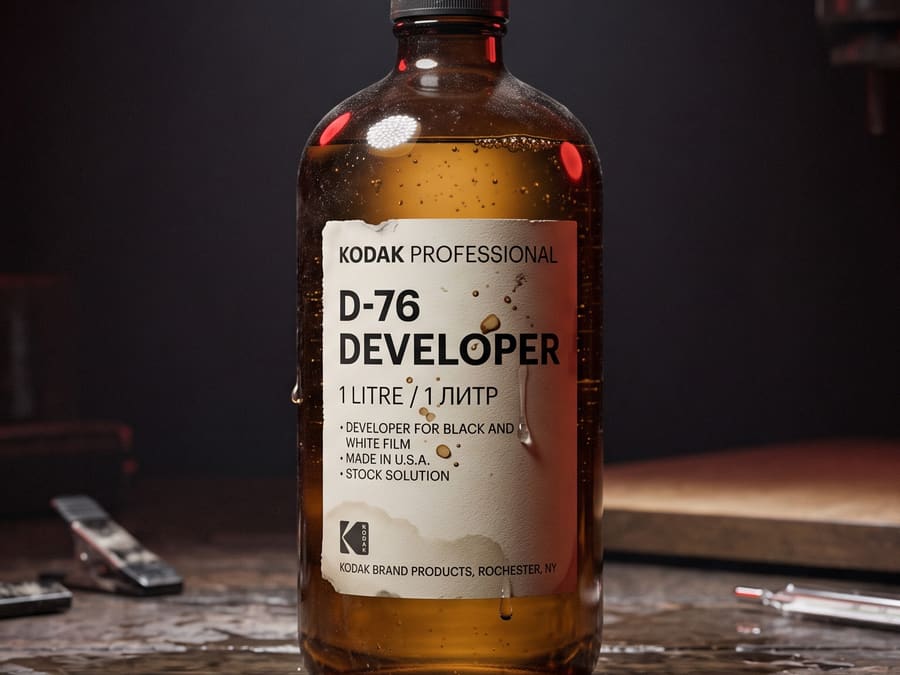
Kodak D-76
A standard proven over decades for soft, smooth halftones.
About the Developer
D-76 is the most recognizable black-and-white developer in history: the combination of metol and hydroquinone produces smooth tonal transitions and predictable results. This formula has been used in photography for over 50 years; it slightly increases light sensitivity and brings out detail in the shadows while reducing the contrast of the negative. It is sold as a ready-to-use powder (Kodak D-76 or Ilford ID-11, which has an identical composition)—for most beginners, it’s easier to buy a packet than to mix it from scratch.
Character
A classic, all-purpose powder developer. It produces balanced grain, normal sharpness, good tonal range, and predictable contrast—an excellent “reference standard” for testing. It produces a softer, smoother image at stock strength, and is slightly sharper at dilutions of 1+1 and 1+3, though the grain is more noticeable.
Best films
Kodak Tri-X 400, Kodak T-Max 100/400, Ilford FP4+, HP5+, Delta 100/400, Kentmere 100/400, Fomapan 100/200/400, Svema/ORWO — as a baseline control option.
How to Use
- 1Dissolve the D-76 powder in water at ≈50°C and bring the volume to 1 liter.
- 2Let the solution settle and cool to 20°C.
- 3Mix it 1:1 with water to make a working solution (or use it undiluted for a gentler result).
- 4Pour it into the tank and develop at 20°C.
- 5Campaign: continuously for the first 30 seconds, then 5–10 seconds every minute.
- 6Drain the developer, rinse, fix the film, and rinse it thoroughly.
Development times for different films
| Film | Breeding | Time @ 20°C |
|---|---|---|
| Kodak Tri-X 400 | undiluted | 6¾ min |
| Kodak Tri-X 400 | 1:1 | 10 min |
| Ilford HP5+ 400 | 1:1 | ≈10–11 min |
| Kodak Tmax 100/400 | 1:1 | ≈9–10 min |
Time is the starting point. The first developed film will indicate whether you need to adjust the time to suit your equipment and agitation. The average development time for roll film according to the formula specifications is 14–20 minutes at 20°C; if the temperature deviates from 20°C, the time is recalculated according to the manufacturer’s table (from 200% at 12°C to 70% at 24°C).
Pros
- A predictable result, proven over decades—a convenient benchmark for comparing other developers
- Balanced grain and good tonal range without any abrupt compensation effects
- It is widely available as a ready-to-use powder (Kodak D-76, Ilford ID-11)
Cons
- Not the sharpest or the finest-grained option—it falls short of specialized developers at both extremes
- The 1:1 working solution cannot be stored—use it on the day it is prepared.
- Longer preparation time for the powder compared to ready-to-use liquid concentrates
The classic formula (for reference)
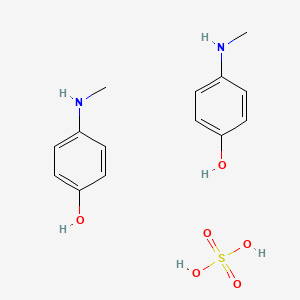
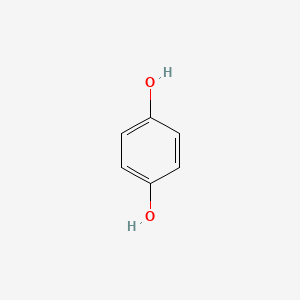
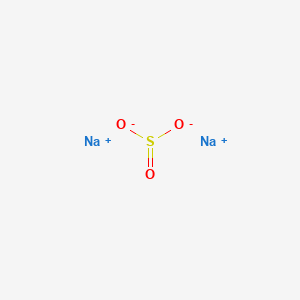
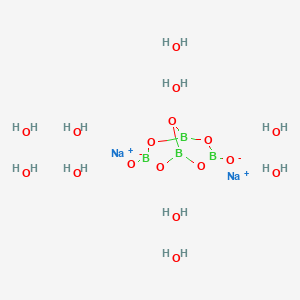
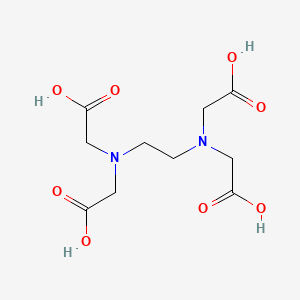
Chemical structures: PubChem (public domain)
Mixing it at home
Most photographers buy the ready-made Kodak D-76 powder (or the identically formulated Ilford ID-11) rather than mixing it themselves. But compounding it from separate chemicals is not hard — order matters: metol barely dissolves in a strong sulfite solution, so it goes in before the bulk of the sulfite.
- 1Heat about 750 ml of distilled water to 45–50 °C.
- 2Dissolve a small pinch of sodium sulfite (about 1 g) — it protects the metol from oxidation.
- 3Dissolve the metol completely.
- 4Dissolve the remaining sodium sulfite (about 100 g).
- 5Dissolve the hydroquinone, then the borax (and Trilon B, if you use it as a water softener).
- 6Top up with cold water to 1 litre and cool the solution to 20 °C.
- 7Let it settle for 2–3 hours and filter it through cotton wool before use.
Key points
- Metol barely dissolves in a strong sulfite solution — so a pinch of sulfite goes in before the metol and the bulk after.
- Keep the water at 45–50 °C: any hotter and the developing agents oxidise quickly.
- The working temperature of the finished developer is 20 °C. Use D-76 undiluted for a soft negative, or 1:1 for a sharper one.
Recipe variants
D-76d — buffered modification (low contrast)
A version of D-76 for when you need low contrast. The borax + boric acid pair acts as a buffer that keeps the alkalinity stable, giving more uniform results in long development than a heavily diluted plain D-76.
| Water (52 °C) | 750 ml |
| Metol | 2 g |
| Sodium sulfite (anhydrous) | 100 g |
| Hydroquinone | 5 g |
| Sodium tetraborate (borax), cryst. | 8 g |
| Boric acid, cryst. | 8 g |
| Water | to 1 L |
How to use: Used undiluted. Development time is 10–25 min at 18 °C, depending on the contrast you want.
- Use crystalline boric acid specifically — the anhydrous form dissolves poorly.
- At a borax-to-boric-acid ratio of 8:8 the development speed is about the same as plain D-76. Shifting the ratio (less borax and proportionally more acid — slower and softer, and vice versa) tunes the contrast.
- The buffer also works on its own: over long storage the alkali released by oxidation is neutralised by the acid, keeping activity stable.
- A freshly mixed batch can fog slightly — add 0.25 g/L of potassium bromide.
- It uses more developer per roll than plain D-76.
- The recipe was described by J. Crabtree (1938); V. P. Mikulin (1974) noted that at 8:8 the speed can be 25–50 % lower than D-76 — probably for the films of that era.