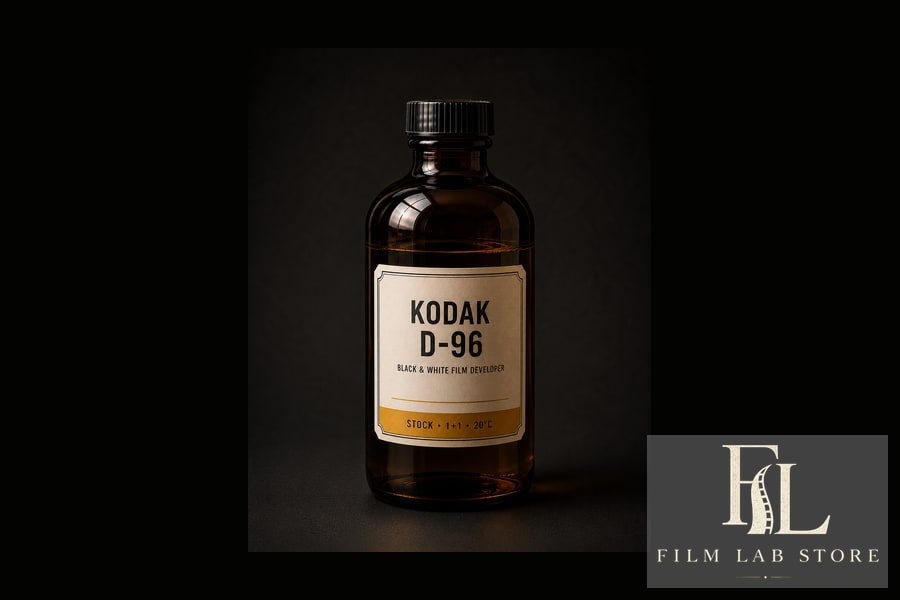
Kodak D-96
A standard film developer for black-and-white cinematographic negatives—it produces a soft, even, “cinematic” tone.
About the Developer
D-96 is Kodak’s proprietary developer for black-and-white motion picture negative film (e.g., Eastman Double-X 5222/7222): In continuous machine processing, the film is developed to a density of 0.65–0.70 in approximately 7 minutes at 21°C. Amateur photographers use D-96 in a standard photo tank for the same cinematographic films and their equivalents (Fomapan, ORWO). Films with a remgelatin (anti-halo) backing, such as Double-X, require the backing to be removed before or during development: in machine processing, this is done by spray nozzles; in a home developing tank, the backing is usually washed off separately before the developer is added.
Character
Film developer for black-and-white motion picture negative. Produces a soft, "cinematic," even negative with good tonal range.
Best films
Kodak Double-X 5222/7222, ORWO UN54/N75, Fomapan, Svema/ORWO film stocks, soft cinematic look.
How to Prepare and Use
- 1Dilute the developer according to the instructions on the package to make a working solution (the solution ready for use without further dilution).
- 2If you are developing film with a gelatin-coated backing (such as Double-X), remove it in a separate step before pouring in the developer.
- 3Develop at 20–21°C, using standard tank inversion agitation: continuously for the first 30 seconds, then for 5–10 seconds every minute.
- 4Drain the developer, process the film in the stop bath, fix it, and rinse it thoroughly.
Development times for different films
| Film | Breeding | Time @ 20°C |
|---|---|---|
| Kodak Double-X 5222/7222, ISO 200 | stock | 6 min |
| Kodak Double-X 5222/7222, ISO 400 (pushed) | stock | 8 min |
| Fomapan 400 | stock | 8 min |
Development times for a small tank at 20°C—based on data from CineStill D96 (the modern equivalent of the D-96 formula) and film manufacturers. Kodak’s official technical specifications list approximately 7 minutes at 21°C for machine continuous development of Double-X—use both values as a guide and adjust them for your specific tank.
Pros
- Original formula for film stock with a remgelatin (antigalo) base
- A soft, "cinematic" tone without harsh highlights
- Compatible with modern films such as Fomapan and ORWO
Cons
- Little known outside the film industry—it's harder to find reliable data on handheld cameras
- Originally designed for continuous machine development, rather than manual agitation
- Films with a gelatin-based backing require a separate step to remove the backing before the developer