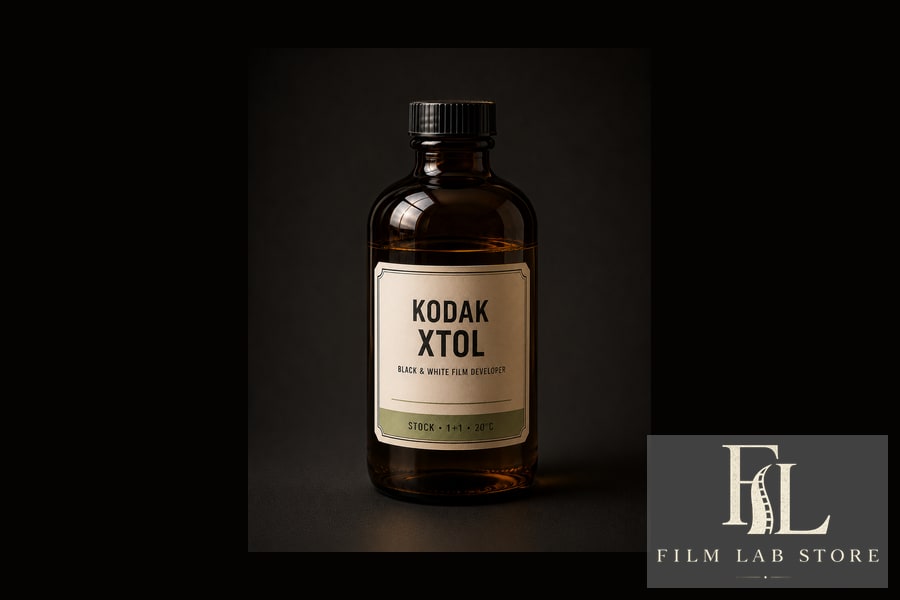
Kodak XTOL
Kodak's proprietary XTOL powder—not to be confused with the homemade X-TOL and AKFF clones on this site.
About the Developer
This is the product page for Kodak XTOL, a two-component (Part A and Part B) store-brand powder developer that does not contain hydroquinone: its active ingredient is ascorbic acid, which is why this developer is considered more environmentally friendly and less toxic than classic MQ-based formulations. The website separately describes homemade clone recipes that do not use Kodak—X-TOL and ascorbate-phenidone AKFF; these are different products, but their chemistry is similar in principle.
Character
A modern ascorbic acid-based powder developer. It maintains sensitivity well and produces fine grain, good detail, and a wide tonal range. One of the best all-purpose developers for scanning.
Best films
Kodak T-Max 100/400, Tri-X, Ilford Delta 100/400/3200, HP5+, FP4+, Kentmere 100/400, Fomapan 100/200/400.
How to Prepare and Use
- 1Pour approximately 75% of the total volume of warm water (18–30°C) into the mixing container.
- 2While stirring, slowly add Part A and continue stirring until it is completely dissolved—the solution may turn a yellowish-copper color, which is normal.
- 3While continuing to stir, add Part B; the coppery tint will disappear once the powder has completely dissolved.
- 4Add water to reach the final volume (2, 5, 25, or 50 liters, as indicated on the package) and stir until smooth.
- 5Use undiluted for repeated (replenishable) processing, or dilute 1+1 for a one-shot treatment with slightly finer grain and sharper definition—use the 1+1 solution immediately and do not store it.
- 6Develop at 20°C, drain, fix the film, and rinse.
Development times for different films
| Film | Breeding | Time @ 20°C |
|---|---|---|
| Kodak Tri-X 400 | stock | 7 min |
| Kodak Tri-X 400 | 1+1 | 9 min |
| Kodak T-Max 400 | stock | 6 min 30 sec |
| Kodak T-Max 400 | 1+1 | 9 min 15 sec |
Official Kodak technical specifications: small tank, agitation every 30 seconds, 20°C. Adjust according to your film and agitation settings.
Pros
- Does not contain hydroquinone—it is more environmentally friendly and less toxic than traditional MQ developers
- Fine grain and high sharpness at the same time, with a wide tonal range
- It maintains the film's sensitivity well during the push process
Cons
- Sensitive to hard water—may become cloudy when mixed
- A 1+1 solution cannot be stored—it is strictly for one-time use only
- It is important to follow the mixing order: first Part A, then Part B