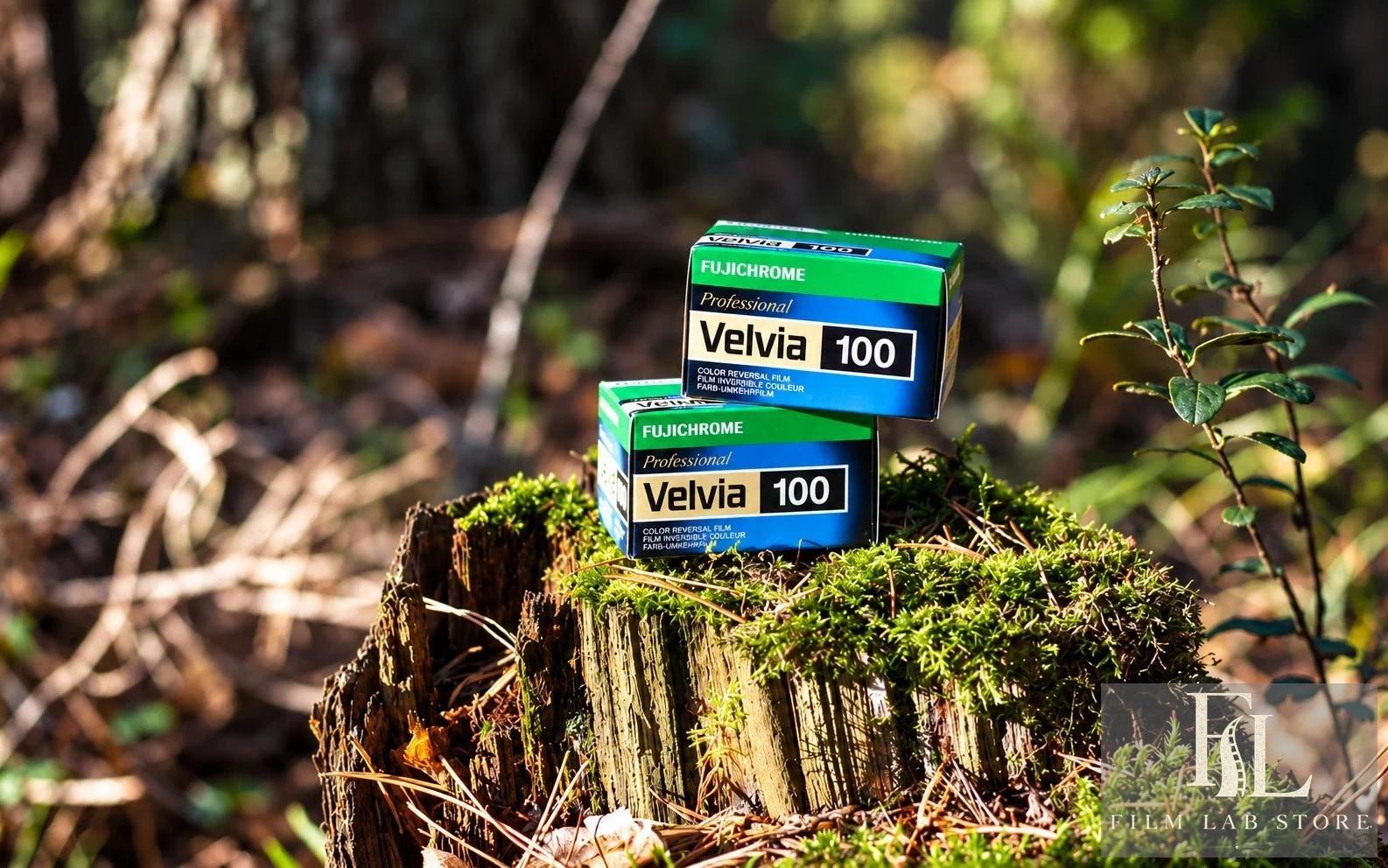
Where Velvia came from, why Velvia 50 vanished and came back, how Velvia 100 differs, why the film is so hard to buy right now, and my own Velvia 50 frames from Kyiv.
Some films are loved for natural color. Some forgive exposure mistakes or render skin beautifully.
Velvia is not one of them.
Greens turn emerald, the sky goes deep blue, a sunset becomes almost orange fire. You can barely see the grain. Nobody would call it neutral, and I think that's the whole point: the character is why people fell for it.
Velvia 50 and Velvia 100 are among my favorite films. What I like is that the slide holds less of what was in front of the camera and more of how I remember it.
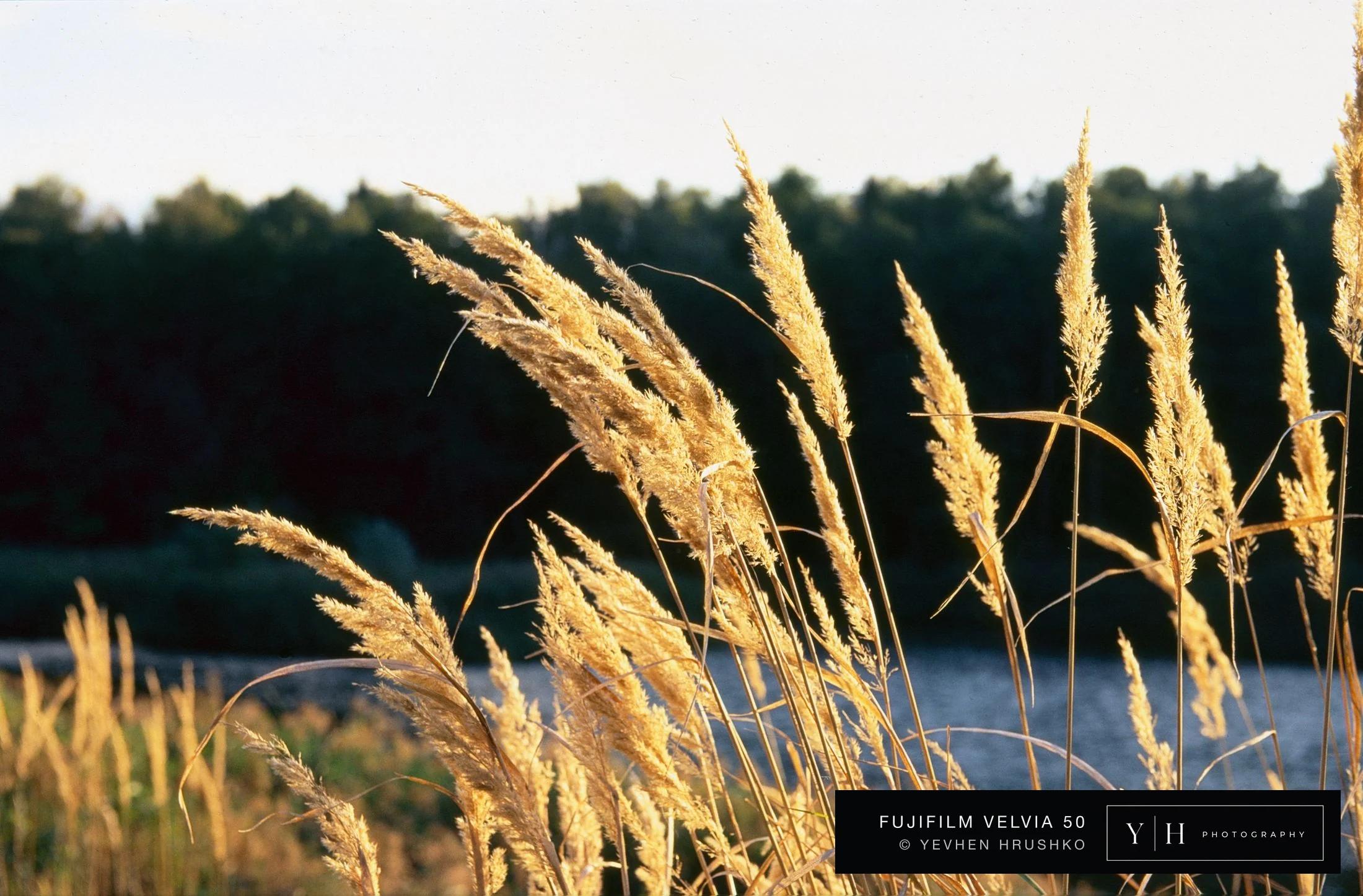
Below: where it came from, why it was discontinued and brought back, and why a fresh roll now costs real money. A few of my frames come first; the rest are at the end.
1990: Fujichrome Velvia arrives
Fujifilm released Fujichrome Velvia (code RVP) in 1990. It was a professional ISO 50 color reversal film for people who needed sharpness, detail, and rich color.
Before digital, color slide was a working material: it went to magazines, advertising, books and exhibitions. You processed the film in E-6 and held a finished positive in your hand, no print or scanner needed.
Velvia gave slides a different color. Deep greens, bright reds and oranges at sunset, clean dense blues, and very fine grain. Photographers who shot mountains, forests, the ocean and wildlife adopted it quickly, and before long "Velvia color" became a term of its own in landscape photography.
Velvia's secret: colors as we remember them
Velvia is often explained as memory colors (Memorized Color). Fujifilm's own description is more modest: Velvia's color emphasizes reds and greens. But I prefer the memory-color idea, because it explains why these frames hit so hard.
The point is that we don't remember colors as they really were. A sunset in memory is brighter than it was, grass in the mountains greener, the sky bluer. Velvia lands on that memory rather than on a neutral "truth". That's why you recognize a Velvia frame straight away.
All of that comes from the emulsion and E-6 processing, with no filters added afterward.
Why landscape photographers love it
Color first, of course, especially greens and reds. Forest, meadow, autumn leaves, flowers and a sunset sky look more alive on the slide than in real life.
The grain is very fine. On a good frame, you can make out single branches, the texture of stone, blades of grass on a distant slope.
Contrast is high, which cuts both ways. Deep shadows, dense color, real depth. But in a scene with a wide brightness range, it's easy to lose detail in the shadows or highlights.
And then there's the slide itself. A well-exposed transparency on a light table or on a projector screen looks nothing like a file on a monitor.
Velvia works best in soft natural light: morning, before sunset, after rain, in an autumn forest, in the mountains. For natural skin portraits or scenes with a huge brightness range, I'd pick another film. But for nature's color, very little else comes close.
Fujifilm Velvia 100
The first Velvia's main limitation was ISO 50. On a tripod, that's fine; handheld, on an overcast day, or at dusk, you want something faster.
In 2003 Fujifilm introduced Velvia 100F, followed by Velvia 100, first in Japan. Velvia 100 launched more widely in the US and Europe in 2005.
Don't mix them up: 100F was made for accurate color, while regular Velvia 100 continued the original's bright, saturated line. It has ISO 100, very fine grain, and even richer color. Fujifilm's Japanese catalog rates its saturation one step above Velvia 50, especially in reds and greens.
So Velvia 100 is not just Velvia 50 plus one stop. It has its own character.
How Velvia 50 vanished and came back
In 2005, Fujifilm stopped making the original Velvia 50 because it could no longer source some emulsion components.
Velvia 100 already existed, but plenty of people felt it was a different film and couldn't replace the old one. Fujifilm received many letters asking for Velvia 50 back. Its engineers found substitutes for the missing components and reworked production.
In November 2006, Fujifilm announced the film's return, and in 2007 Velvia 50 was back on sale as RVP50. It isn't the same emulsion as in 1990, but according to Fujifilm,m its characteristics are almost identical to the original.
I like this story: photographers asked, and the manufacturer actually brought the film back. That doesn't happen often.
Velvia 50 or Velvia 100: which one?
Both are daylight films, processed in E-6, and both are contrasty, fine-grained, and rich. The difference is in the details.
Feature | Velvia 50 | Velvia 100 |
|---|---|---|
Speed | ISO 50 | ISO 100 |
Colour | The classic Velvia palette | Reds and greens even more saturated |
RMS granularity | 9 | 8 |
Contrast | High | High |
Long exposures (with corrections) | Up to 32 seconds; longer not recommended | Up to about 8 minutes |
Process | E-6 | E-6 |
Formats | 135, 120 | 135, 120 |
RMS is measured granularity: the lower the number, the finer the grain. Here Velvia 100 even comes out slightly ahead.
Velvia 100 also handles long exposures much better, which helps with water, dusk, and clouds through an ND filter. Exposure and color corrections are in the data sheets: Velvia 50 (PDF) and Velvia 100 (PDF).
If you want the classic Velvia, I'd start with Velvia 50. It's a film for slow work on a tripod, when you have time to wait for the light.
Velvia 100 gives you an extra stop, which makes it easier when traveling, shooting handheld, or when the light changes fast.
But you won't understand a film's character from a table. It's easier to shoot a roll of each and compare the slides.
Why Velvia is so expensive and hard to find
Professional slide film used to be a consumable. Now a few rolls of Velvia are a noticeable expense. There are several reasons.
1. Raw materials
2005 wasn't the last time. In March 2023, Fujifilm temporarily stopped taking new orders in Japan for some films, including Velvia 50 and Velvia 100 in 135 and 120. The reason was the same: not enough raw materials.
Orders reopened on 12 June 2023, but that didn't make fresh film appear overnight.
2. Manufacturer prices
In June 2023, Fujifilm raised its shipment prices for photographic film by roughly 13–88% depending on the product. On 1 April 2025, Japan saw another increase: 135 and 120 reversal film went up by about 31–52%.
That doesn't mean every roll of Velvia in a shop went up by exactly that much. But the scale is clear. Fujifilm put it down to raw materials, components, and shipping getting more expensive faster than it could save money elsewhere.
3. Slide became a niche
Far less film is sold now than thirty years ago, and slide film least of all. Not every lab runs E-6, and a multilayercolorr emulsion is complex to make. Small batches and unreliable logistics add to the price.
4. Velvia 100 left the US
In 2021, the US Environmental Protection Agency (EPA) restricted the use of the chemical PIP (3:1). Velvia 100's emulsion contained less than 0.0003% of it, but the law is the law: on 6 July 2021, Fujifilm announced it was ending sales of Velvia 100 in the US. The decision only applied to the American market.
5. Supply
As of autumn 2026, Velvia 50 and Velvia 100 are still in Fujifilm's Japanese catalog, so calling them discontinued is wrong.
But as someone who buys and sells film: right now Velvia is in severe shortage in Europe and America. Fresh batches arrive rarely and sell out almost immediately.
And a place in the catalog guarantees nothing anyway. Shops often have a few stray rolls left, are missing the format you want, or limit how many you can buy. Some formats are really gone: Fujifilm announced the end of Velvia 50 sheet film in 2021, also because of raw materials.
So "discontinued", "temporarily out of stock" and "in the catalog but rarely delivered" are three different situations. Velvia is in the third one.
How to shoot Velvia
Before you load an expensive film into the camera, know a few things. I covered the basics in my guide on shooting film.
Shoot at box speed. ISO 50 for Velvia 50, ISO 100 for Velvia 100. Save exposure experiments for the second roll.
Meter carefully. Slide film forgives mistakes far less than negative. Especially overexposure: blown highlights can't be pulled back.
Bring a tripod. With Velvia 50 and a stopped-down lens, shutter speeds get long quickly.
Chase the light. Velvia likes soft mornings, golden hour, and the light after rain best.
Allow for long exposures. Reciprocity failure kicks in, and you'll need exposure corrections and color-correction filters.
Process in E-6. Velvia is a reversal film; C-41 won't give you slides. You can send me color slide film for E-6 development and scanning; details are on the film development and scanning page.
Keep it cool. Heat and humidity shift speed and color balance. More in my article on storing film.
One last tip: before scanning, look at the processed slides against the light. After that, nobody needs to explain why people love Velvia.
My Fujifilm Velvia 50: from golden sun to night-time Kyiv
Velvia is usually shown on mountains, valleys, the ocean, and rainforests. That's where its reputation comes from.
I have nothing exotic: trees, a lake, reeds, streets and Kyiv at night. Ordinary subjects, but that's exactly what I wanted this film to do.
When the sun turns to gold
My favorite time to shoot Velvia is the evening.
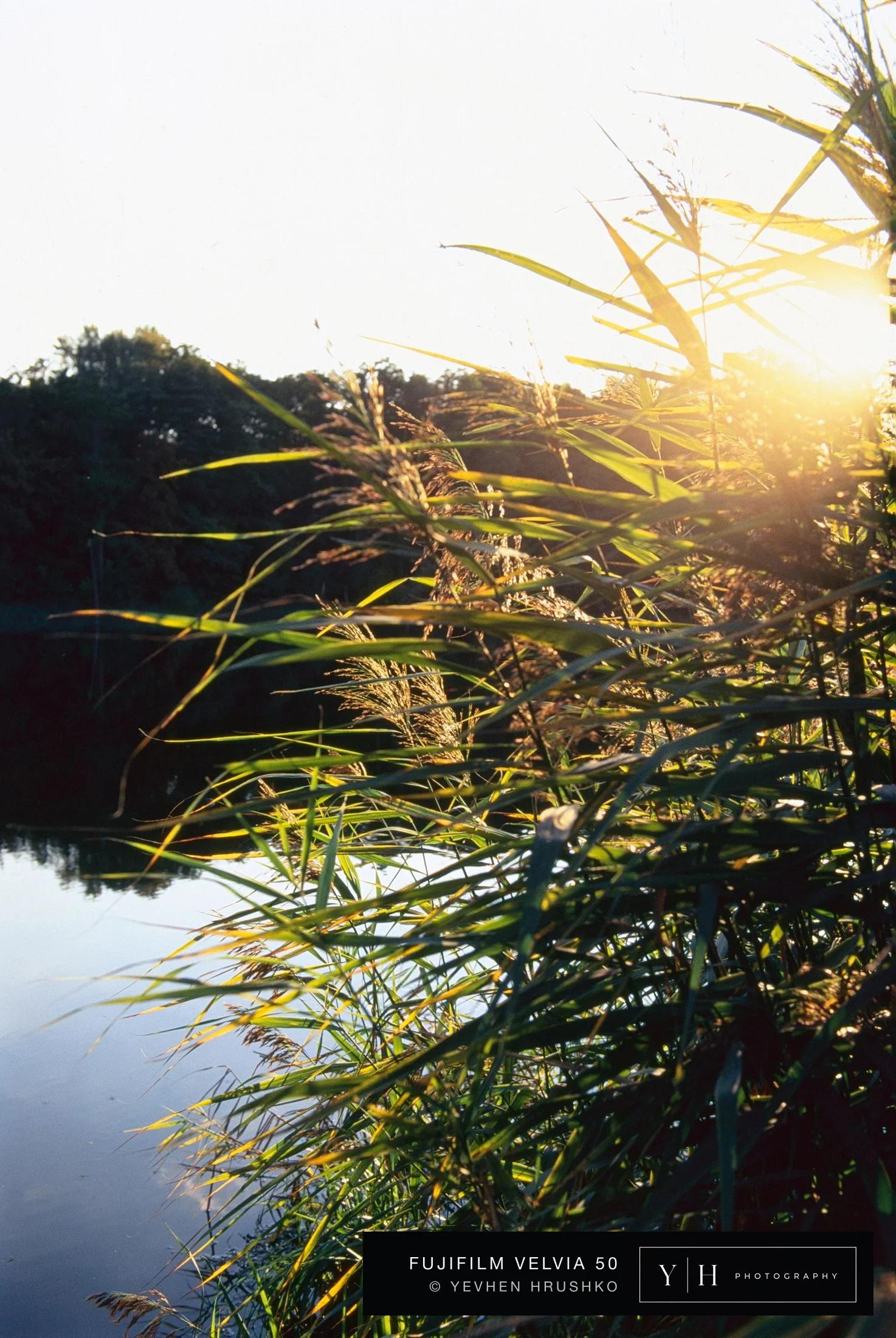
Like the frame at the top of this article: seed heads at sunset, with a dark green wall of trees behind them. The sun lights up every stalk. A frame like this shows what Velvia 50's contrast and color do to the simplest subject.
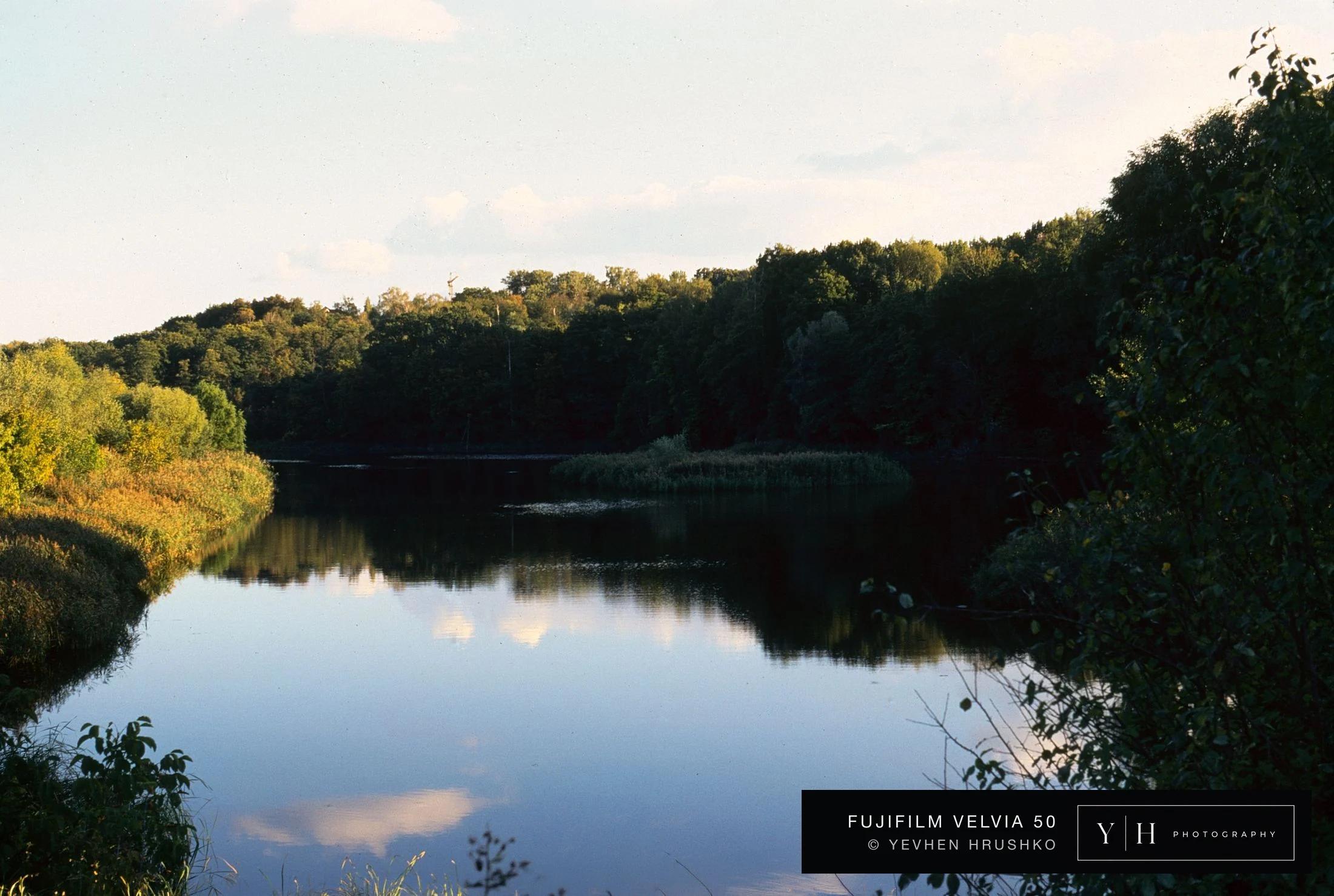
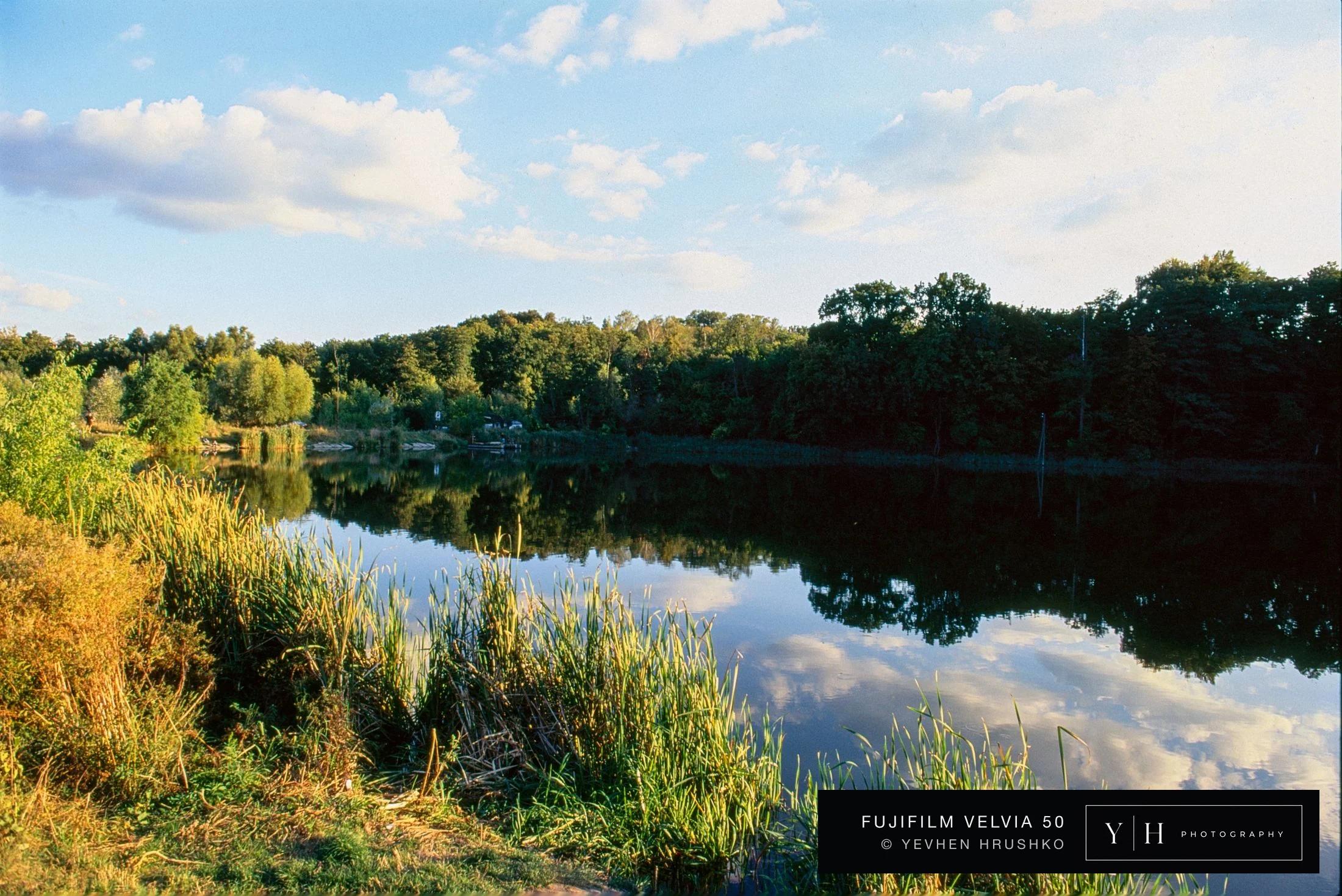
Then trees reflected in still water. Dark greens, the first yellow leaves, a blue sky.
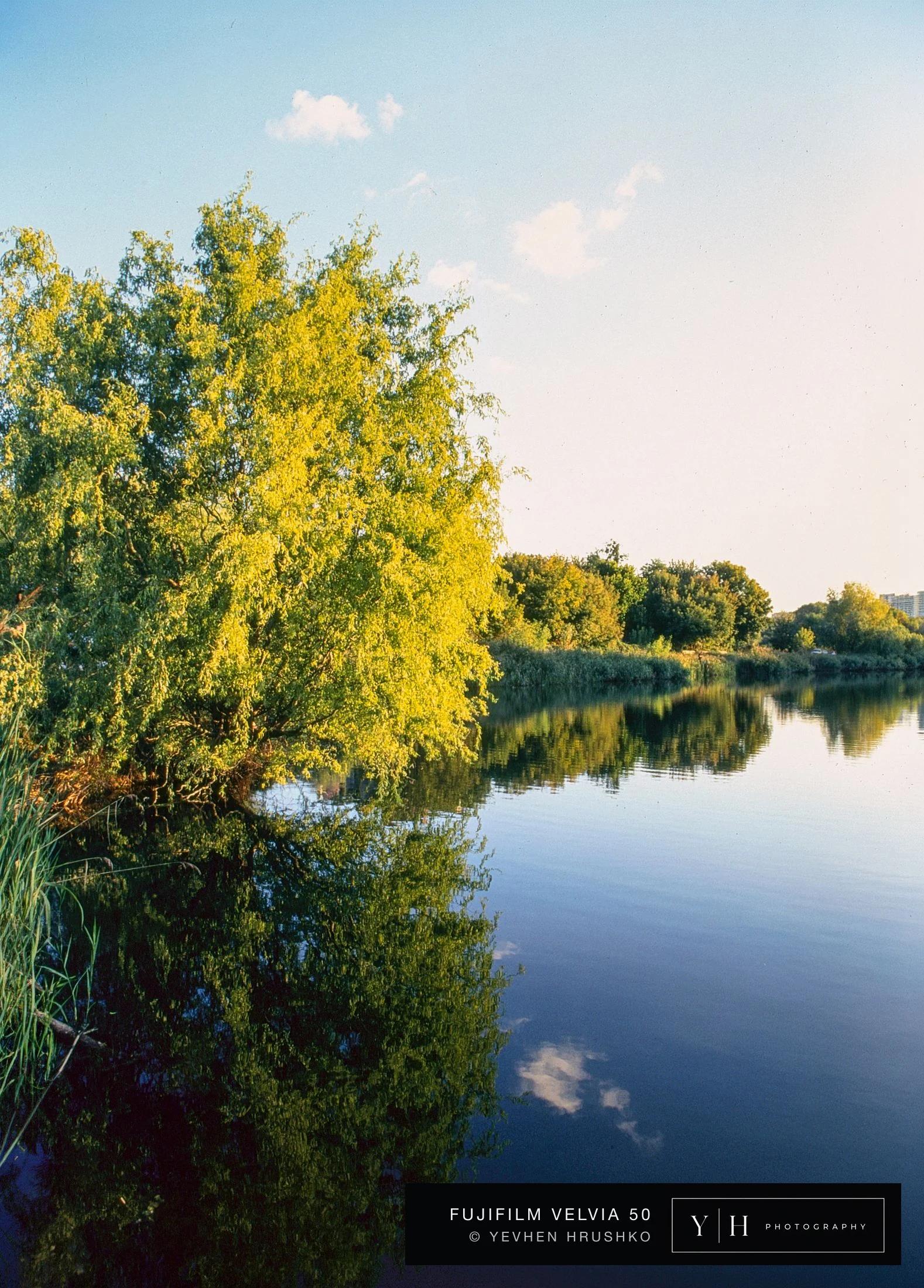
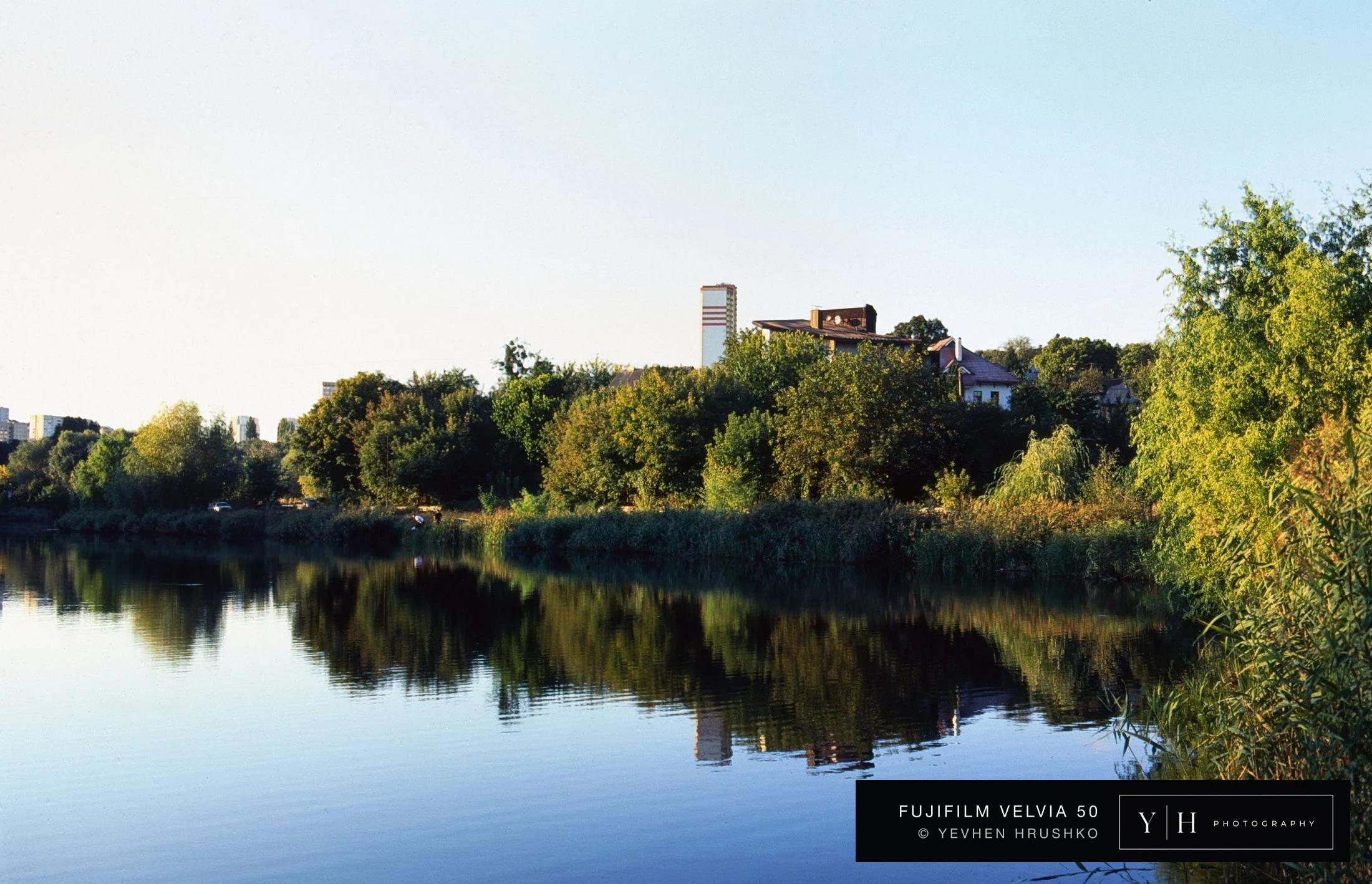
Velvia doesn't even try to be neutral. It adds something to what I saw, and after these frames I completely understand landscape photographers.
What about ISO 50 at night?
Velvia 50 at night is an odd idea: ISO 50, high contrast, long exposures you have to work out. But the night frames are probably my favorites.
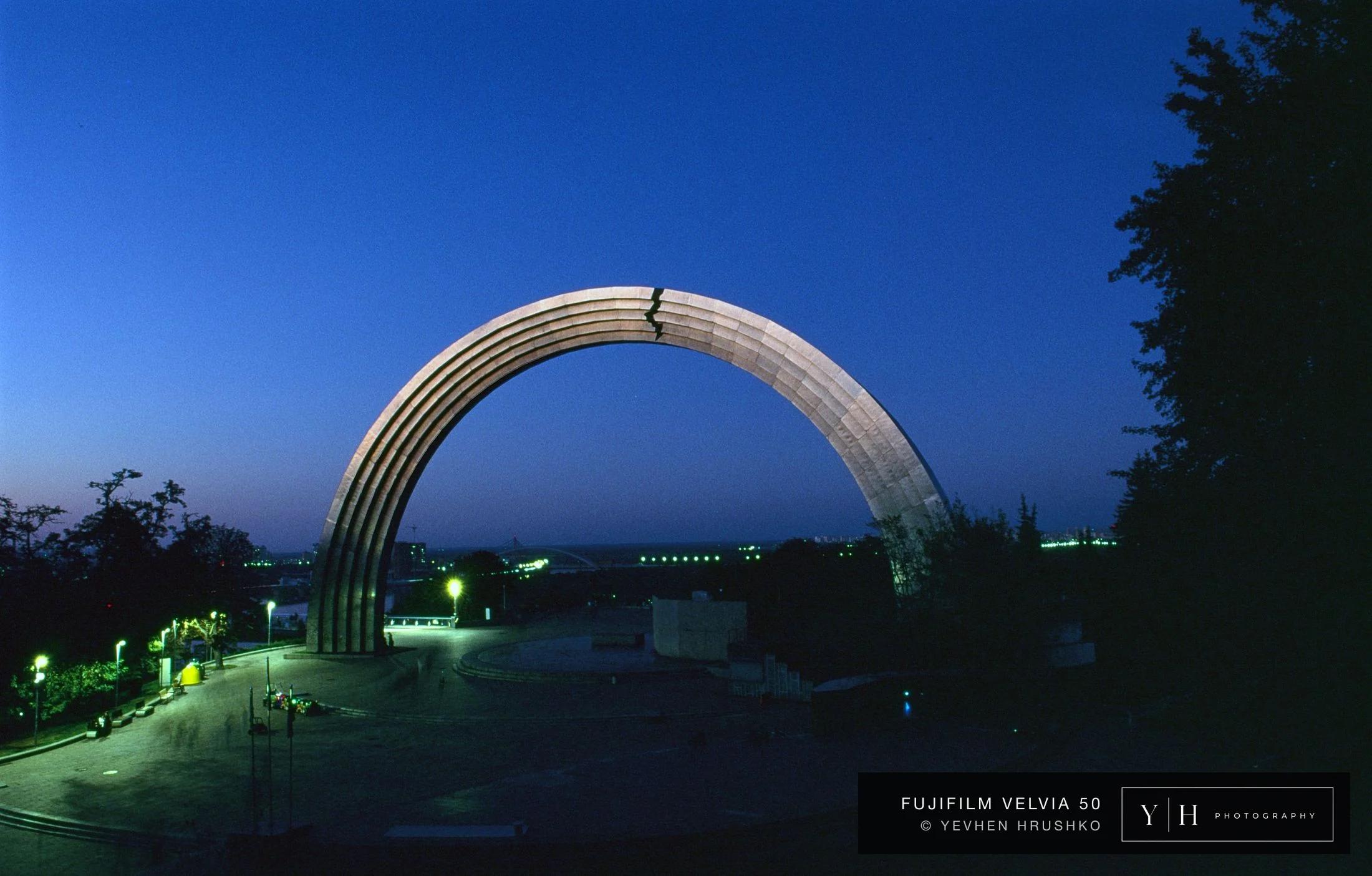
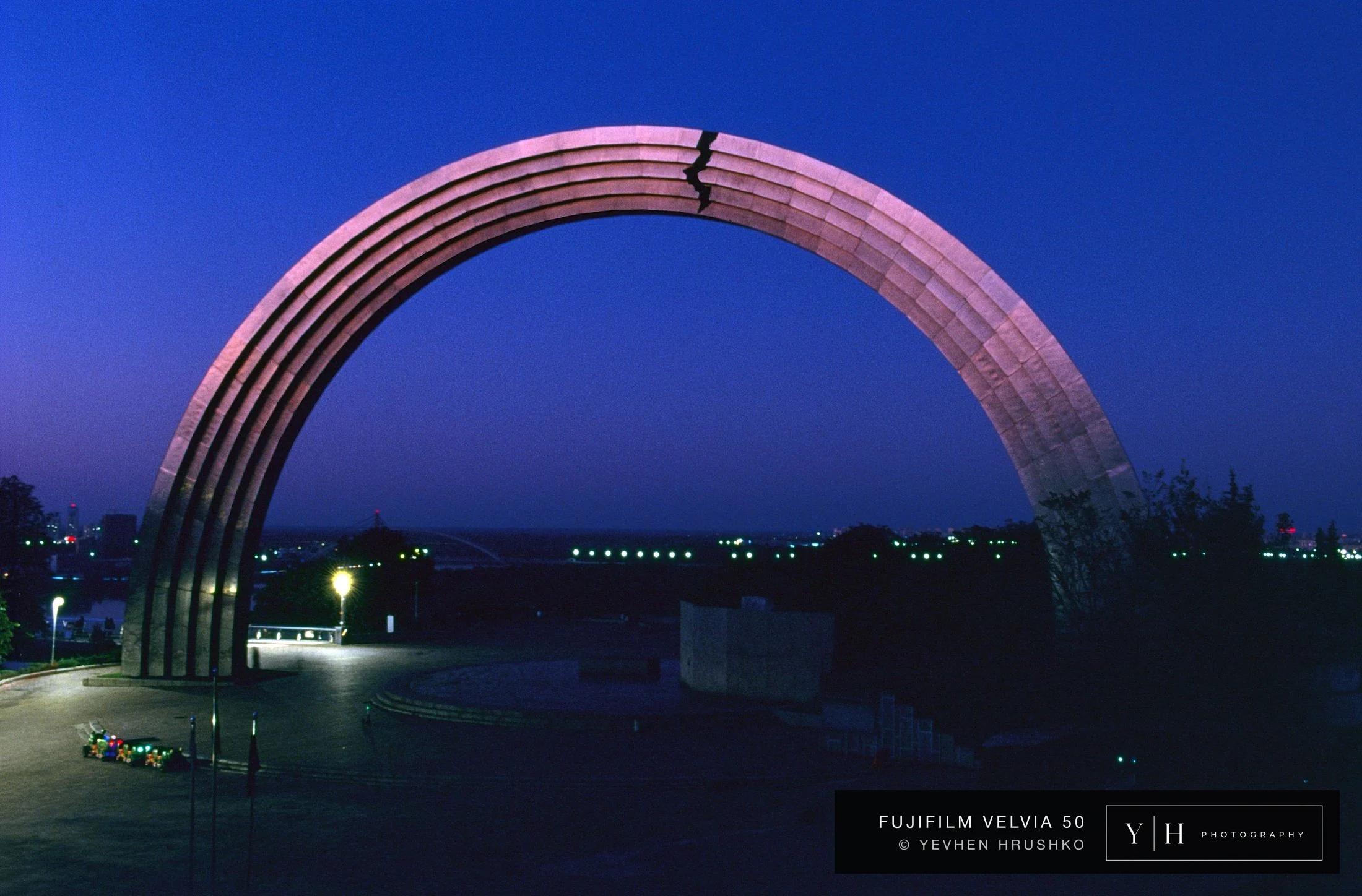
The People's Friendship Arch (now the Arch of Freedom of the Ukrainian People) against a dense blue sky. Below it, cold city lights, lit stairs and paths, trees almost dissolved into the dark.
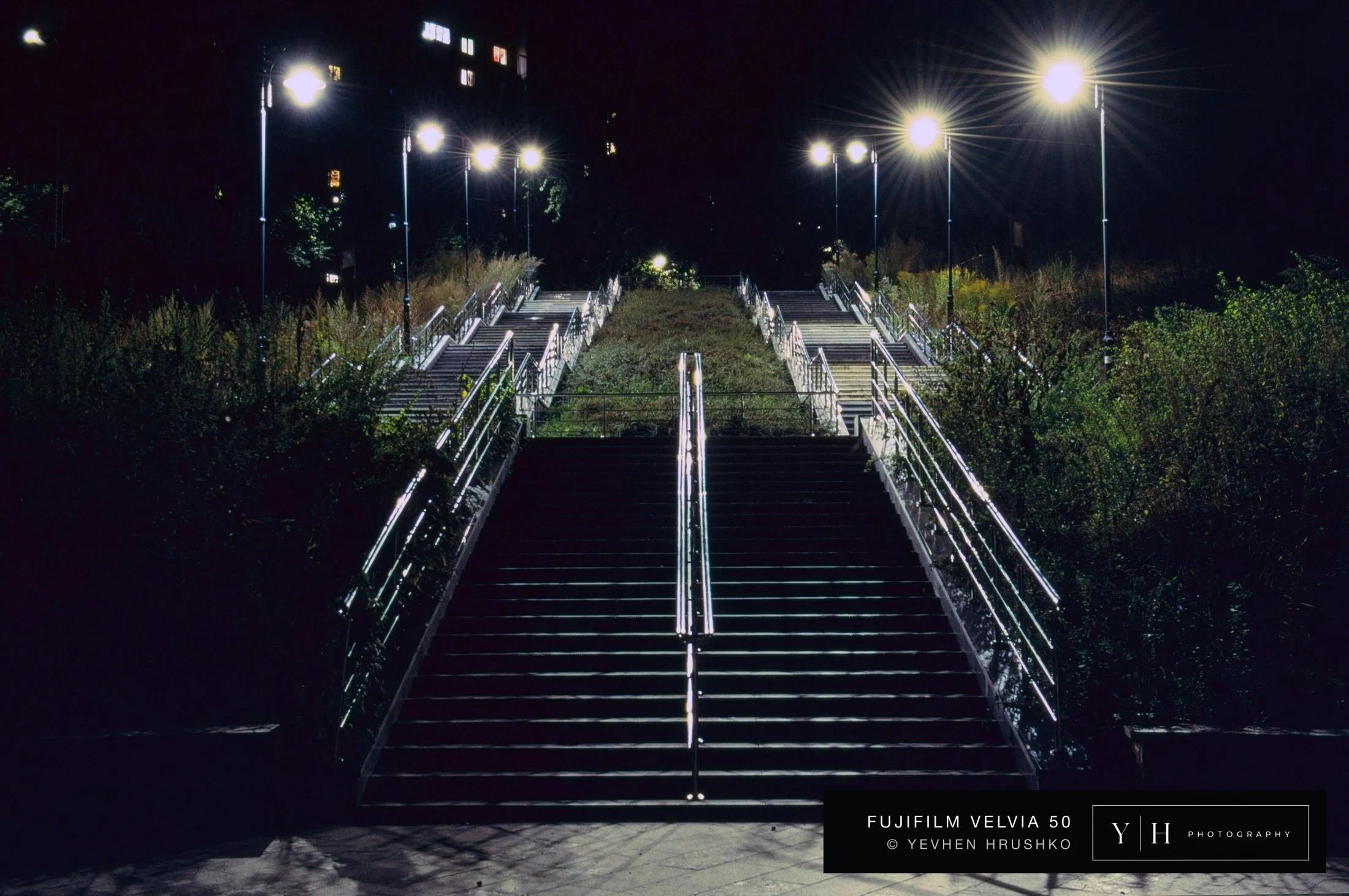
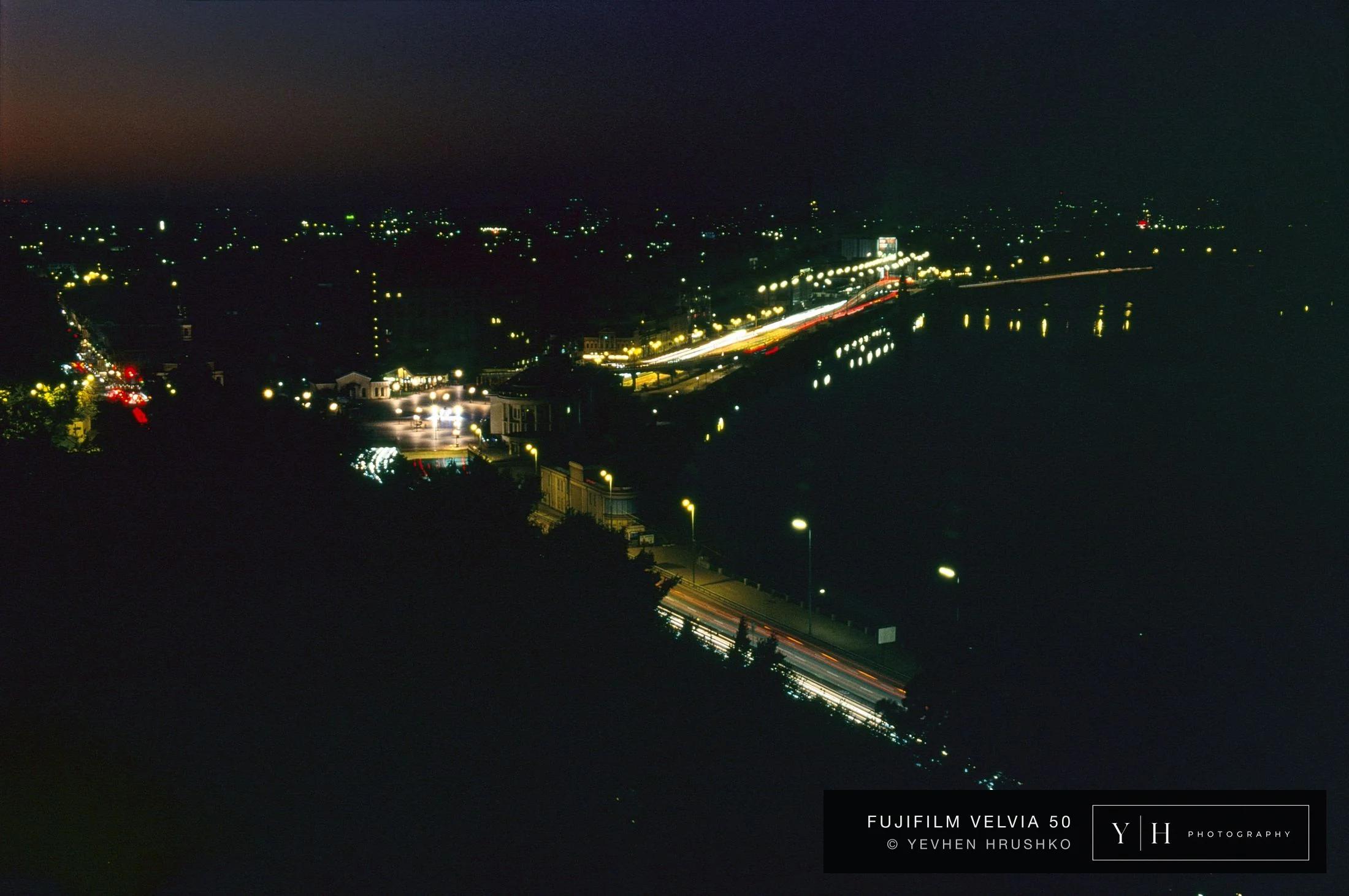
No warm evening gold here. Instead, cold blues, greens and purples, with street lamps burning as bright points against very dense shadows.
Night on ISO 50 takes patience, and it's a long way from digital HDR: shadows go black, lamps blow out. But I like these frames exactly as they are.
Even an ordinary city
I also like what Velvia does with completely everyday things.

A yellow trolleybus. Graffiti on a brick wall.

I doubt Fujifilm designed a landscape film with trolleybuses in mind. But color isn't only in mountains and sunsets; sometimes it's waiting at the bus stop round the corner.
That's why I like trying films on different subjects: the same emulsion behaves differently depending on the light and what's in front of the lens. The more Velvia 50 I shoot, the more interesting it gets.
Is it worth the money?
Velvia is expensive now, fresh stock takes some finding, and slide film needs far more care than negative.
But that's exactly why you shoot it differently. You don't waste frames: you wait for the light, pick your spot, check the meter twice. Then you get the finished transparencies back and hold them up to the light. I shoot
Velvia 50 and Velvia 100. They're not perfect, and they don't suit everything. But no other film gives me color like this.
If you come across a fresh roll of Velvia, shoot something you really love on it. After you process your first slide, you'll see why photographers once talked Fujifilm into bringing it back.