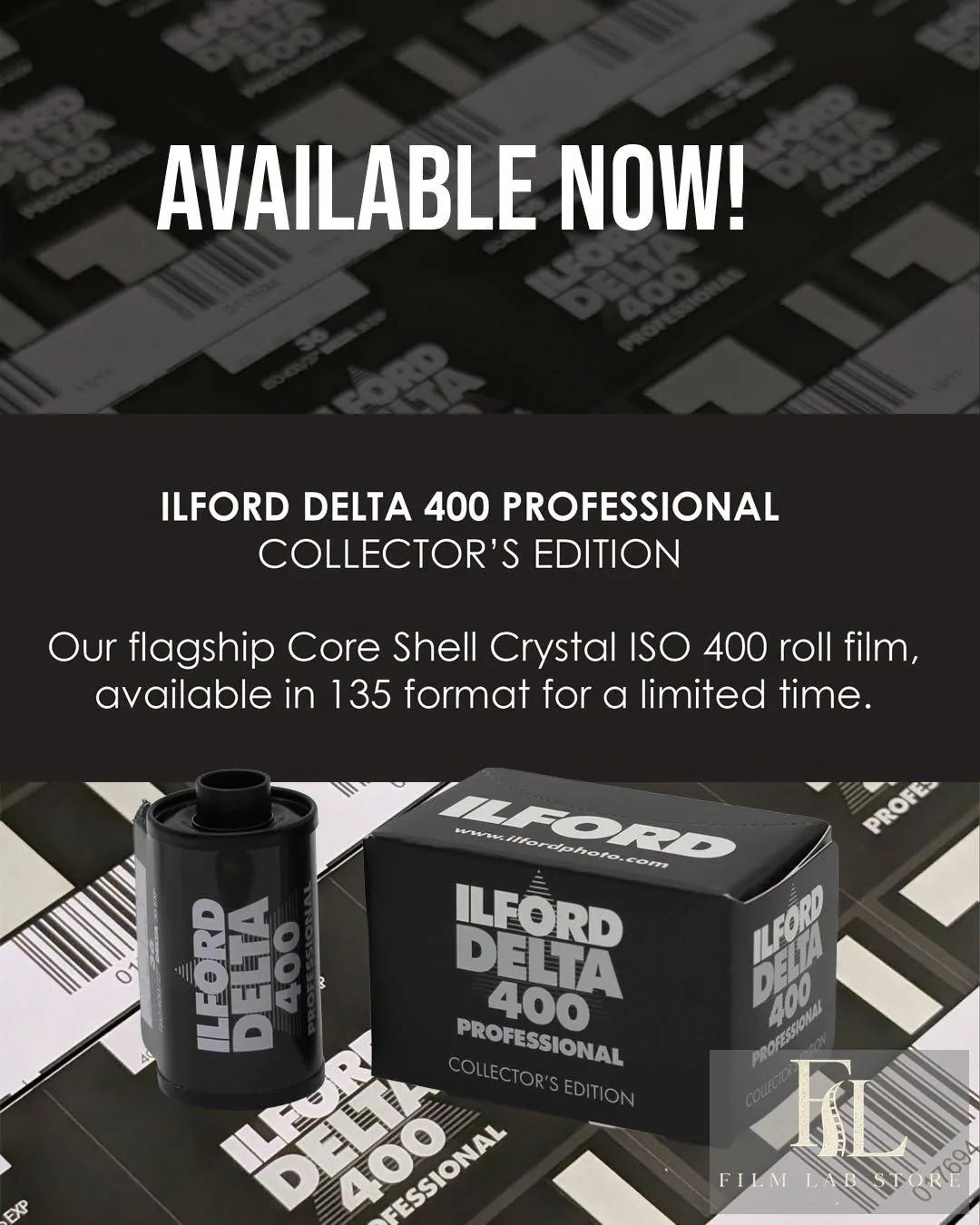
ILFORD has released Delta 400 Professional in a limited Collector's Edition: an all-black cassette, an all-black carton, 135 format only. The packaging is not the whole story — ILFORD says this run is coated on a clearer base with anti-halation protection. At FilmLabStore the film is available to order.
In short. The emulsion is unchanged — Core-Shell, ISO 400. Two things are different: the black cassette and carton, and, according to ILFORD, a clearer base that should improve shadow detail, sharpness and scanning. 135 format only, limited numbers.
What Delta 400 is
ILFORD Delta 400 Professional is a black-and-white negative film with a nominal speed of ISO 400/27°. Unlike traditional cubic-grain emulsions, the Delta line is built on Core-Shell crystal technology: flat core-and-shell crystals deliver more sharpness and finer grain at the same speed.
ILFORD's own datasheet rates the film across an exposure index range of EI 200–3200 — it can be pulled or pushed, provided the developer suits the job.
In practice Delta 400 is valued for:
- fine, tidy grain for an ISO 400 film;
- high sharpness and fine detail;
- a long, even scale of greys;
- enough speed for an overcast day and for indoor work.
Its character is clean and modern. Where HP5 Plus is chosen for pronounced grain texture, Delta is chosen for the cleanest possible negative — a difference that shows up most in scanning and in large prints.
What actually changed in the Collector's Edition
It is easy to stop at "a different box" here, and be wrong.
ILFORD's announcement says the limited run is not only an all-black cassette and carton: the film is coated on a clearer roll film base with anti-halation protection, with improved dynamic range, shadow detail, sharpness and scanning promised, while keeping the look photographers know.
Here is what that means in datasheet terms. The Delta 400 technical information states that the 35mm film is coated on a 0.125mm acetate base, while the roll film (120) is coated on a 0.110mm clear acetate base with an anti-halation backing that clears during development. ILFORD's wording reads as though the 135 cassette now carries the base normally reserved for the 120 roll. The manufacturer does not say so directly — this is my reading of two of its own documents.
What this changes in practice: less halation around bright light sources in the frame, a cleaner and more neutral base when scanning, tidier highlights in backlit scenes. What does not change: speed, grain and development times.
"Improved dynamic range" is a manufacturer's claim, not a measurement. Test it on your own subjects with your own developer and scanner. I will report back once I have shot my own rolls.
Why ISO 400 is the most useful compromise
ISO 100 belongs in bright sun, ISO 800 and above rescues you in the dark, and 400 covers nearly everything in between: the street, travel, an overcast day, a room with large windows. One roll stays in the camera from midday to dusk without a change halfway through.
Delta 400 also holds up in reportage and in portraiture: the fine grain does not eat skin texture, and the long tonal scale forgives difficult light.
If you are still deciding which speed to start with, there is a separate guide: Film ISO: how to choose 100, 200, 400 or 800.
Shooting and developing
Rate it at box speed — EI 400. When the light runs out, ILFORD allows up to EI 3200, but a push needs the right developer: DD-X, Microphen, Ilfotec HC or RT Rapid.
Development times at 20°C, from ILFORD's datasheet (spiral tank, intermittent agitation):
| Developer | Dilution | EI 400 | EI 1600 | EI 3200 |
|---|---|---|---|---|
| ILFOTEC DD-X | 1+4 | 8 min | 13½ min | 18 min |
| ID-11 / Kodak D-76 | stock | 9½ min | 14½ min | 19 min |
| MICROPHEN | stock | 6½ min | 10½ min | 14 min |
| ILFOSOL 3 | 1+9 | 7 min | 14 min | — |
| ILFOTEC LC29 | 1+19 | 7½ min | 13½ min | — |
| Kodak Xtol | stock | 7½ min | 13 min | 17 min |
With continuous agitation (a rotary processor) reduce these times by around 15%. ILFORD advises against a pre-rinse — it can lead to uneven development.
If you would rather not develop it yourself, you can order development and scanning from me, push processing to a stated EI included.
Who it is for
- Collectors. The black carton is one of the rare cases where an ILFORD limited edition genuinely looks different rather than carrying a different sticker.
- People who scan a lot. A clearer base with anti-halation protection is precisely a scanning and highlight story.
- Anyone who has never shot Delta. A good reason to meet an emulsion that behaves quite differently from the familiar HP5 Plus.
An honest word about limited runs: numbers are limited and ILFORD promises no repeat. Whether you buy two and keep one in the box is your own call — an exposed roll is no worse than a collected one.
Where to order
ILFORD Delta 400 Professional Collector's Edition 135/36 — available to order, delivery in 2-3 weeks. The rest of the black-and-white and colour stock is in the catalogue, and if you are just starting out, see how to choose your first roll of film.
Frequently asked questions
Is the Collector's Edition emulsion different from regular Delta 400?
The emulsion is the same — Core-Shell ISO 400. According to ILFORD, the base is what differs: clearer, with anti-halation protection. Speed and development times are unchanged.
Can I shoot it at EI 800 or 1600?
Yes. ILFORD's datasheet allows EI 200 to 3200, provided development matches the index you chose. Mark the actual EI on the cassette so the lab develops it correctly.
Which formats is the Collector's Edition made in?
ILFORD announced 135 only. No 120 or sheet film was mentioned for this release.
When can I get the film?
It is an order-in item, and the usual lead time is 2-3 weeks. I confirm exact timing once the order is placed.