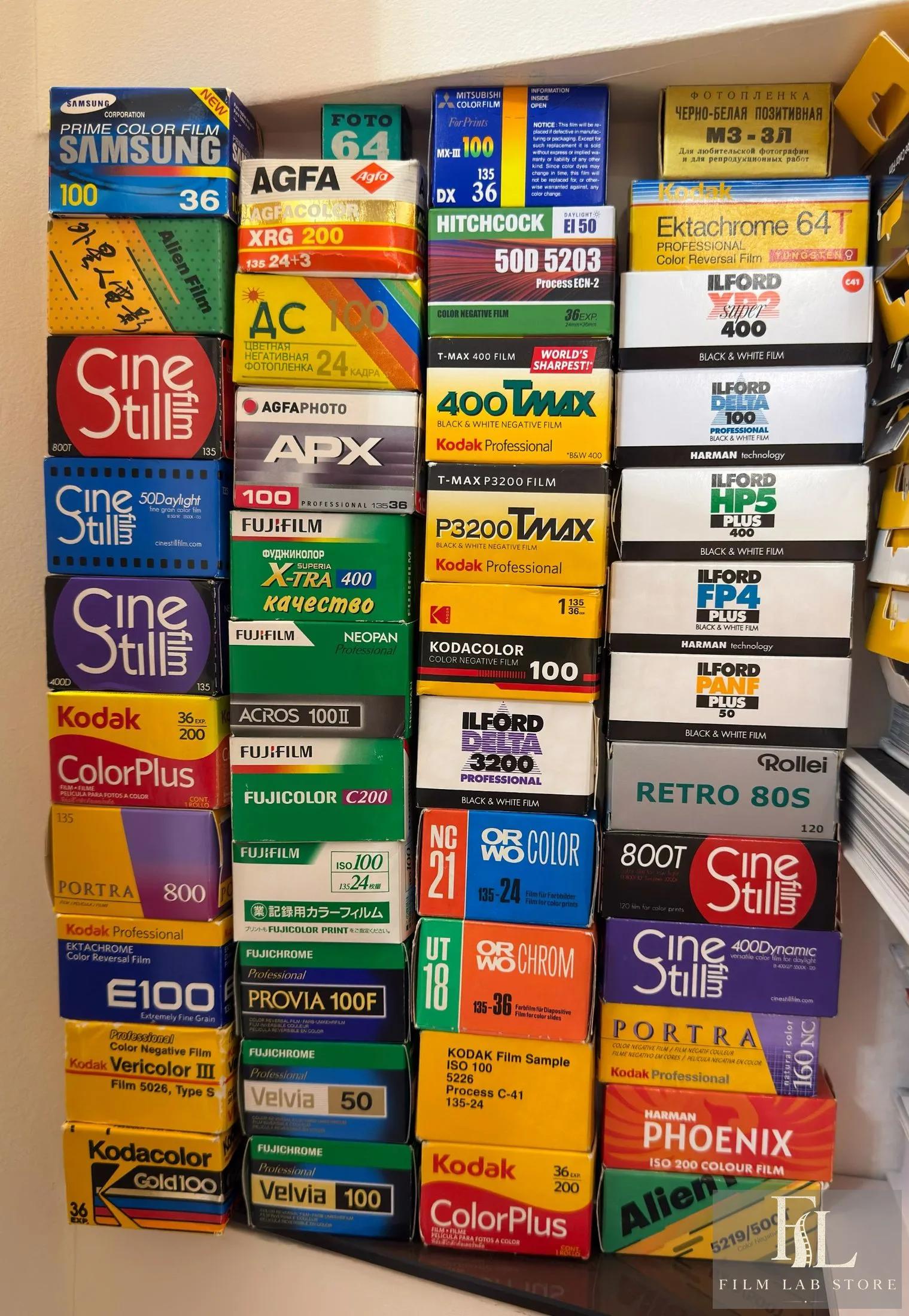
Choosing your first film looks hard because a shop shelf hits you with thirty names and a lot of unexplained numbers. In practice there are only five decisions to make, and almost none of them are about the brand.
In short:
- Your camera decides the format, not you: 135 or 120. This is the only mistake that makes the purchase useless.
- For a first roll, buy fresh C-41 colour negative, ISO 200–400. It is the most predictable start.
- Shooting mostly in daylight — ISO 200. No idea where or when you'll be shooting — ISO 400.
- For a first classic black-and-white roll — ILFORD HP5 PLUS 400, or the cheaper Kentmere PAN 400. If the only lab near you runs C-41 — ILFORD XP2 SUPER.
- Leave expired film, slide, cine stocks and push processing for your second or third roll. The first one exists to test the camera and yourself.
- Budget the cost of a finished frame, not the price of the roll: film plus development plus scanning.
◆
1. Format: 135 or 120
This is the one decision where a mistake costs you the whole purchase.
Most amateur film cameras take 35mm film, type 135 — a metal cartridge, 24 or 36 exposures. Medium format cameras use 120 film: wider, wound on a spool together with backing paper, and with no cartridge at all. The two are physically incompatible and no adapter exists.
If you're unsure, open the back and look at what fits, or find the manual for your specific model.
You don't have to start with 35mm. 135 is simply more convenient more often: more frames per roll, cheaper per frame, a wider choice of cameras and emulsions. But if you already own a Kiev 60, a Lubitel or any other medium format camera, starting straight on 120 is perfectly fine.
2. Budget per frame, not per roll
Beginner guides almost never mention this, which is a shame — it is what decides whether you keep shooting or quit after the second roll.
Film is only the first third of the cost. Development and scanning come on top. Against the full cost of finished frames, the gap between a "cheap" and an "expensive" roll matters much less than the shelf price suggests: saving on the film itself rarely accounts for more than a quarter of the total.
The practical conclusion: there is almost no point economising on your first roll, and no point overpaying for a professional emulsion either. The price difference between the cheapest and the most expensive film will not change your result while the camera is untested and exposure isn't yet in your hands.
Second conclusion: find out what development costs and how long it takes before you buy film. It affects the choice more than any colour description on the box — especially if it turns out the nearest lab only runs C-41 and you bought black-and-white.
3. Colour negative, black-and-white, or slide
Colour negative, C-41
For most people who simply want normal colour photographs, this is the right start. Development gives you a negative, which is then scanned or printed.
The main advantage here isn't the colour — it's the process. C-41 is the most widely available development process in the world. Almost every lab runs it, it's standardised, and the result depends less on which lab you use.
This category includes Kodak Gold 200, ColorPlus 200 and Kodacolor 200, UltraMax 400, Portra (now Ektacolor Pro), Ektar 100, Lomography films, CineStill 400D and HARMAN Phoenix II.
Classic black-and-white film
ILFORD HP5 PLUS, Kentmere PAN 100/200/400, FOMAPAN, ILFORD FP4 PLUS. These don't go through C-41 but through a conventional black-and-white process.
Black-and-white has a quirk that is both its greatest strength and the beginner's biggest complication: the result depends heavily on developer, dilution, time and temperature. The same HP5 looks different in D-76 and in Rodinal — in grain, contrast and shadow rendering. For an experienced photographer that is an enormous field to work in. For a first roll, one rule is enough:
Tell the lab the exact film name and shoot at box speed. Everything else can wait.
ILFORD XP2 SUPER — black-and-white in C-41
A separate and very practical case. XP2 produces a black-and-white image, but it is a chromogenic film developed in standard C-41. Nominal speed is ISO 400, and ILFORD explicitly allows shooting anywhere from EI 50 to EI 800 with no change in processing — which for a beginner means a real margin for error.
If C-41 is easy to find near you but proper black-and-white development isn't, XP2 is the more practical choice over HP5.
Slide film, E-6
Kodak Ektachrome E100, Fujichrome Velvia and Provia. Development gives you a positive rather than a negative, and holding one up to the light genuinely is impressive.
But slide has narrow exposure latitude: a one-stop error is already visible, two stops usually means a ruined frame. E-6 processing is more expensive and less common. On top of that there is now an availability problem: Velvia 100 has been off the US market since 2021, Velvia 50 survives only in 35mm and 120, and Provia and Velvia supply is intermittent worldwide.
Starting with slide is possible — but only if slide is specifically what you want and you're confident with a meter. For a first roll, negative is safer and cheaper.
4. ISO: matched to your light and your camera
ISO is the film's nominal sensitivity. The higher it is, the less light you need. Higher is not the same as better.
| ISO | Where it works | What to keep in mind |
|---|---|---|
| 50–125 | bright daylight, landscape, tripod, studio | you run out of light fast |
| 200 | summer, street, travel, daytime portraits | almost no margin in the evening |
| 400 | city, overcast, changing light | still not enough at night |
| 800+ | indoors, evening, fast shutter speeds | price, grain, camera limits |
ISO 100–200 if you'll mostly shoot in good daylight. Kodak Gold 200, ColorPlus/Kodacolor 200, Ektar 100, ILFORD FP4 PLUS 125, Kentmere PAN 100.
There's a less obvious argument for slower film: an older camera whose fastest shutter speed is 1/500 hits its ceiling in bright sun with ISO 400 loaded. There's nowhere left to shorten exposure, so you stop down to f/16 and lose control over depth of field. With ISO 100–200 that problem disappears.
ISO 400 if you don't know in advance what the light will be. Kodak UltraMax 400, ILFORD HP5 PLUS, Kentmere PAN 400, FOMAPAN 400, XP2 SUPER. It's the most versatile choice for cities, overcast weather and slower lenses.
But the popular line that "beginners always need 400" is wrong. If the whole roll is going to be shot on sunny walks, ISO 200 will be more comfortable and cleaner.
ISO 800 makes sense when light is genuinely scarce: indoors, evening, concerts, a slow lens. But the key point here:
ISO 800 does not turn night into day. In poor light you will still need a fast lens, flash, a tripod or a long exposure. Sensitivity alone doesn't solve it.
This is exactly why you shouldn't reach for CineStill 800T just because "800 sounds right for night." It's a specialised film balanced for tungsten light — and, strictly speaking, not a native ISO 800 emulsion but the 500T motion picture stock that CineStill rates at EI 800. It has a strong character and visible halation around light sources. That's a deliberate choice, not a universal solution.
Why ISO can't be chosen separately from the camera
Take two people. The first has an SLR with a 50mm f/1.8. The second has a compact whose lens, at its working zoom position, opens to roughly f/5.6. That's more than three stops between them — meaning that at the same ISO 400 their capabilities at dusk aren't remotely comparable.
So the right question isn't "which ISO is better" but "which ISO is better for my light, my lens and my camera."
5. Exposure latitude: why negative forgives mistakes
For a first roll this matters more than any colour description on the box.
Exposure latitude is a film's ability to still yield a usable image when you got the exposure somewhat wrong. Don't confuse it with dynamic range — related concepts, but not the same one.
Colour negative is markedly more forgiving than slide. A concrete example: for Gold 200, Kodak's own datasheet E-7022 states latitude from two stops underexposure to three stops overexposure. That's a lot. But you can't transfer that figure to any colour film — HARMAN Phoenix, for instance, has noticeably narrower latitude and handles underexposure badly.
Which is worse — underexposure or overexposure?
For colour negative, underexposure is worse. If too little light reached the shadows, the information simply wasn't recorded. Trying to lift those areas during scanning produces muddy colour, noise and visibly coarser grain.
That doesn't mean "always shoot a stop over." For a first roll, something else is more useful: set box speed and try to expose correctly. A sense of when to deliberately overexpose will come — but you need a baseline first.
6. What you can actually buy in 2026
Here we have to say something the older guides don't.
Kodak's names have changed
Through 2025–2026 Eastman Kodak took film distribution back from Kodak Alaris and ran a series of renames. The emulsions stayed the same; the brands changed:
- Portra 160/400/800 → Ektacolor Pro 160/400/800 (March 2026)
- T-Max → Ektapan
- ColorPlus 200 → Kodacolor 200 (35mm)
- Gold 200, UltraMax 400, Ektar 100 and Tri-X kept their names
What this means in practice: both packagings will sit on shelves side by side for a while yet, and online guides lag behind reality. If a seller offers you "Ektacolor Pro 400" instead of Portra, it isn't a fake or a substitute — it's the same film in a new box. We've covered this separately.
Colour: where to start
Kodak Gold 200 is still one of the most sensible first rolls for daylight shooting. Available in both 135 and 120 (120 arrived in 2022). Its weak spot is obvious: indoors, ISO 200 hits its ceiling fast.
Kodak ColorPlus 200 / Kodacolor 200 — the same idea, cheaper, 35mm only. The persistent claim that ColorPlus and Gold are "exactly the same film" has no solid basis: they carry different edge markings, Gold has its own Kodak datasheet, and ColorPlus was never made in 120. Tests show close but not identical rendering. For a first roll it doesn't matter either way — freshness and price matter more.
Kodak UltraMax 400 — the answer to "I have no idea where I'll be shooting." 35mm only: for medium format the versatile alternative is Portra/Ektacolor Pro 400.
Portra / Ektacolor Pro 400 — an excellent professional film. Starting with it is possible but unnecessary: it won't fix a missed focus, a faulty shutter or a metering error. And an expensive roll often backfires — people start being afraid to press the shutter, which is the worst thing that can happen while you're learning.
Kodak Ektar 100 — fine grain and saturated colour in bright light, but ISO 100 makes it noticeably less versatile. A deliberate choice, not a first one.
Two things worth knowing about Fujifilm 200 and 400. Their American origin and closeness to Kodak are widely discussed but have never been officially confirmed, and testing shows they aren't simply rebadged Gold and UltraMax. More importantly: Fuji supply is unstable worldwide right now, and Superia X-Tra 400 was discontinued in 2024. Planning your first roll around it is risky.
Black-and-white: where to start
ILFORD HP5 PLUS 400 — the obvious versatile option. ISO 400, 135 and 120, and an enormous body of proven development recipes. ILFORD itself describes it as a good choice for beginners thanks to its wide exposure latitude, and that isn't just marketing: HP5 genuinely holds up from EI 400 all the way to EI 3200 with matching development.
Kentmere PAN 400 — nearly the same thing, cheaper. 135 and 120. If you plan to shoot a lot and learn through volume, this is the right choice. Since 2025 the range also includes Kentmere PAN 200, a sensible compromise between 100 and 400.
FOMAPAN 400 — good budget material for learning and for testing a camera, with a more classic grain character. One practical detail that isn't in the datasheet: Foma rates it at ISO 400, but many people who shoot it consistently meter at EI 200–320 and get denser shadows. That's community experience, not a manufacturer recommendation — for a first roll just shoot box speed and save the experiments.
ILFORD XP2 SUPER — if C-41 is all you have nearby.
What's available in Ukraine
A separate reality: not everything on the list above is reliably available here, and what is available is sometimes priced absurdly. Before committing to a specific name, check what is actually in stock — and at what price — in our film catalogue and with other Ukrainian sellers. Sometimes it's smarter to take an available fresh roll than to wait a month for the "right" one.
7. What not to buy as a first roll
Not because these are bad materials — because each of them adds an unknown variable.
Unknown expired film. Its condition depends less on the date than on storage: temperature, humidity, background radiation. Picture it: you bought an old camera and loaded twenty-year-old film into it. The frames came out badly. What caused it — the shutter, the meter, your exposure, the emulsion, or the storage? There will be no answer.
Fresh film is your baseline. Until you have one, there's nothing to diagnose against. Expired film is a wonderful material, but for the second or third roll — and we've written about it separately.
Slide (E-6) if you don't yet have a feel for exposure.
ECN-2 cine stock without a specific reason. It's a different process, and not every lab will take it on.
Push processing your first roll. It turns analysis of the result into guesswork.
The most expensive film in the shop. Price and suitability for learning are different parameters.
8. DX coding: why your camera may get the ISO wrong
If you have an automatic 35mm compact, pay attention to DX coding — the checkerboard pattern on the cartridge that tells the camera the film speed.
Important: DX does not change the film's physical sensitivity. It only reports a number the camera then uses to calculate exposure.
With an uncoded cartridge, different cameras behave differently, and there is no single standard. Most often the camera falls back to ISO 100, but there are models that default to ISO 25 (Canon Prima Mini, Pentax Espio), ISO 50 or ISO 200; some keep the last speed they read, and some let you set ISO manually.
The practical conclusion: if your film has no DX code, or you rolled the cartridge yourself, look up your camera's manual once. Otherwise you risk shooting an entire roll two stops off.
9. ISO, EI and push: the three words that confuse everyone
This is the main trap when coming from digital.
On a digital camera, ISO changes frame to frame. In a film camera there is one physical material inside with one nominal sensitivity. If you loaded Gold 200 and moved the camera's ISO dial from 200 to 400, the film didn't become a 400 — only the exposure calculation changed, and the whole roll will come out a stop under.
So it's worth separating:
- ISO — the material's nominal sensitivity, the number printed on the box
- EI (Exposure Index) — the value the photographer actually exposes at
Push isn't "changing the film's ISO." It's a pairing: you expose at a different EI, then the lab alters the development. Push genuinely works, but it simultaneously changes contrast, image structure and shadow rendering — and on colour, the balance too.
So don't turn your first roll into a simultaneous test of the camera, the meter, an unfamiliar emulsion, a non-standard EI and non-standard development. A normal roll at box speed first. Experiments after.
10. Why film colour online won't match yours
Worth knowing before you buy, so you aren't disappointed.
When you look at Gold, Portra or Fuji samples online, you're not seeing "the colour of the film." You're seeing the whole chain:
emulsion → exposure → development → scanner → inversion → operator's settings → post-processing → JPEG.
The same Kodak Gold can look warm, neutral, saturated or pastel depending on who digitised it and how. The emulsion genuinely affects the image, but the final file is not the single objectively correct interpretation of the negative.
The practical conclusion: choosing your first film by its Instagram look is a poor strategy. Learn to get a technically sound frame first, then go looking for your colour.
11. A six-question decision tree
1. What format does your camera take?
135 → a 35mm cartridge. 120 → 120 film. This one isn't negotiable.
2. Colour or black-and-white?
Colour → C-41 colour negative. Black-and-white → see question 3.
3. What development is available near you?
Classic black-and-white available → HP5 PLUS, Kentmere, Fomapan. C-41 only → XP2 SUPER.
4. Mostly daylight?
Yes → ISO 100–200. For colour, Gold 200 or ColorPlus/Kodacolor 200.
5. Will the light change?
Yes → ISO 400. For colour, UltraMax 400. For black-and-white, HP5 PLUS or Kentmere PAN 400.
6. A lot of indoors and evening?
ISO 400–800 — but check your lens's maximum aperture and whether you have flash or a tripod first.
FAQ
Which film should a beginner buy?
Fresh colour negative in the right format, ISO 200–400. It lets you learn exposure and test the camera without extra variables.
ISO 200 or 400?
200 if you're shooting mostly in daylight. 400 if the light is unpredictable or your lens is slow. When in doubt, take 400: an overexposed negative frame can be saved, an underexposed one can't.
Can I shoot ISO 400 in summer?
Yes. Just make sure your camera's fastest shutter speed and aperture range let you expose correctly in bright sun. On a camera capped at 1/500 this can become a problem.
Should I buy Portra (Ektacolor Pro) as my first film?
There's no technical need. The higher price won't fix camera, focus or exposure errors — and the fear of "wasting an expensive frame" gets in the way of learning.
Is XP2 real black-and-white film?
Yes, the image is fully black-and-white. But it's a chromogenic film, developed in C-41 rather than a conventional black-and-white process.
What happens with film that has no DX code?
It depends on the camera: some default to ISO 100, others to ISO 25 or 50, others let you set the value by hand. There's no single standard — check the manual.
Does push increase a film's sensitivity?
No. Push is shooting at a chosen EI plus altered development. The emulsion doesn't physically turn into a different film.
Kodak renamed its films — are they the same?
Yes. Ektacolor Pro 400 is Portra 400; Kodacolor 200 is the ColorPlus equivalent. The emulsions didn't change — the distribution and branding did.
Should I start with expired film?
Better not. Get a proper baseline on fresh material first, or you won't know what actually went wrong.
135 or 120 for a beginner?
Your camera decides. If it takes 135, you need 135. With a medium format camera it's entirely fine to start on 120 straight away.
Conclusion
You don't choose a first film by brand, or by someone else's photographs. Check five things — your camera's format, the type of film, the development process available to you, the light you'll be shooting in, and the limits of your camera and lens. The name will follow on its own.
If you want the shortest possible answer:
- Gold 200 or ColorPlus / Kodacolor 200 — colour for daylight
- UltraMax 400 — colour when the light is unpredictable
- HP5 PLUS 400 — classic black-and-white
- Kentmere PAN 400 — black-and-white on a budget
- XP2 SUPER — black-and-white where only C-41 is available
A first roll isn't there to find you the perfect emulsion. It's there to get you shooting — and to show you what you want to change on the second one.
◆
If you're not sure what suits your particular camera, write to me — describe the camera, the lens and where you plan to shoot, and I'll suggest something specific. Once it's exposed, you can send the roll in for development and scanning, and fresh film is in the catalogue.
Read next: