You are choosing between ISO 200 and 400 for a day out, and then you remember you will drop into a café in the evening. Should you just take 800? The answer does not depend on light alone. The same film gives you completely different options on an f/1.4 lens and on an f/5.6 zoom — and in bright sun, high sensitivity can take away your freedom to open the aperture rather than help you.
Let's look at what ISO actually means, how it connects to shutter speed, your lens and your camera's shutter, and how to pick a speed for a particular shoot instead of buying one "just in case".
Which ISO to choose — the short answer
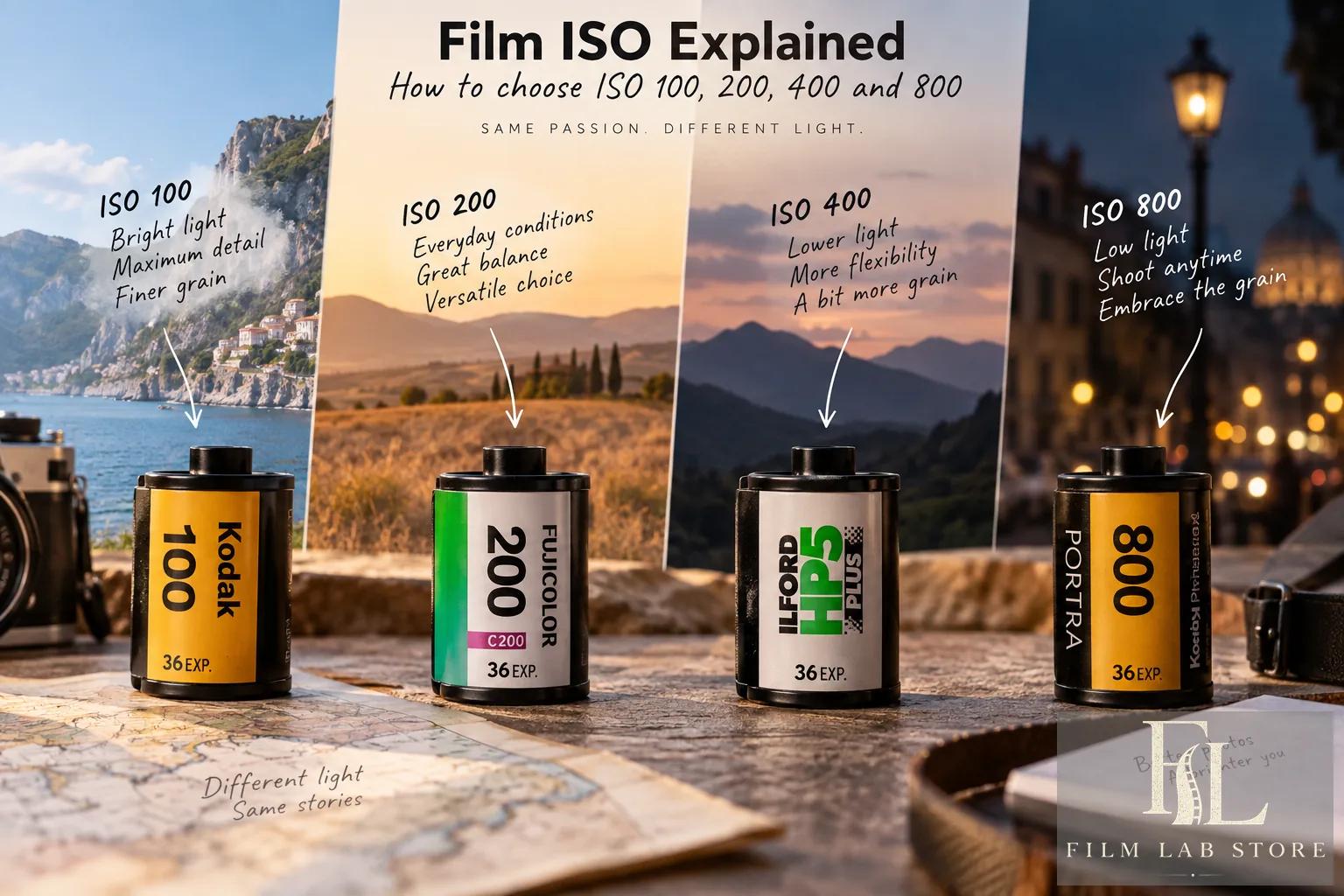
ISO 100 — bright sun, landscape, architecture, studio flash and tripod work. Comfortable when there is plenty of light, especially on a camera with a limited range of fast shutter speeds.
ISO 200 — daytime walks, travel, summer, street photography and portraits in good natural light. One stop faster than ISO 100, but less restrictive of a wide aperture in sun than ISO 400.
ISO 400 — changing light, overcast, everyday street work, movement, slower lenses. Often practical in autumn and winter, but it is not a compulsory choice for every beginner.
ISO 800 — interiors, evenings and movement, when one extra stop over ISO 400 genuinely gets you to a usable shutter speed. It is not a guarantee of handheld shooting in the dark.
The main rule: choose the ISO that lets your camera use the shutter speed and aperture you actually need. On a camera limited to 1/500 s, ISO 100–200 is usually easier on a bright day than 400–800. But even ISO 100 does not guarantee you can shoot at f/2 in direct sun. With a tripod, the opposite holds: a slow film can be perfectly sensible even at night.
What ISO means on film
ISO speed is a standardised measure of a photographic material's sensitivity to light under defined conditions. It answers one question: how much light the film needs for the intended result. It is not a quality rating, not a measure of how bright the finished scan will be, and not a description of colour rendering.
Different film types use different methods to determine speed. Black-and-white negative systems use ISO 6, colour negative films use ISO 5800, and colour reversal (slide) materials use ISO 2240. All three standards are still current.
Strictly speaking, the figure describes not the emulsion on its own but the material under a defined process. For black-and-white film this is written into the standard's own title — film/process systems. Development affects the characteristics of the negative. Turning the ISO dial on the camera, however, does not change the properties of the film already loaded.
Box speed is the informal name for the nominal rating the manufacturer suggests you use. For an ordinary Gold 200 or HP5 Plus 400 the starting values are obvious: 200 and 400. But on specialised materials, the number in the name can indicate a recommended working rating rather than a measured ISO speed. Delta 3200 and T-Max P3200 are the clearest examples — more on them below.
This article is about choosing a speed for shooting, not about decoding old boxes. For historic markings and unknown materials there is a separate guide — how to determine the ISO of old film: ASA, DIN and GOST.
Why film ISO does not work like digital ISO
On a digital camera you can change the ISO setting for every frame, and the camera adjusts how it handles the signal — and, in automatic modes, the exposure settings too. In a film camera the whole roll stays the same physical material.
Say you loaded ISO 400 but set 800 on the meter. If you follow its readings, it will suggest roughly half the exposure: 1/250 s instead of 1/125 s at the same aperture, for example. The film has not become more sensitive — it received less light.
The precise wording is: you are exposing ISO 400 film at EI 800. EI, or Exposure Index, is the value used to calculate exposure.
There is an important practical boundary here. If you shoot fully manually and change neither shutter speed nor aperture, changing the ISO setting on the meter alone will not change the frame. Its readings only take effect when you — or the automation — act on them.
ISO and stops of exposure
A stop means a twofold change. Full stops of film speed form this sequence:
25 → 50 → 100 → 200 → 400 → 800 → 1600 → 3200.
Each doubling of ISO halves the light exposure the film requires. At a constant aperture that means a shutter speed twice as fast.
| Film speed | Nominal shutter speed in the same light at f/4 | Difference from ISO 100 |
|---|---|---|
| ISO 100 | 1/125 s | Baseline |
| ISO 200 | 1/250 s | One stop |
| ISO 400 | 1/500 s | Two stops |
| ISO 800 | 1/1000 s | Three stops |
This is a worked example, not a setting for any given street: the light here is assumed, and the shutter speeds follow a camera's familiar scale.
Two reminders. Shutter speed is the length of time the film receives light. The aperture controls the opening in the lens: f/2 passes more light than f/4. The stop you gain can be spent on closing the aperture rather than shortening the shutter — instead of moving from 1/125 to 1/250 s, you can keep 1/125 s and go from f/4 to f/5.6.
A higher ISO does not make the photograph brighter. With a faster film we reduce the amount of light so the image is correctly exposed. If light, shutter speed and aperture all stayed the same, the comparison would be different: both materials would receive the same light exposure, but would respond to it differently.
When to choose ISO 100, 200, 400 and 800
ISO 25–50: when there is plenty of light, or a long exposure is fine
Slow films suit bright days, landscape, controlled lighting and tripod work. They are also useful when a long exposure is part of the plan rather than a problem. Fujichrome Velvia 50 and ADOX HR-50 are examples of the class.
This is not a universal starting point for a walk with an unknown route, though. Step from an open sunlit square into shade and your margin on fast shutter speeds shrinks noticeably. Technical and other specialised materials should be judged by their own documentation, not by a small ISO number alone.
ISO 100–125: bright days, landscape and controlled light
ISO 100 is comfortable in summer, at the sea and on the beach, for architecture, daytime landscape and studio work with flash. Such films often have a potential advantage in grain and detail. But the main exposure benefit is different: with plenty of light you can use less extreme shutter speeds, or a relatively wider aperture.
The word "relatively" matters. ISO 100 helps compared with 400, but it does not cancel the shutter's limits. If your camera only reaches 1/500 s, a wide-open f/1.4 in direct sun does not become available automatically.
In the evening, in deep shade and indoors, ISO 100 more often calls for a fast lens, flash or a tripod. So it is a good choice for predictable conditions, but not necessarily for a roll you intend to shoot both in daylight and late in the evening.
Ektar 100, Kodak Pro Image 100, T-Max 100, Kentmere Pan 100, Delta 100, Fomapan 100, FP4 Plus 125 and Ektachrome E100 all illustrate a similar speed range. They are not interchangeable in colour, grain or process: the same ISO solves only part of the problem.
ISO 200: the sensible choice for a daytime walk
ISO 200 gives one stop over 100. If ISO 100 would have needed 1/60 s at your chosen aperture, ISO 200 allows roughly 1/125 s. That helps on a walk where you move between sun and moderate shade.
The range suits daytime street work, travel and portraits in good light. A sunny autumn does not require ISO 400 just because the calendar says October. And a spring walk in good daylight does not rule out ISO 200 either.
There is one more advantage over ISO 400: a stop more freedom on a camera whose fastest shutter speed is 1/500 or 1/1000 s. If most of the roll will be shot in daylight, that argument may matter more than a small reserve for the evening.
Gold 200, ColorPlus 200, Kodacolor 200, Fujifilm 200, Kentmere Pan 200 and Fomapan 200 are examples of the class. Harman Phoenix II 200 shows why the ISO number should not be confused with character: it has the same speed as Gold, but no orange base, different colour and a very different contrast.
ISO 400: why it is called universal
ISO 400 is one stop faster than 200 and two stops faster than 100. In changing light that gives a useful margin: a shutter speed that would be about 1/30 s on ISO 100 shortens to roughly 1/125 s on 400.
That is why ISO 400 is often convenient for cities, overcast weather, travel, street photography, movement and slower lenses. The extra light margin is not only for evenings: with a telephoto lens it helps you reach a fast shutter speed even in daylight.
But being universal is a compromise, not an absence of limits. In bright sun ISO 400 runs into the shutter's ceiling sooner, and in a dark room the shutter speed may be too long even with the lens wide open.
UltraMax 400, Portra 400, Fujifilm 400, HP5 Plus, Kentmere Pan 400, Tri-X 400, T-Max 400, Delta 400, XP2 Super and Fomapan 400 all belong to one speed class. Their grain, tonality, colour and behaviour in processing differ. The number 400 promises no particular result.
ISO 800: one extra stop, not night vision
ISO 800 helps when one stop is what stands between you and a workable shutter speed. That happens in cafés, indoors, after sunset, when shooting movement, or with a lens you cannot open far enough.
When ISO 800 genuinely helps. At ISO 400 the meter reads f/2 and 1/30 s. On ISO 800 film in the same light you get roughly f/2 and 1/60 s. For many subjects and focal lengths, that is the difference between a risky handheld frame and an acceptable one.
When ISO 800 does not solve the problem. At ISO 400 you need f/2 and 1/2 s. ISO 800 film gets you to about f/2 and 1/4 s. You gain something, but for an ordinary handheld frame the shutter speed is still far too long.
So choose 800 based on where the shutter speed lands after that one stop, not on the word "night".
Colour examples include Portra 800, SantaColor 800, CineStill 800T and Lomography Color Negative 800. CineStill 800T is balanced for tungsten light, which is a separate property rather than a consequence of the number 800.
ISO 1600 and above: when the number on the box is not a measured speed
Concerts, low-light reportage and fast movement can demand even shorter exposures. Here you look at Delta 3200, Kodak T-Max P3200, or an ordinary black-and-white film such as HP5 Plus or Tri-X shot at a chosen EI with matching push processing.
And it is in this class that you can see the number in the name is a working rating, not a measurement.
ILFORD Delta 3200 has a standardised speed of ISO 1000/31° in daylight. The manufacturer measured it in ID-11 developer at 20 °C. The material is nevertheless intended for shooting at EI 3200 with extended development, and ILFORD particularly recommends the EI 1600–6400 range.
Kodak T-Max P3200 tells the same story, and Kodak puts it even more plainly: the nominal speed is EI 1000 when processed in T-Max developer and EI 800 in other Kodak black-and-white developers. The film is designed as a multi-speed stock, and "3200" describes the intended way of using it.
Two different manufacturers name a product after its working rating rather than its measured ISO speed. This is not marketing deception: these films were created for shooting at high EI with matching development. The rating here is simply chosen together with the processing, not separately from it.
Why some Kodak films have two names
If you come across Ektacolor Pro 160/400/800 and Ektapan 100/400/P3200 in shops, these are not new emulsions. Eastman Kodak has taken film sales back in-house and sells the same materials under its own historic names, while Kodak Alaris keeps the familiar Portra and T-Max. We use the better-known names in this article. There is more on this in Kodak is taking film back under its own control.
ISO, grain, detail and contrast are not the same thing
A higher ISO does not always mean coarser grain
Within a related technology the trend is real. HARMAN, for example, describes Kentmere Pan 400 as grainier than Pan 100. But you cannot compare completely different emulsions on speed alone.
Conventional grain structures, Core-Shell crystals in ILFORD Delta and tabular T-Grain crystals in Kodak T-Max are different technological approaches, and each yields its own balance between speed and graininess. A single ISO number cannot tell you which of two unlike films will look grainier.
Real detail matters more than potential detail
A slow film may have an advantage in grain and resolution. But the amount of visible detail also depends on the lens, focusing accuracy, camera and subject movement, negative size, development and scanning.
A telling calculation: ISO 100 at 1/15 s versus ISO 400 at roughly 1/60 s, same light and same aperture. If the first frame is blurred, the fine-grain advantage is meaningless — the second will hold more visible detail despite the faster material. And 1/60 s is itself no guarantee of sharpness with every lens and every kind of movement.
ISO does not set contrast
It is not true that ISO 800 is always more contrasty than ISO 100. Contrast depends on the particular material and its processing. Push development can affect it noticeably — but then the change in tonality comes from the combination of reduced exposure and extended development, not from the number on the meter.
An ISO 800 film and an ISO 400 film shot at EI 800 and pushed one stop solve a similar shutter-speed problem, but they are under no obligation to render shadows, colour and grain the same way.
Exposure latitude is not encoded in the ISO number
Exposure latitude is the margin of deviation from optimal exposure within which you can still get an acceptable result. ISO answers a different question: how much exposure the material needs.
Gold 200 and Portra 800 both have wide exposure latitude despite their different speeds. ILFORD also highlights the wide latitude of HP5 Plus 400. So high speed does not in itself mean a "fussy" film, and low speed does not automatically mean a generous margin for error.
Choose the ISO for the exposure problem first. Then choose the specific emulsion for grain, colour, contrast and tonality. Choosing types and materials in general is covered separately: how to choose your first roll of film.
Why your camera's fastest shutter speed changes the ISO decision
When people say a camera has a "maximum shutter speed of 1/500", they usually mean the fastest shutter speed. Do not confuse it with the longest one — one second, say.
In low light the problem is that the exposure comes out too long. In bright sun the opposite happens: the camera cannot close the shutter quickly enough for the aperture and film you have chosen.
What Sunny 16 shows
Sunny 16 is a practical rule of thumb: in bright direct sun, start at f/16 with a shutter speed close to the reciprocal of the ISO. For ISO 100 that is about 1/100–1/125 s, for 400 about 1/400–1/500 s. It is not a substitute for metering the actual scene.
Below is a calculation from that rule, rounded to familiar full stops. The table shows the approximate aperture at your camera's fastest shutter speed.
| Fastest shutter speed | ISO 100 | ISO 200 | ISO 400 | ISO 800 |
|---|---|---|---|---|
| 1/500 s | f/8 | f/11 | f/16 | f/22 |
| 1/1000 s | f/5.6 | f/8 | f/11 | f/16 |
| 1/2000 s | f/4 | f/5.6 | f/8 | f/11 |
| 1/4000 s | f/2.8 | f/4 | f/5.6 | f/8 |
| 1/8000 s | f/2 | f/2.8 | f/4 | f/5.6 |
Weather, the position of the sun and the light on your subject will shift the readings. And the aperture has to physically exist on the lens: f/22 in the table does not mean every lens stops down that far.
Why ISO 100 helps but does not remove the problem
On a camera limited to 1/500 s, switching from ISO 400 to 100 lets you open from roughly f/16 to f/8. That is two stops of freedom — but it is not f/2.
From f/16 to f/2 is six stops. In this worked sunlit example, ISO 100 at f/2 would need about 1/8000 s, and ISO 400 about 1/32000 s. A camera capped at 1/500 s cannot do that.
The ways out are to stop down, move to less intense light, or fit a neutral density (ND) filter that cuts the light reaching the film. For ISO 100, going from f/8 to f/2 while keeping 1/500 s would need roughly four stops of reduction. That is an exposure calculation, not a recommendation of any particular filter.
This is the most common reason owners of older gear end up disappointed by "universal" ISO 400. Rangefinders, Soviet SLRs and many compacts stop at 1/500 s, and in summer such a camera loaded with ISO 400 is effectively condemned to f/16 — and therefore to no background blur at all. If you are still choosing a body, see how to choose your first film camera: the shutter ceiling is one of the decisive specifications there.
Lens speed: sometimes worth more than two stops of ISO
Lens speed tells you how wide the lens opens. All else being equal, an f/1.4 lens passes considerably more light than a zoom that only reaches f/5.6 at the focal length you are using.
The full stops run: f/1.4 → f/2 → f/2.8 → f/4 → f/5.6 → f/8. Each step to the right roughly halves the light. Between f/2 and f/5.6 there are three stops; between f/1.4 and f/5.6, four.
| Aperture | Light relative to f/2 |
|---|---|
| f/1.4 | About one stop more |
| f/2 | Baseline |
| f/2.8 | One stop less |
| f/3.5 | About 1.6 stops less |
| f/4 | Two stops less |
| f/5.6 | Three stops less |
| f/8 | Four stops less |
Values are rounded; the f/3.5 row is calculated from the ratio of the squares of the f-numbers. This compares apertures, not the measured light transmission of specific lenses.
Now the important consequence. Suppose that in a particular room ISO 400 at f/5.6 gives 1/60 s. In the same light, ISO 100 at f/1.4 allows roughly 1/250 s. The film lost two stops of speed, but the lens gained four — a net two stops in favour of the system with the faster lens.
This is exactly why the advice "get 800 for a dark room" is nearly meaningless without knowing the lens.
But the advantage only exists if you can actually shoot wide open. If your frame needs f/5.6, having f/1.4 on the scale adds no light at the f/5.6 you are actually using. Choose the ISO for your working aperture, not just the maximum one.
Focal length and movement: the shutter speed you actually need
A higher ISO is useful for more than darkness. Sometimes there is plenty of light but you need a fast shutter — for a telephoto lens or for a moving subject.
Camera shake
For an unstabilised 35 mm camera there is an old guideline: keep the shutter speed no longer than 1 / focal length in millimetres.
| Focal length | Guideline against camera shake |
|---|---|
| 28 mm | 1/30 s |
| 50 mm | 1/60 s |
| 85 mm | 1/125 s |
| 135 mm | 1/125–1/250 s |
| 200 mm | 1/250 s |
It is a heuristic, not a guaranteed threshold: the result depends on how you hold the camera, what you brace against, how much you intend to enlarge the image and how demanding you are about detail. And it describes camera movement — it does not freeze a person or a car in the frame.
Subject movement
For a walking person, 1/125–1/250 s is a practical starting point; for fast movement, around 1/500 s and shorter. Speed, direction of travel, distance and how large the subject appears all change the requirement.
| What you are shooting | How to apply the guideline |
|---|---|
| A person posing calmly | Start from focal length, then allow for small movements of the model |
| A walking person, a quiet street scene | Start at roughly 1/125–1/250 s |
| A child playing actively | Use the fast-movement guideline: around 1/500 s and shorter |
| A car or sport | 1/500 s is a starting point, not a guarantee of freezing the action |
| A concert | The performer's movement decides: a still pose and a sharp gesture need different speeds |
If ISO 200 gives you 1/125 s, moving to 400 allows about 1/250 s and 800 about 1/500 s. Here the extra speed buys you the ability to stop movement, not just to keep shooting later into the evening.
Which ISO to choose in summer, spring, autumn and winter
The calendar helps you imagine a likely scenario, but it does not measure light.
In summer, ISO 100–200 is often convenient for daytime walks, the sea and the beach. But a summer evening in a park may call for a faster film, and direct sun can restrict a wide aperture even on ISO 100.
In spring, with sun alternating with cloud, ISO 200–400 makes sense. That is the same changing-light rule at work, not a separate "spring speed".
In Kyiv in autumn, ISO 400 is often practical for a city roll with cloud and shifting light. On a bright sunny day, 100–200 remain perfectly appropriate.
In winter, ISO 400 — sometimes 800 — can be easier in weak light and short daylight hours. But snow in sun can be extremely bright, and the rule "winter always needs 800" ignores both the light and the shutter's limits.
Why snow calls for attention to metering, not just a higher ISO
A meter reading reflected light may read a predominantly white scene as excessively bright and recommend too little exposure — and then the snow comes out grey and darker than expected. Raising the ISO and letting the camera recalculate the shutter speed does not fix this: the working exposure pair changes, but the metering principle does not.
Depending on how you meter, you may need positive exposure compensation, or an incident reading with a handheld meter. There is no single correction for all snow — it depends on the composition, the metering mode and what the automation has already done. Do not add a fixed "two stops for snow" without assessing the scene.
ISO in different weather
The table is a guide for handheld shooting in natural light. Words like "excellent" and "limited" describe your chances of reaching workable settings, not the quality of the film.
| Light | ISO 100 | ISO 200 | ISO 400 | ISO 800 |
|---|---|---|---|---|
| Bright sun | Excellent | Excellent | Fine, but mind the shutter | Possible, often excessive |
| Light cloud | Fine | Excellent | Excellent | Fine |
| Overcast | Possible; depends on the lens | Fine | Excellent | Excellent when you need a fast shutter |
| Rain, deep shade | Limited | Possible | Fine | Often fine |
| Dusk, handheld | Limited | Limited | Possible | Easier, but no guarantee |
| Static scene on a tripod | Excellent | Excellent | Fine | Rarely needed for light alone |
Thin cloud and a heavy overcast are not the same light level, and the mere fact of rain does not set a shutter speed. Metering the actual scene matters more than any row in this table.
Which ISO you need indoors
"Indoors" is not a light level. A flat beside a large window in daylight, an office, a museum and a dark bar can require entirely different exposure pairs.
Beside a window in daylight, ISO 200–400 may be enough, especially with a fast lens. A bright kitchen belongs in this scenario only if the light genuinely reaches the subject: the direction the window faces and the weather both matter.
In an office, shopping centre or museum, 400–800 can be a starting point, but the name of the place guarantees nothing. Meter where the subject actually is and check the shutter speed available. Do not assume a room is bright simply because it feels comfortable to your eyes: your vision adapts, film does not.
In a café, an evening flat or at a house party, ISO 800 helps when one stop was what you were missing. If 400 gives you 1/30 s, moving to 800 may be worthwhile. If the starting point is half a second, you need a different solution.
In a bar or at a concert, you may need both a fast lens and a higher EI with matching black-and-white processing. Flash is only an option where it is permitted and appropriate. A tripod helps with a static interior, but it does not freeze guests or performers.
A practical order of operations: choose the aperture you are genuinely willing to use; decide the longest shutter speed you can accept; meter the light. Only then decide whether 400 is enough, whether 800 helps, or whether you need to change how you are shooting.
Evening and night: ISO 800 is not always the answer
Golden hour, sunset, blue hour, a lit city street and a genuinely dark scene are different problems.
At golden hour, ISO 200–400 often remains a working range. At sunset and dusk, go by your meter: the same roll can move from comfortable shutter speeds to risky ones very quickly. At blue hour, 400–800 is more useful handheld, but the brightness of the particular place matters more than the name of the time of day.
In a lit city at night, handheld, ISO 800 and above makes sense when the subject itself is lit well enough. A neon sign can be bright while the person standing next to it needs far more exposure. High speed does not create light that is not there.
For a night city on a tripod with a static subject, ISO 100 can be an excellent choice: you use a long exposure instead of a fast film. With genuinely long exposures you need to account for reciprocity failure: some materials need more exposure than the ordinary calculation suggests. Take the correction from that particular film's documentation, not from a general table covering all emulsions.
Studio and flash: when ISO 100–200 is enough
With studio flash, ISO 100–200 is a convenient baseline, because you control the amount of light yourself. At the same distance and unchanged power, moving from ISO 100 to 200 lets you stop down one stop. Alternatively, keep the aperture and roughly halve the flash energy. The same relationships apply to an on-camera flash, though the exact settings depend on its control mode.
Check the flash sync speed separately. On a camera with a focal-plane shutter it can be considerably longer than the fastest shutter speed. Being able to shoot at 1/4000 s does not mean an ordinary single flash pulse will light the frame evenly at that speed. Within correct sync, changing the shutter speed mainly adjusts the contribution of continuous light — provided the brief pulse falls entirely within the open shutter window.
Continuous studio light is a different case: there the ordinary relationship between shutter speed and illumination applies again. The word "studio" alone does not guarantee enough light for ISO 100. Meter the exposure pair for the power and aperture you have chosen.
How to choose an ISO for your particular camera
Before buying, a handful of questions is enough. They do not name a single number — they show you which way to move.
| Question | How the answer affects the choice |
|---|---|
| What is the fastest shutter speed: 1/500, 1/1000 or quicker? | In bright light a limited shutter usually makes ISO 100–200 easier; 1/4000–1/8000 leaves more freedom |
| How wide does the lens open? | f/1.4–2 lets you consider a slower film; f/4–5.6 strengthens the case for 400–800 |
| What focal length? | A telephoto more often needs a fast shutter, so a higher ISO becomes more valuable |
| Is there a working light meter? | Without reliable metering, do not guess: use a handheld meter or a trusted app |
| Is the camera manual or automatic? | Manual control lets you check both ends of the exposure pair; with automation, allow for its algorithm |
| Does the camera read DX, and does it support the rating you want? | Compatibility can rule out an option before light even enters the discussion |
| Where will most of the shooting happen? | A bright street leans to 100–200; changing light to 200–400; a dim interior to 400–800 |
| Do you need a wide aperture? | In sun that argues for a lower ISO or an ND filter — but ISO 100 alone is no guarantee |
| Will there be movement? | Freezing it may require speed even in good light |
| Do you have a tripod, and is the subject static? | Then you can use a slower film and a long exposure |
| Are you planning to use flash? | ISO 100–200 is often enough; higher means less flash energy needed, or a smaller aperture |
A camera without a meter
Sunny 16 is useful as a starting point and a sanity check. For changing light, a handheld meter or a decent smartphone app is more practical: set the speed of the film you are using and transfer the calculated exposure pair to the camera.
Exposure latitude helps you survive a small miss, but it does not replace metering. ISO 200 can be comfortable in bright summer light and ISO 400 in changing conditions; the absence of a built-in meter does not in itself demand one particular speed.
Automatic cameras and DX
A compact may read the ISO from the cassette's DX code. The supported range, the values it recognises and its behaviour with an uncoded cassette all depend on the model.
Do not assume that any camera without DX will default to ISO 100. Check the manual: what is supported, whether you can set a value by hand, and what happens with uncoded film. A fast film offers no practical advantage if the camera cannot expose it correctly.
General camera handling — from loading to the end of the roll — is covered in how to shoot film.
ISO and EI: what is actually set on the meter
ISO is the standardised speed of the material under defined conditions. EI is the value you use when calculating a particular exposure. EI need not match the nominal figure, and it is not in itself a new measurement of the emulsion's sensitivity.
For an ordinary ISO 400 film, if you follow the meter:
| EI set | Exposure relative to EI 400 | Light the film receives |
|---|---|---|
| EI 100 | +2 stops | Four times more |
| EI 200 | +1 stop | Twice as much |
| EI 400 | No change | Nominal reference |
| EI 800 | −1 stop | Half as much |
| EI 1600 | −2 stops | A quarter as much |
Hence an important distinction: buying a faster ISO 800 film and giving an ISO 400 film half the light are not the same action. The shutter settings may coincide, but the material and the result of processing will differ.
Push and pull: only what you need for the ISO decision
Push +1 on an ordinary ISO 400 film means exposing at EI 800 with matching extended development. Push +2 means EI 1600 and a suitable processing regime. With black-and-white film you normally change development time, guided by the specific film and developer.
Extended development changes the density and contrast of an image that has already been recorded — it does not create shadow detail that never received enough light. That is why a push is not equivalent to swapping the emulsion for a genuine ISO 800 or 1600: along with the useful shorter shutter speed you accept compromises in shadows, grain and tonality.
It is a normal tool, not a forbidden trick. For HP5 Plus the manufacturer explicitly supports working at different EIs — 800, 1600 and 3200 included — and publishes development times for them. But the EI and the processing must be agreed before development: tell the lab the exact film and how it was exposed.
Pull is exposing at a lower EI with correspondingly reduced development — ISO 400 at EI 200, for instance. It can be used to control contrast, but the exact effect depends on the material and the process. Shooting at EI 200 with standard development is not in itself a pull.
For a first encounter with ordinary film, box speed and standard processing is a sensible baseline.
Can you change ISO mid-roll?
You can change the setting. The speed of the loaded film does not change. What you change is the EI and — if you act on the new readings — the amount of light.
Shooting a few frames of ISO 400 at EI 400, then at EI 800 and EI 200, is a legitimate deliberate exposure test. But in ordinary processing the whole roll goes through one process. You cannot use this to give frame five a push +1, frame twelve normal development and frame twenty a pull −1.
There are manufacturer-sanctioned exceptions. ILFORD XP2 Super, nominally ISO 400, allows different EIs from 50 to 800 on the same roll with standard C-41. ILFORD cites EI 400 as the general optimum, EI 200 as the finer-grain option and EI 50 as giving denser negatives still. This does not mean identical results at every value, and it does not transfer automatically to other films.
For an ordinary roll you intend to push, a single pre-chosen EI keeps exposure and processing straightforward. For XP2 or a deliberately planned test, the strategy can be different.
ISO by scenario
These are starting ranges, not rules. In the rows about lenses and cameras, the light is assumed to suit the range given: equipment specifications do not assign an ISO independently of the light.
| Scenario | Starting range | Important caveat |
|---|---|---|
| Summer walk, bright sunny day | 100–200 | Deep shade is a different situation |
| Sea and beach | 50–200 | A wide aperture may still need an ND filter |
| An ordinary daytime walk | 200–400 | Check your lens speed |
| Overcast day | 200–400; 400–800 under heavy cloud | "Overcast" is not one light level |
| Rain, deep shade | 400–800 | A tripod lets you go lower |
| Kyiv in autumn | Often 400 | A sunny day does not rule out 100–200 |
| Kyiv in winter | Often 400, sometimes 800 | Snow in sun can be very bright |
| Street photography | 200–400 by day; 400–800 in the evening | Not every street frame needs a fast shutter |
| Daytime portrait | 100–200 | At f/2 the shutter ceiling may still bite |
| Portrait in low light | 400–800 | A fast lens changes the answer |
| Children, active movement | 400–800 | No ISO on its own stops movement |
| Travel on a single roll | 200–400 | An evening interior may be beyond reach |
| A flat by a window in daylight | 200–400 | Window orientation, weather and where the person stands all matter |
| Interior, office, museum | 400–800 to start | The name of the room guarantees no light |
| Café in the evening, house party | 400–800 and above | Even 800 may not be enough |
| Golden hour, early evening | 200–400 | Look at the subject, not just the sky |
| Blue hour, dusk handheld | 400–800 | One stop does not always solve it |
| Night city, handheld | 800 and above | Only when the subject itself is lit well enough |
| Night city on a tripod | 50–400 | Account for that film's reciprocity behaviour |
| Concert, dark bar | 800+ or B&W at a high EI | Needs matching processing; flash is not always allowed |
| Studio or on-camera flash | 100–200 as a baseline | Mind power, distance and sync speed |
| Landscape, architecture on a tripod | 50–100 | Moving elements in the scene change the problem |
| Medium format | By light, lens and movement | A large negative does not compensate for missing exposure |
| Camera capped at 1/500 s | 100–200 on a bright day | f/2 may require an ND filter |
| Camera with 1/4000 s | 100–400 in bright light | By Sunny 16, ISO 400 still wants about f/5.6 |
| Automatic compact | Often 200 or 400 | Check the manual, the ISO range and DX first |
| f/1.4–2 lens | 100–400 in many situations | The margin only exists wide open |
| f/5.6 zoom | 400–800 is usually more useful | In sun, mind the shutter ceiling |
| 135–200 mm telephoto | 400–800 is often easier | On a tripod with a static subject you can go lower |
Choosing an ISO in five steps
- Decide what light most of the roll will see. Bright day, studio or tripod — start at ISO 100–200. Mostly daytime walking — ISO 200. Light unknown in advance, overcast, city — ISO 400. Lots of indoors, evenings or movement — compare 400 and 800.
- Check the shutter ceiling. If the camera only reaches 1/500–1/1000 s and you want a wide aperture in sun, a lower ISO helps — but you may still need an ND filter.
- Check the lens. f/4–5.6, a telephoto or active movement all argue for a higher ISO. Being able to shoot at f/1.4–2 makes a lower one realistic.
- Check for a tripod and whether the subject moves. A static subject on a tripod can be shot at ISO 100, at night included.
- Work out where the shutter speed lands. If it is still too long at 800, the fix is not the next ISO step but more light, a wider aperture, a tripod, or a black-and-white film at a high EI with matching development.
If the camera is automatic, add one more step: check the supported ISO values and how it handles DX.
A higher ISO does not mean a higher price
The common expectation that faster film costs more does not hold up in practice. Price is set by the manufacturer, the type of material, positioning and logistics — not by the number on the box.
Any catalogue makes this easy to check. In the Kentmere Pan line, the 100, 200 and 400 speeds cost exactly the same — within a single series, ISO does not affect price at all. And across brands the relationship is often the reverse of what you would expect: a black-and-white ISO 400 such as Fomapan 400 or Kentmere Pan 400 costs noticeably less than an ISO 100 like T-Max 100, Delta 100 or slide film such as Velvia 100.
The practical conclusion: settle on a suitable speed range first, then compare what is available within it on price and character. The absence of one particular brand does not mean there is nothing suitable in that class.
Beginners' mistakes
ISO 100 for a dark interior with no plan. When there is little light, picking a "fine-grained" film is not enough. Decide in advance how you will get the exposure: a wide aperture, flash or a tripod.
ISO 800 for the beach on a camera capped at 1/500 s. The film will not be ruined by the scenario itself, but you may need an aperture the lens does not have, or an ND filter. A fast film does not always add freedom.
Choosing without regard to the lens and shutter. Advice from a friend who shoots f/1.4 may not work with an f/5.6 zoom. And the reverse: a slow film on a fast system is often more practical than it sounds.
Accidentally shooting ISO 400 at EI 800 and expecting an automatic push. That is first of all an exposure error, not development that has already happened. Before processing, tell the lab the exact film, the EI you set, and whether the whole roll was shot that way. The processing has to be chosen, not assumed.
Avoiding ISO 400 purely because of grain. The potential gain from a slow film does not make up for camera shake. Judge whether the shutter speed is workable alongside the character of the emulsion.
Choosing on the strength of Instagram or Flickr scans alone. You are seeing the result of a particular exposure, emulsion, development and digitisation. Someone else's photograph does not tell you what shutter speed you will get with your lens in your room.
Myths about film ISO
| Claim | Verdict | Why |
|---|---|---|
| ISO 400 is always better than ISO 200 | False | It gives a stop of margin but restricts a wide aperture in sun more |
| The higher the ISO, the brighter the photographs | False | With correct exposure, the shutter speed or aperture changes instead |
| High ISO always means coarse grain | Mostly false | The trend holds within related technologies; unlike emulsions must be compared separately |
| ISO 100 always gives the best quality | False | Camera shake can wipe out the fine-grain advantage |
| ISO 800 is night film | Mostly false | It is one extra stop over 400 |
| Night photography requires ISO 800 or faster | False | A static scene on a tripod works at a low ISO |
| You can change the ISO on every frame | Depends what you mean | You can change the EI setting, not the loaded emulsion; the shared process is the limit |
| Set 800 and ISO 400 film becomes ISO 800 | False | What changes is the meter's recommendation — and, if you follow it, the exposure |
| Push +1 is identical to real ISO 800 | False | Shadows, grain and tonality need not match |
| Film ISO works exactly like digital ISO | False | A film camera cannot change the material's properties through its electronics |
| Winter always needs a fast film | False | What matters is the actual light; snow in sun can be very bright |
| Indoors, ISO 400 is always enough | False | Interiors and their lighting differ by many stops |
| Portraits need a slow film | False | Low light, movement and your working aperture may call for 400–800 |
| Faster film always costs more | False | Within one line the price is often identical, and ISO 400 can be cheaper than ISO 100 |
These verdicts address the categorical claims in the first column. They do not forbid using any of those speeds in conditions that suit them.
Frequently asked questions about film ISO
Which film ISO should a beginner choose?
For good daylight, 100–200; for changing conditions, 400. ISO 800 makes sense when that extra stop gets you to the shutter speed you need. Before deciding, check your lens speed and your camera's fastest shutter speed.
ISO 100 or 200 — which one?
ISO 200 gives one stop of margin over 100. In the same light and at the same aperture that is roughly twice as fast a shutter. ISO 100 is easier when light is abundant, the lighting is controlled, or you are on a tripod.
ISO 200 or 400?
200 is often enough for a daytime walk. 400 is more useful under cloud, in changing light, with movement and with slower lenses. In bright sun on an older camera, 200 leaves you more freedom to choose an aperture.
ISO 400 or 800?
800 is exactly one stop of advantage. A 1/30 s exposure becomes about 1/60 s — but 1/2 s only becomes 1/4 s. Decide on whether the resulting shutter speed is workable for your subject.
Which ISO is best in summer?
For bright daytime work, 100–200 is often convenient. For an evening route, shade or movement, 400–800 may serve you better. The season does not replace metering the light.
Which ISO should I choose in winter?
400 is often practical, and 800 can help in weaker light. But on sunlit snow, 100–200 are appropriate too. Consider not just the amount of light but how your meter handles a predominantly white scene.
Which ISO should I use indoors?
By a window in daylight, 200–400 is possible. For other interiors, start at 400–800 but check the shutter speed. In a dark room even ISO 800 may require a fast lens, flash or a tripod.
Which ISO should I use in the evening?
At golden hour, 200–400 is often enough; at dusk, 400–800 is more useful. The deciding question is whether the shutter speed is sufficient for handheld shooting and for movement, not the exact time on the clock.
Which ISO should I use at night?
For a lit city at night, handheld, consider 800 and above. For a static scene on a tripod, ISO 100 works well: you will need a long exposure and possibly a reciprocity-failure correction for that particular film.
Can I change the ISO on film?
You can change the ISO/EI setting, but the film itself does not change. The exposure changes — if you act on the new readings. A roll is normally developed as a whole; XP2 Super is an example of a film that tolerates different EIs within the standard process.
What happens if I shoot ISO 400 as ISO 800?
If you follow the meter, the film receives one stop less light. That is ISO 400 exposed at EI 800. Appropriate push development can be arranged separately, but setting 800 does not perform a push automatically.
How does ISO differ from EI?
ISO is the material's standardised speed under defined conditions. EI is the value the photographer uses to calculate exposure. They can coincide, but EI 800 does not turn an ISO 400 film into a different emulsion.
Does a higher ISO always mean more grain?
Often it does within a closely related product line. Across different emulsions, one number is not enough: crystal technology, development and enlargement all affect visible grain too.
Is ISO 100 suitable for portraits?
Yes — in good light, with flash, or with a suitable lens. In low light and with movement, ISO 400–800 may be more practical. A slow film is not a requirement for portraiture.
Do I need ISO 800 for night photography?
No. A fast film is primarily a way to shorten the exposure. If the subject is static and the camera is on a tripod, a slow film works; for long exposures, check that film's own corrections.
How does the camera's fastest shutter speed affect the ISO choice?
The slower the shutter ceiling, the harder it is to combine a fast film with a wide aperture in sun. By Sunny 16, at 1/500 s ISO 100 needs about f/8 and ISO 400 about f/16. For f/2, even ISO 100 may call for an ND filter.
Why is Delta 3200 called 3200 if its ISO is 1000?
Because the number in the name describes the recommended working rating with extended development, not the speed measured to the standard. The same applies to Kodak T-Max P3200, whose nominal rating is EI 800–1000 depending on the developer. Films like these were designed from the outset for shooting at a high EI.
In summary: choose the ISO by the exposure pair you need
Before buying, work out what shutter speed your subject requires and what aperture is available or desirable. Then check which speed lets you reach that combination in the light you expect.
ISO 100–200 suits good daylight and controlled lighting. ISO 400 provides margin for changing conditions. ISO 800 is worth choosing when that extra stop solves a specific shutter or aperture problem — not simply because the shoot happens to be an evening one.
A tripod and a static subject let you drop the ISO even at night. A wide-open f/1.4–2 reduces the need for a fast film, while an f/5.6 zoom, a telephoto or movement can make 400–800 the sensible option. In bright sun, a camera capped at 1/500 s strengthens the case for 100–200 — sometimes together with an ND filter.
The best ISO is the one that lets your camera and lens use the shutter speed and aperture you need. Not the highest, and not the lowest.
Once the range is settled, all that remains is to look at what is available at that speed in the FilmLabStore film catalogue and pick the emulsion on its character, processing and price. If you are unsure, write to us — we will suggest something for your camera and your subject.