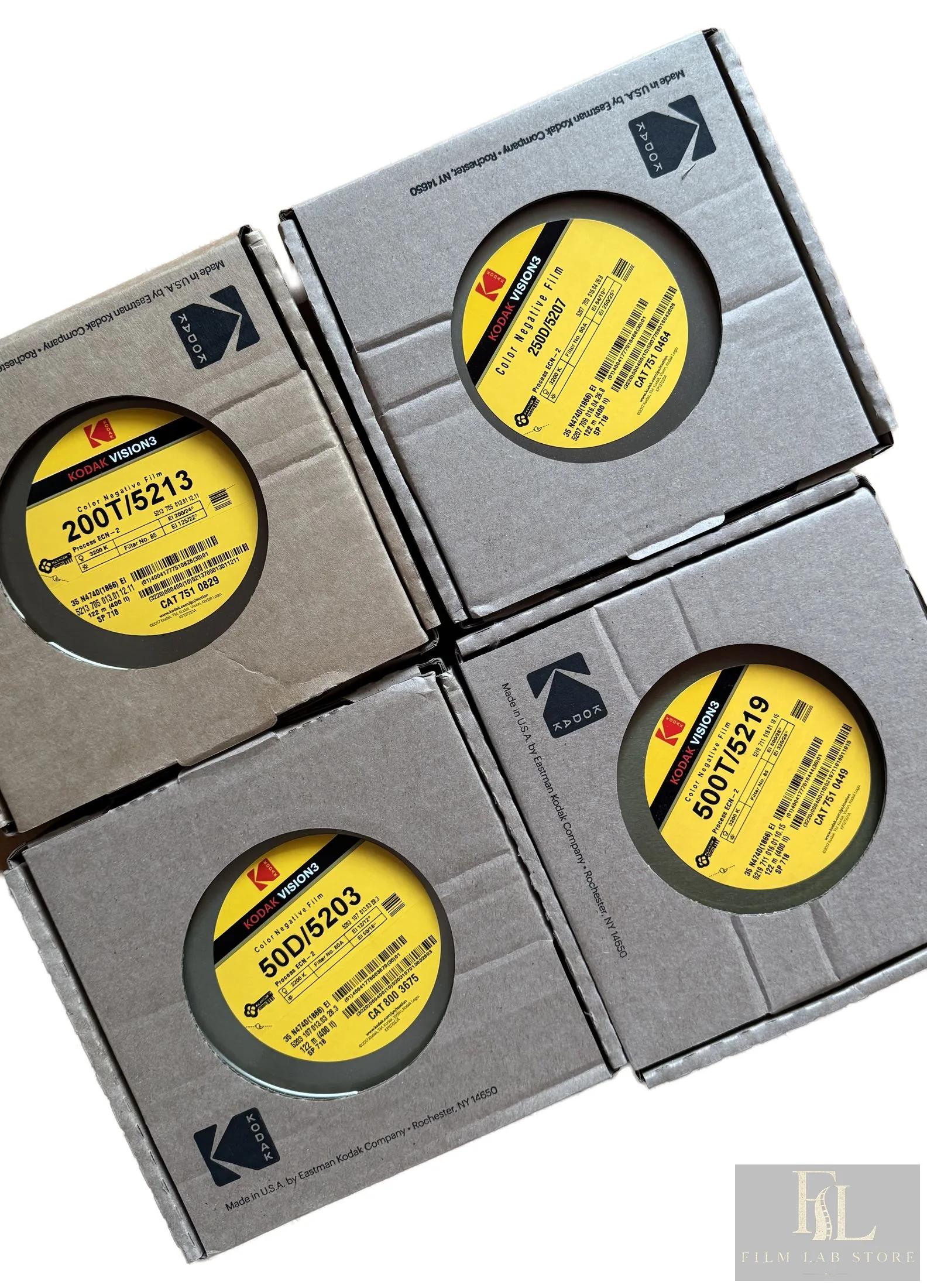
Kodak has moved the VISION3 family to a new structure: the anti-halation layer now sits under the emulsion, and the carbon Rem-Jet backing is gone. It is called AHU — Anti-Halation Undercoat. FilmLabStore now has 135 cassettes of 36 exposures, hand-spooled from original 400 ft motion-picture rolls: 200T, 250D and 500T in the AHU version, 50D in the classic Rem-Jet one.
In short. AHU is not "Rem-Jet that washes off more easily" — it is a different film structure. The emulsion, the speed and the native process (ECN-2) are unchanged. You can check your own can by its CAT number; the table is below.
What is spooled, and what it costs
| Film | Balance | EI | Structure | Price per 36 exp |
|---|---|---|---|---|
| Kodak VISION3 50D 5203 | Daylight 5500 K | 50 | Classic, Rem-Jet | 700 UAH |
| Kodak VISION3 200T 5213 AHU | Tungsten 3200 K | 200 | AHU, Rem-Jet free | 1000 UAH |
| Kodak VISION3 250D 5207 AHU | Daylight 5500 K | 250 | AHU, Rem-Jet free | 1000 UAH |
| Kodak VISION3 500T 5219 AHU | Tungsten 3200 K | 500 | AHU, Rem-Jet free | 1000 UAH |
Product pages: 50D 5203 · 200T 5213 AHU · 250D 5207 AHU · 500T 5219 AHU.
What changed in Kodak VISION3
For many years Kodak's professional motion-picture film carried a Rem-Jet layer on the back of the base — a black carbon coating. It suppressed light reflecting inside the film, reduced halation around bright sources, controlled static and protected the base as the film travelled through a camera.
It had one significant drawback: Rem-Jet has to be softened and physically removed during ECN-2. That is exactly why an ordinary VISION3 roll could not simply be handed to a photo lab with "please run it as C-41".
In August 2025 Kodak announced the new structure. The anti-halation function moved underneath the light-sensitive layers — that is AHU, the Anti-Halation Undercoat: a silver-bearing gelatin underlayer that clears during the bleach step of the standard process. A separate clear, process-surviving antistatic coating remains on the back.
Kodak's own wording, in the 5219 technical data sheet (March 2026 edition): "An Anti-halation undercoat replaces the traditional remjet backing layer. A process surviving antistat has been incorporated to reduce dirt attraction."
The change covers all four main stocks — 50D 5203, 200T 5213, 250D 5207 and 500T 5219 — in every format from 8 mm to 65 mm, and rolls out as existing stock turns over.
Why an anti-halation layer is needed at all
Light hitting the film is not always fully absorbed by the emulsion. Some of it passes through, reflects off the back surface and returns into the emulsion, producing a glowing ring around a bright source — halation. A neon sign, a headlight, a street lamp, a specular highlight: that is where you see it.
Some remjet-free films have no anti-halation layer at all, which is where the famous red halos around neon come from. Kodak took a different route: VISION3 AHU keeps a full halation-control system, and the company states that control is as good as before or better. So huge red halos are not something to expect from AHU by default — it is a different product.
AHU or Rem-Jet: how to check your can
The stock number — 5203, 5219 — tells you nothing, because it did not change. The CAT number did, and Kodak published the mapping. For 35 mm × 400 ft:
| Film | Previous CAT No. | AHU CAT No. |
|---|---|---|
| VISION3 500T 5219 | 8738304 | 7510449 |
| VISION3 250D 5207 | 8986903 | 7510464 |
| VISION3 200T 5213 | 1337740 | 7510829 |
| VISION3 50D 5203 | 8003675 | 7510902 |
My cans: 200T — CAT 751 0829, 250D — CAT 751 0464, 500T — CAT 751 0449. Those are AHU. My 50D carries CAT 800 3675 — the previous generation, with Rem-Jet, and that is exactly how I sell it.
The documents behind this are hosted here: Kodak's official CAT number change notice (PDF) and how to read a Kodak film can label (PDF).
So is VISION3 a C-41 film now?
No. Removing Rem-Jet solved a mechanical processing problem, not a chemical one.
The VISION3 emulsion is still designed for ECN-2, and that is still what Kodak specifies. The difference between the processes is not only Rem-Jet: ECN-2 uses the CD-3 colour developing agent, standard C-41 uses CD-4, and the temperature, time, pH and dye-forming conditions differ as well.
C-41 can produce a perfectly usable image on VISION3 AHU, but the colour, contrast and sensitometry will not be the same.
My recommendation is simple. **ECN-2 is the main process.** C-41 is an acceptable cross-process for AHU versions — tell the lab up front that your film is AHU with no Rem-Jet. For my **50D this does not apply at all**: it has the classic Rem-Jet and must not go into an ordinary C-41 machine.
Exposure: box speed and filters
These figures come from the can labels themselves, and from Kodak's technical data.
| Film | Balance | Box speed | With a correction filter |
|---|---|---|---|
| 50D 5203 | Daylight 5500 K | EI 50 | Under tungsten, 80A filter — EI 12 |
| 200T 5213 | Tungsten 3200 K | EI 200 | In daylight, 85 filter — EI 125 |
| 250D 5207 | Daylight 5500 K | EI 250 | Under tungsten, 80A filter — EI 64 |
| 500T 5219 | Tungsten 3200 K | EI 500 | In daylight, 85 filter — EI 320 |
Shooting a tungsten stock in daylight without a filter is a legitimate move: the image goes cool and the balance is corrected when scanning. But it is a choice, not "correct exposure".
Overexposure and push
VISION3 tolerates extra exposure, and it has the physical headroom for it: Kodak claims two stops of extended highlight latitude thanks to Sub-Micron Technology. Hence the common practice of shooting 250D or 500T at +1 stop — cleaner shadows, a denser negative.
The popular "VISION3 must be shot at +1 or +2", however, is not an official Kodak rule. Box speed is the right starting point; experiment deliberately from there.
Push is the same story, only stricter. Kodak's ECN-2 developer times:
| Mode | Developer time |
|---|---|
| Pull 1 | 2 min 30 s |
| Normal | 3 min 00 s |
| Push +1 | 3 min 40 s |
| Push +2 | 4 min 40 s |
Kodak puts it plainly: "Push processing is not recommended as a means to increase photographic speed" — the real speed gain is significantly less than the loss from underexposure, while contrast, colour and grain all suffer. You can shoot 500T at EI 1000, but "underexposing the film" and "raising its speed in development" are not the same thing.
Why a VISION3 scan can look flat
Because it is meant to. A camera negative is not a finished photograph — it carries the maximum amount of information for grading later. A first ECN-2 scan often looks low in contrast, greyish and undersaturated, and that is precisely the headroom VISION3 exists for in cinema. Contrast and colour are built back in during scanning and grading.
VISION3 AHU and CineStill are not the same thing
A common shortcut. CineStill makes its own products designed for C-41, and the company itself objects to being described as "Kodak with the Rem-Jet removed".
Kodak did not merely remove Rem-Jet — it engineered a full new anti-halation layer under the emulsion. So VISION3 AHU ≠ VISION3 without anti-halation.
Kodak VISION3 50D 5203 — sunlight and minimal grain
The finest-grain stock in the family. Daylight balance, EI 50: bright sun, landscape, architecture, fashion, a studio with strong light, outdoor portraits. Where maximum detail matters, 50D delivers a negative that is hard to fault.
My batch is the classic Rem-Jet one (CAT 800 3675), so it goes to ECN-2 with mechanical removal of the layer, and nowhere else.
Kodak documents: brochure (PDF) · technical data (PDF).
Kodak VISION3 200T 5213 AHU — interiors and artificial light
One of the family's most interesting stocks for portraits and interiors. Kodak describes 200T as a film that gives the image structure of a slower stock at a working EI of 200 — tidy grain without the feel of a fast film.
Indoors, tungsten, evenings, studio, cinematic portraits. In daylight: an 85 filter and EI 125, or a cool image without one.
Kodak documents: brochure (PDF) · technical data (PDF).
Order 200T 5213 AHU — 1000 UAH
Kodak VISION3 250D 5207 AHU — one film for the whole day
If you take a single VISION3 out for a day of shooting, take this one. Noticeably faster than 50D, with an image structure that is still very tidy. Kodak singles out 250D for skin-tone rendering, reduced grain in shadows and extended highlight latitude.
Street, portraits, travel, overcast weather, reportage — load it in the morning and stop worrying about how the light will change by evening. As a first VISION3, it is the easiest way in.
Kodak documents: brochure (PDF) · technical data (PDF).
Order 250D 5207 AHU — 1000 UAH
Kodak VISION3 500T 5219 AHU — evening, neon, cinema
500T begins where the light runs out: the city at night, neon, bars, interiors, concerts, mixed lighting, handheld work. Kodak built it as a fast tungsten negative with improved shadow performance and generous highlight headroom — and it is the easiest route to that cinematic visual language.
A personal note: 500T is one of my favourite films. I simply love it. It gives all my photographs that cinematic vibe — one of those cases where the character of a film is obvious without explanation. — Yevhen Hrushko
In daylight: an 85 filter and EI 320. Plenty of people shoot 500T in daylight unfiltered on purpose, for the cool cinematic character, and fix the balance when scanning.
Kodak documents: brochure (PDF) · technical data (PDF).
Order 500T 5219 AHU — 1000 UAH
Real VISION3 in an ordinary camera
I hand-spool the cassettes from original Kodak 400 ft rolls, 36 exposures each. Spooling changes nothing: not the emulsion, not the speed, not the colour balance, not the AHU, not the grain, not the process — Kodak built all of that into the camera negative. I only turn a professional cinema roll into a format that loads into almost any 35 mm camera.
You can hand the exposed film straight back to me: development and scanning in ECN-2, with Rem-Jet or without. If you are curious what earlier generations of camera negative look like, I wrote about the original VISION 250D 5246; the rest of the stock is in the catalogue.
Frequently asked questions
How does AHU differ from Rem-Jet?
Rem-Jet is a black carbon layer on the back of the base that has to be removed mechanically during processing. AHU is an anti-halation underlayer beneath the emulsion that clears by itself during the bleach step of the standard process. Same function, different structure; Kodak states halation control is at least as good as before.
Can VISION3 AHU be developed in ordinary C-41?
Technically yes, as a cross-process: the carbon layer that used to contaminate the machine is gone. But Kodak still specifies ECN-2 as the native process, and colour and contrast in C-41 will be different. Tell the lab the film is AHU regardless.
How do I tell whether mine is AHU or Rem-Jet?
By the CAT number on the can: for 35 mm × 400 ft the AHU versions are 7510449 (500T), 7510464 (250D), 7510829 (200T) and 7510902 (50D). The stock numbers — 5219, 5207, 5213, 5203 — did not change.
Should VISION3 be overexposed by +1 or +2?
Kodak has no such rule. Start at box speed; +1 stop gives cleaner shadows and a denser negative, and the highlight headroom allows it — Kodak claims two extra stops of latitude in the highlights.
Why does the negative look washed out after ECN-2?
That is how it should look: a camera negative stores information for grading, not a finished image. Contrast and saturation are added during scanning and colour correction.