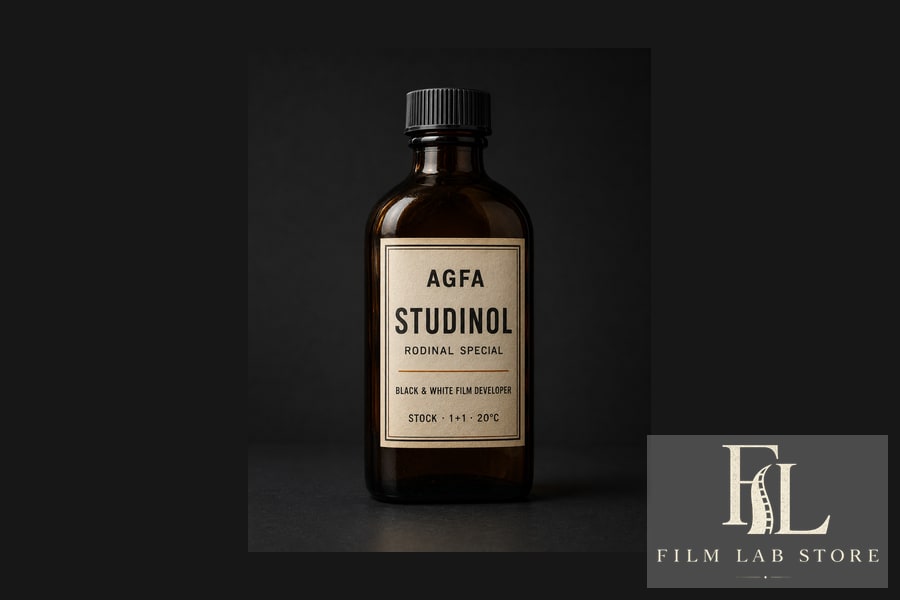
Agfa Studinol (Rodinal Special)
A highly concentrated, universal developer based on a phenidone-hydroquinone system and triethanolamine—despite its name, it functions like Microphen, not Rodinal.
About the Developer
Agfa Studinol is widely known among amateur photographers abroad, but for a long time it was not widely available in our region. It is an excellent, versatile, highly concentrated developer with unique properties. Despite the similarity in name to the classic Rodinal, it has completely different properties and uses a different composition of developing agents—its performance is most similar to that of Microphen. It uses a combination of phenidone and hydroquinone as developing agents, which ensures thorough development of the film and prevents grain growth. The concentrate stores very well thanks to the use of water and triethanolamine (TEA) as solvents in a ratio close to 1:1. The working solution is prepared by diluting the concentrate with water at a ratio of 1 part concentrate to 15 parts water. Agitation mode: continuous stirring for the first minute, followed by one full rotation of the tank’s spiral every 30 seconds. The development time is the standard time indicated on the film packaging.
Character
A versatile, highly concentrated phenidone-hydroquinone developer based on triethanolamine (TEA); its performance is similar to that of Microphen (not to be confused with Rodinal, despite the similarity in name).
Best films
Its characteristics are similar to those of Microphen—it renders well on high-sensitivity films (Ilford HP5+, Delta 400 Professional, Kodak Tri-X) and is suitable for moderate push processing while maintaining fine grain.
How to Prepare and Use
- 1To use, dilute the concentrate with water in a ratio of 1 part concentrate to 15 parts water (1:15).
- 2Agitate continuously for the first minute, then make one full rotation of the tank spiral every 30 seconds.
- 3The development time is the standard time indicated on the film package.
Pros
- Highly concentrated — compact storage and a long shelf life for the concentrate thanks to TEA
- The fenidone-hydroquinone combination controls grain growth just as effectively as Microphen
- Simple agitation mode: one minute continuously, then one rotation every 30 seconds
Cons
- The name is easily confused with Rodinal—the formula and results are completely different
- There is no separate time chart for specific films—only the time listed on the box
- Requires a precise ratio of water to TEA (approximately 1:1) when boiling the concentrate
Recipe for 1 liter of concentrate
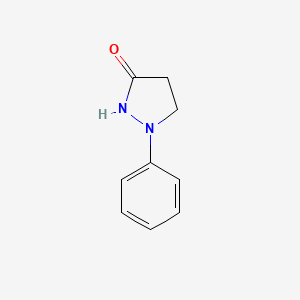
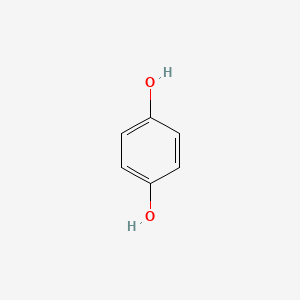
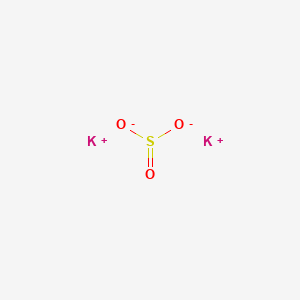
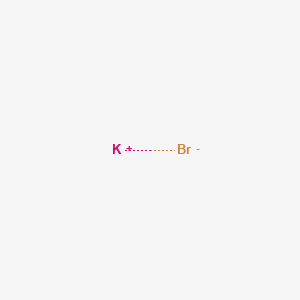
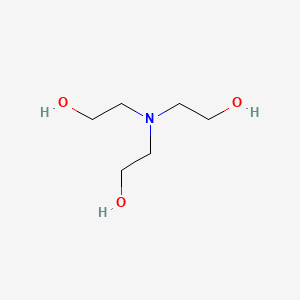
Chemical structures: PubChem (public domain)
Mixing it at home
A highly concentrated phenidone–hydroquinone concentrate on triethanolamine; you make the concentrate first, then dilute it 1:15 before use.
- 1Dissolve all solids (phenidone, hydroquinone, potassium sulfite, potassium bromide) in about 500 mL of hot water (~50°C).
- 2Once it has completely dissolved, add triethanolamine (TEA) to the solution and mix thoroughly.
- 3Bring the total volume of the solution to 1.0 liter.
Key points
- Despite the name Rodinal Special, its character is not Rodinal’s: the phenidone–hydroquinone pair on TEA behaves like Microphen — it boosts speed rather than giving Rodinal’s acutance.
- The triethanolamine concentrate keeps well; make the working solution by diluting 1:15 right before developing.