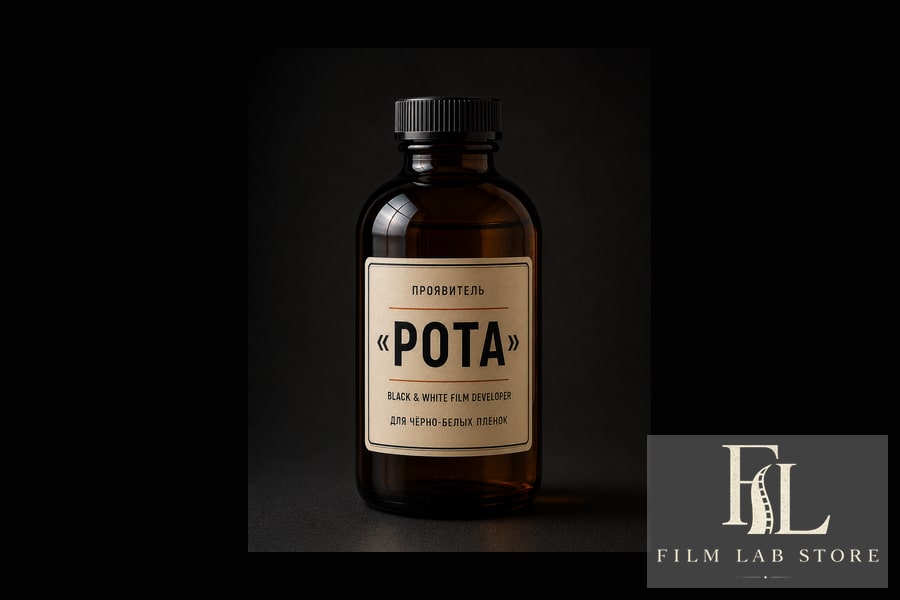
"ROTA" Developer
A low-contrast, single-component phenidone developer for scenes with excessive lighting contrast.
About the Developer
When you need to significantly reduce excessive image contrast, there are two approaches you can take: apply special processing techniques using standard developers (heavy dilution, development with a “depleted” solution, two-solution development) or use a special low-contrast developer. “ROTA” is precisely such a specialized developer, long and well known. It uses only phenidone as its developing agent—and nothing else—which contradicts all the established rules for formulating developers, but it works nonetheless. Phenidone is very active when combined with other substances, but on its own it excellently reveals the centers of the latent image and enlarges them—though it increases density only slightly and is quickly depleted. “ROTA” is based precisely on this principle. The resulting negatives look unusual, and it is difficult to determine their degree of development by eye—without printing—so the final decision is often made after a test print.
Character
A special low-contrast developer containing only phenidone—without a second developing agent, phenidone is quickly depleted and increases the image density only up to a certain limit, limiting contrast in areas where a conventional developer would produce overexposed highlights.
Best films
Scenes with excessively high lighting contrast, where a standard developer produces a negative that is too harsh; applicable to any film that requires reduced contrast without special techniques such as heavy dilution or two-bath development.
Pros
- A one-of-a-kind, single-component (fenidone only), low-contrast formula
- Effectively reduces excessive contrast without dilution or two-solution methods
- A simple and inexpensive mixture of three substances
Cons
- The solution is used only once—it is less cost-effective than reusable developers
- The negatives look unusual; it's hard to assess their printability without a test print.
- Short shelf life—up to 20–25 days for an unopened solution, up to 7 days for an opened one
Recipe for 1 liter
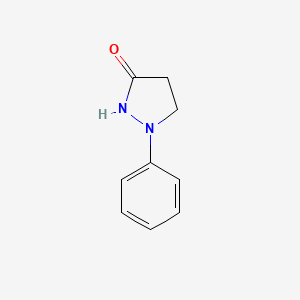
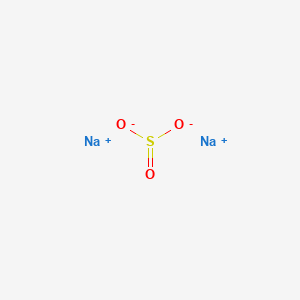
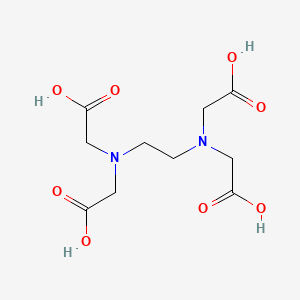
Chemical structures: PubChem (public domain)
Mixing it at home
The developer comes in two packets; the phenidone is dissolved separately in hot water (60–65 °C, no higher!).
- 1The developer is supplied in two packets: one contains phenidone, and the other contains sodium sulfite and Trilon-B.
- 2Pour about 300 ml of distilled water at a temperature of ~40°C into a 1-liter container and dissolve the contents of the large bag in it; rinse the empty bag with warm water and pour the rinse water into the solution.
- 3Separately, heat 500 ml of distilled water to 60–65°C (no higher!). Add a small amount of the solution from the large bag (20–40 mL) and, before the temperature drops, dissolve the phenidone in this mixture, stirring constantly—it does not dissolve well in water.
- 4Rinse the fenidone package with hot water several times and pour the water into the fenidone solution.
- 5While stirring constantly, pour the phenidone solution into the solution from the large bag and let it cool to room temperature.
- 6Bring the total volume to 1 liter, let it settle for at least 3 hours, and strain if necessary.
Key points
- A low-contrast developer on phenidone alone: without a second agent the phenidone exhausts quickly, which itself tames contrast — handy for harshly lit scenes.
- Check the development time using a test sample: it is usually 4–12 minutes. The developer is for single use only—the solution is discarded after developing a single film (~30 ml per film).