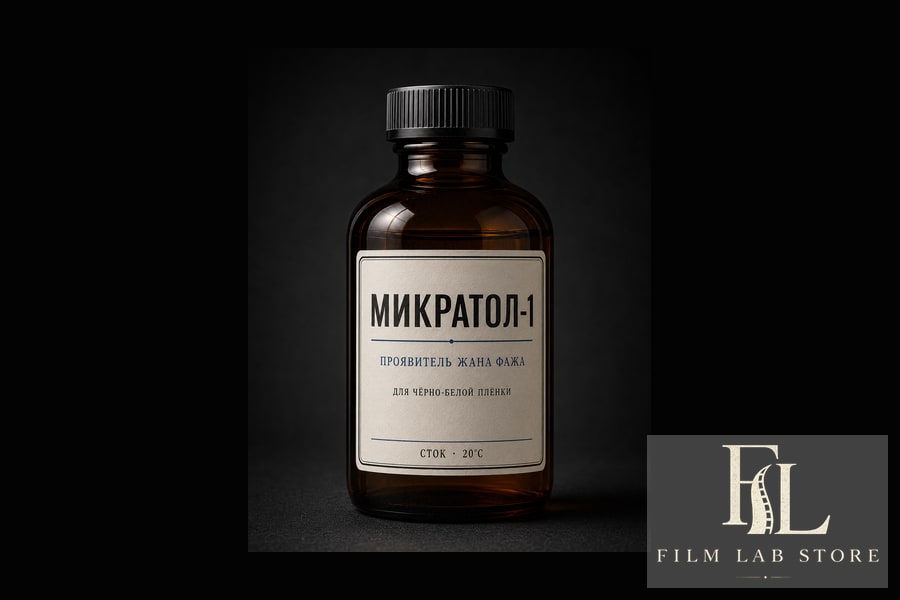
Micratol-1 (Jean Fajot's developer)
A highly concentrated phenidone-metol developer for Mikrat technical films that increases equivalent sensitivity without increasing overall contrast.
About this developer
Mikratol-1 was developed for a specific purpose: to extract the maximum equivalent sensitivity from Mikrat series technical films without enlarging the grain or increasing the contrast beyond what is necessary. There are two ways to use it. The first is to mix stock solutions A and B in equal parts and dilute the resulting mixture with water at a ratio of 1:19; this working solution is used only once. The second, two-stage method is more interesting: the film is first developed in a 1:19 dilution of Solution A—at this stage, development is gentle, with active detail rendering— — and after 7 minutes, solution B is added while continuing to rotate the spiral, and processing continues for another 12–16 minutes. It is during this second stage that the film’s sensitivity increases—while the grain size remains virtually unchanged.
Character
The developer, also known as Jean Fage’s developer, consists of two stock solutions—A (metol) and B (phenidone + hydroquinone + potassium). An important feature: it does not increase the overall contrast of the image—instead, it increases the film’s equivalent sensitivity. It operates in two modes: by mixing A and B in a 1:1 ratio followed by a 1:19 dilution, or by sequential two-stage development (first in the diluted solution A, then with the addition of solution B).
Best films
Mikrat-Isopan (M-300), Mikrat-Ortho (M-200), and similar technical halftone films.
How to Prepare and Use
- 1Method 1: Mix solutions A and B in a 1:1 ratio, then dilute the resulting mixture with water in a 1:19 ratio (for example, 10 mL each of solutions A and B per 400 mL of water at 20°C); if necessary, add an anti-fogging agent, such as benzotriazole, for old film.
- 2For Method 1, rotate the spiral 3–5 times per minute; total development time is about 7 minutes (for Mikrat-300: 25 units — 18 min, 50 units — 21 min, agitating 3 turns every 3 min).
- 3Method 2: Dilute Solution A with water in a 1:19 ratio (about 20 mL of Solution A to 330 mL of water), and develop the film for 7 minutes while stirring continuously.
- 4While continuing to rotate the spiral, add about 20 ml of Solution B to the tank and continue developing for another 12–16 minutes.
Pros
- A Significant Increase in the Equivalent Sensitivity of Mikrat Technical Films
- The two-stage method causes almost no grain enlargement
- Economical usage—the working solution is prepared from small portions of stock solutions
Cons
- Highly specialized—designed specifically for Mikrat film, not for mass-market film
- Two different application modes complicate the process
- The working solution is for single use only
- The source does not specify the exact total storage period for reserve solutions beyond the mandatory 24-hour holding period
Two backup solutions, 1 liter each
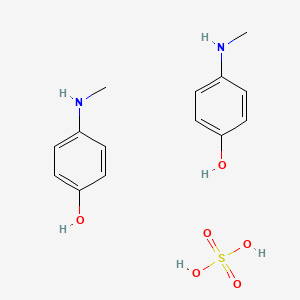
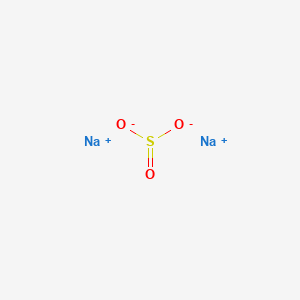
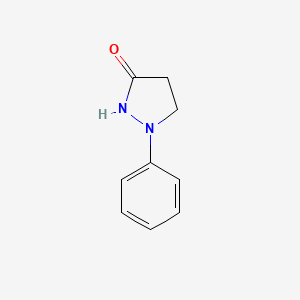
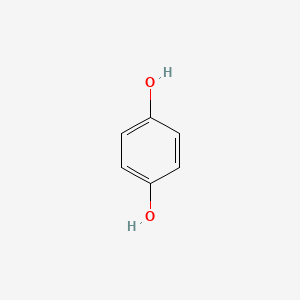
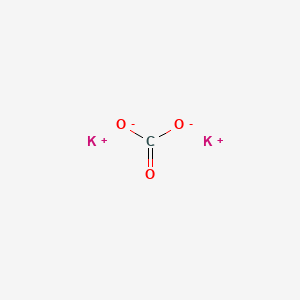
Chemical structures: PubChem (public domain)
Mixing it at home
A two-solution developer for Mikrat technical films; solutions A and B are aged at least 24 h before use.
- 1Prepare Solution A: Dissolve metol and anhydrous sodium sulfite in distilled water to a total volume of 1 L.
- 2Prepare Solution B: Dissolve phenidone, hydroquinone, sodium sulfite, and potassium sulfite in distilled water to a total volume of 1 L.
- 3Let both reserve solutions settle for at least 24 hours before use.
Key points
- Jean Fajot's developer: two stocks — A (metol) and B (phenidone–hydroquinone–potash) — held for at least a day before use.