Film Chemistry Guides
Practical home-photochemistry guides: reagent substitution, reducing grain, antifoggants, storing solutions in winter, and safety.

Interchangeability of reagents
What can and cannot be substituted in a developer formula—from the developing agent to the antifoggant.
Reducing Graininess
Where does grain come from on negatives and prints, and how can it be minimized—from shooting to printing?
Solutions in Winter: Precipitation and Crystallization
Why do developer concentrates and solutions with high salt content not tolerate cold well—and how can you salvage them if crystallization has already begun?
Antifoggants
How and when to add additional anti-haze agents—benzotriazole and potassium iodide—to the developer.
Two-bath developers
How do the “Leika News” and “Shtikler” developers work, and why does the two-bath process make it nearly impossible to overdevelop the film?
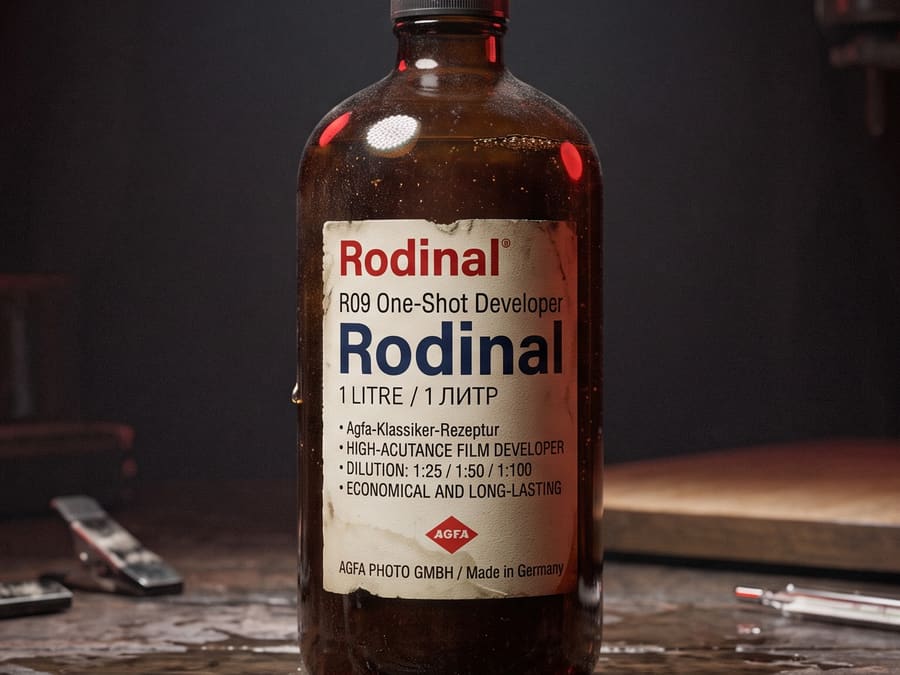
A Few Things About Rodinal
Practical Tips for Working with "Rodinal" Developer: Storage, Dilution, Temperature, and Common Misconceptions About Push Processing and Expired Film.
Commonly Used Reagents
A brief guide to the photochemical reagents most commonly found in formulas for black-and-white developers, fixers, and auxiliary solutions.
Prohibited Substances
Which photochemical reagents are subject to regulatory control as precursors or toxic substances—this is background information, not instructions.