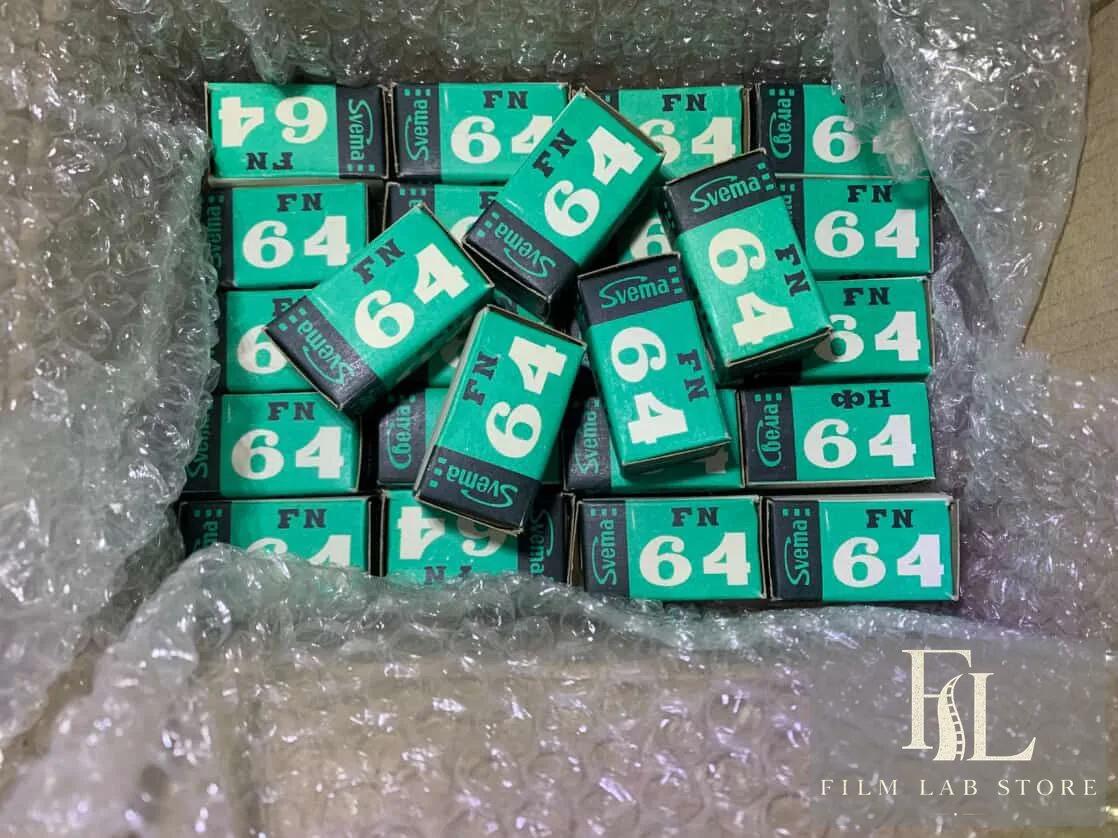
Sometimes, along with an old camera, a family archive, or a box in the attic, you’ll find a roll of film that no one remembers anything about. The cassette may be labeled “65 GOST,” “NP20,” “UT21,” “DIN 21°,” or simply feature the logo of Svema, Tasma, ORWO, Kodak, Fuji, or Agfa.
The first question is usually the same: What is its ISO, and can I still take pictures with it?
With modern Kodak, Ilford, Fujifilm, or Foma films, it’s relatively simple: the ISO is usually printed right on the box or cartridge. With older Soviet, East German, Japanese, European, or rewound films, you have to take a closer look.
In this article, we’ll explore how to determine the sensitivity of old film, how to convert ASA, DIN, and GOST to the modern ISO standard, what to do with Svema, Tasma, and ORWO, and why you shouldn’t always shoot old film exactly as instructed on the box. If you’ve just found some film and aren’t sure where to start, check out my separate guide "I found an old roll of film—what should I do?".
In Brief
- ISO indicates the film's sensitivity to light: the higher the ISO, the less light is needed for exposure.
- ASA In terms of numerical value, it is virtually equivalent to the current ISO standard.
- DIN — German logarithmic system: 21° DIN ≈ ISO 100.
- GOST — the Soviet system; for older films, the ISO equivalents are often approximate (32, 65, 130, 250 GOST).
- The actual sensitivity of expired film may be lower than its rated sensitivity.
- Once the film has been exposed, you can no longer change the ISO—the main task is to determine the correct development process.
- It's best to evaluate old film not only by the number on the box, but also by the type of material, age, storage conditions, and condition.
If the film is already inside the camera, do not open the camera in the light. A single careless movement could expose frames that have been stored inside for decades.
What Is Film ISO in Simple Terms
ISO refers to a photographic film's sensitivity to light. Simply put, it is the speed at which the film "responds" to light.
You can think of ISO as a measure of hearing sensitivity. One person can hear a soft whisper, while another needs to be spoken to more loudly. It’s a similar story with film: one emulsion requires a lot of light, while another can produce an image with less light.
| ISO | What does this mean in practice? |
|---|---|
| ISO 25–50 | Slow film; requires plenty of light—a bright day, a studio, a tripod |
| ISO 100 | Versatile, low-sensitivity film for daytime photography |
| ISO 200 | A compromise between quality and light output |
| ISO 400 | A popular sensitivity setting for outdoor, overcast, and everyday photography |
| ISO 800–1600 | High sensitivity in low light, but usually with more noticeable grain |
The higher the ISO, the shorter the shutter speed can be, or the more you can close the aperture. For example, ISO 400 film requires 4 times less light than ISO 100—that’s two stops of exposure: ISO 100 → ISO 200 → ISO 400.
The number on the box indicates the film's sensitivity at the time of manufacture, not necessarily its actual sensitivity today.
If the film is 30–40 years old, it may have lost some of its sensitivity—especially if it was stored in heat, humidity, in an attic, in a garage, or simply in an unknown location. That’s why you can’t always shoot old film strictly “as written on the box.”
ASA, DIN, ISO, and GOST: What's the Difference?
Older packages often use different systems for indicating sensitivity: ASA, DIN, ISO, and GOST. They all describe roughly the same thing—the sensitivity of photographic material to light—but they do so in different ways.
ASA
ASA — the American sensitivity system. In practical photography, it corresponds almost exactly to the modern ISO standard.
| ASA | An example of a modern ISO |
|---|---|
| ASA 25 | ISO 25 |
| ASA 50 | ISO 50 |
| ASA 100 | ISO 100 |
| ASA 200 | ISO 200 |
| ASA 400 | ISO 400 |
| ASA 800 | ISO 800 |
If the old box says 100 ASA, this can be considered as ISO 100.
DIN
DIN — the German logarithmic system. It is expressed in degrees: 18° DIN, 21° DIN, 24° DIN, and so on. The general rule is that every +3° DIN corresponds to approximately a doubling of sensitivity.
| DIN | ISO / ASA |
|---|---|
| 15° DIN | ISO 25 |
| 18° DIN | ISO 50 |
| 21° DIN | ISO 100 |
| 24° DIN | ISO 200 |
| 27° DIN | ISO 400 |
| 30° DIN | ISO 800 |
| 33° DIN | ISO 1600 |
If you find the inscription 21° DIN, that's roughly ISO 100. If 27° DIN — approximately ISO 400.
ISO
ISO — an international system that combines the arithmetic and logarithmic notations. Therefore, on the film, you may come across the notation ISO 100/21°:
- 100 — arithmetic part, equivalent to ASA;
- 21° — logarithmic scale, equivalent to DIN.
In everyday photography, only the first part is usually used: ISO 100, ISO 200, ISO 400.
GOST
GOST — the Soviet sensitivity system. This is the system most commonly found on old Svema, Tasma, and other Soviet films. The packaging may list the following values: 16, 32, 65, 130, 250, or 350 GOST.
The problem is that the old GOST standard does not always fully correspond to the current ISO standard. Standards have changed over time, and the materials themselves may have been manufactured for decades. Therefore, it is better to use an approximate range rather than a strict equivalence.
| Marking on the film | An example of a modern ISO |
|---|---|
| 16 GOST | around ISO 16–20 |
| 32 GOST | around ISO 32–40 |
| 65 GOST | around ISO 64–80 |
| 90 GOST | around ISO 100 |
| 130 GOST | around ISO 125–160 |
| 180 GOST | around ISO 200 |
| 250 GOST | around ISO 250–320 |
| 350 GOST | around ISO 400 |
These values are a rough guide, not laboratory-grade precision. This is especially true for old, expired, or film whose storage conditions are unknown.
Where to Find Information on Film Sensitivity
Identifying old ISO film often starts with a careful inspection. Don’t be quick to throw away the box, the instructions, the paper wrapper, or the old cartridge: sometimes that’s exactly where the most important information is found.
On the box
The box is the best source of information, if it has been preserved. It may include the following:
- ISO, ASA, DIN, or GOST;
- film type and development process;
- expiration date;
- manufacturer, series, or name of the emulsion.
For example: ISO 100/21°, 65 GOST, ORWO NP22, Kodak Gold 200, Fujicolor C-41.
On 35 mm film
A 35-mm film cartridge usually has a label indicating the film name, ISO, number of frames, and development process. But there’s an important problem with old cartridges: the contents don’t always match the label. During the Soviet era, film was often rewound by hand, so a Kodak, Svema, or ORWO cartridge might actually contain a completely different type of film.
On a paper roll of 120 film
With 120 medium-format film, information is often printed on a paper leader: the manufacturer's name, film type, frame number, and sometimes the ISO speed and additional markings.
If the 120 film has not been exposed, do not unroll it in the light. The protective sleeve protects the film, but the film itself underneath is sensitive to light.
On the factory label or metal cassette
Some older films were sold in reusable metal cassettes or with paper factory labels. Even if the lettering has partially worn away, you can sometimes make out the remnants: “Foto-65,” “130 GOST,” “NP20,” “DIN 21,” “Color negative,” “Reversal.”
On a spool, can, or tape
With old motion picture film, sheet film, or roll film, the information may be printed on the spool, box, can, or paper strip. This is especially true for Svema, Tasma, Kodak, and ORWO motion picture film, as well as technical film.
In the instructions inside the box
Old Soviet packages sometimes included a paper instruction sheet listing the film's speed, recommended processing, filters, development settings, and intended use.
By DX code
Newer 35-mm film cartridges feature a DX code—a metal code on the casing that the camera can read automatically. It may indicate the ISO, but there are limitations for older film:
- The DX code may be missing;
- the cassette might have been rewound;
- The code may not match the content;
- Older mechanical cameras often don't use DX at all.
Therefore, the DX code is useful, but it is not conclusive proof.
Based on the markings on the perforations after development
After development, edge markings—factory markings along the perforations—are sometimes visible on the edge of the film. These can indicate the film type: Kodak Gold, Fujicolor, Ilford HP5, ORWO NP22, Fomapan, Agfa, Svema. This method is useful after development, when you need to determine exactly what was inside the cartridge.
How to Determine the ISO of Soviet and Eastern European Film
For audiences in Ukraine, the most common types of film include Svema, Tasma, ORWO, film from family archives, rewound cassettes, and materials that have been sitting alongside an old camera for decades. The key here is not to guess the ISO based on a single word on the packaging, but to look at the full set of characteristics: name, GOST standard, type of material, year of manufacture, packaging, and intended use.
Svema
Svema is one of the most common brands found in Ukraine. On older packages and cassettes, you may see: Svema FN, FT, DS, TsND, TsNL, MZ, Foto, Mikrat, isopanchromatic and panchromatic film, as well as motion picture film rewound into cassettes.
If it says “Foto-65” or “65 GOST,” you can use ISO 64–80 as a rough guide. If it says “Foto-130,” use ISO 125–160 as a rough guide. But this is just a starting point.
Not every Svema roll was ordinary consumer photographic film. Some rolls might have been motion picture film, technical film, microfilm, or specialty film—with unusual contrast, non-standard spectral sensitivity, and requiring a careful approach to development. Rewound cartridges present a particular challenge: a Svema label does not always guarantee the contents.
Tasma
The Tasma brand produced not only consumer photographic materials, but also technical, aviation, cinematographic, and specialty films: Tasma Photo, Type 17, Type 42, aerial photography films, technical materials, and motion picture films.
You need to be especially careful with these types of materials. Aerial film or technical film can be very high-contrast and not intended for general photography. You can use it creatively, but it’s best to determine the correct exposure and development settings through test shots.
ORWO
ORWO is an East German manufacturer whose film is still frequently found in old stockpiles.
| ORWO | Type / Purpose | ISO Rating |
|---|---|---|
| ORWO NP15 | black-and-white negative | ISO 25 |
| ORWO NP20 | black-and-white negative | ISO 80 |
| ORWO NP22 | black-and-white negative | ISO 125 |
| ORWO NP27 | black-and-white negative | ISO 400 |
| ORWO UT18 | reversible / slide-type | ISO 50 |
| ORWO UT21 | reversible / slide-type | ISO 100 |
| ORWO UT23 | reversible / slide-type | ISO 160 |
| ORWO NC | color negative | depends on the emulsion |
| ORWO CHROM | color, reversible | depends on the emulsion |
The designation NP stands for black-and-white negative film, UT for reversible film, NC for color negative film, and CHROM for color reversible film. But even with a known nominal sensitivity, the age of the film greatly affects the result: ORWO NP22 may be rated ISO 125 on the box, but after decades of storage, its actual working sensitivity will be lower.
Kodak, Fuji, Agfa, Foma, Forte, Konica, Efke, Rollei, Adox, Ilford
With Western and modern brands, it’s usually simpler: the ISO is most often listed directly on the box or cassette—Kodak Gold 200, Fujicolor 100, Ilford HP5 Plus 400, Fomapan 100, Agfa Vista 200, and so on. But the same restrictions apply to older batches:
- The film could have expired decades ago;
- Storage conditions are unknown;
- the cassette might have been rewound;
- the color process could have been outdated or non-standard;
- Results are not guaranteed.
What to Do If the ISO Is Unknown
If the sensitivity is not specified or the marking has been erased, it is best to follow the procedure.
Step 1. Do not open the camera if there might be film inside
If you find an old camera with film inside, don't open the back cover in the light. Even a single accidental movement can ruin the photos that have been sitting inside for decades.
If you're not sure whether the film has been exposed or not, it's best to first have a professional check the camera or carefully rewind the film into the cartridge—but only if you fully understand how that particular camera works.
Step 2. Take a photo of the cassette, box, reel, and camera
Take a few clear photos:
- a general view of the cassette and close-ups of all the labels;
- the box on all sides;
- a paper tape and a reel;
- a camera, if there's film inside;
- any remaining instructions or packaging.
Often, even a small fragment of an inscription can help identify the material.
Step 3. Look for any numbers next to ASA, DIN, ISO, or GOST
Look for the following designations: 100 ASA, 21° DIN, ISO 100/21°, 65 GOST, 130 GOST, 250 GOST. If you see DIN, use the DIN table; if you see GOST, use the GOST table as a rough guide.
Step 4. Determine the type of film
ISO is only part of the equation. It's important to understand what you're dealing with:
- black-and-white or color negative film;
- slide film / reversible film;
- film, microfilm, or aerial film;
- technical material or sheet film;
- Old Soviet film processed using a non-standard process.
The type of film affects not only the exposure but also the development.
Step 5. Take into account expiration dates and storage
Old film may have lost its sensitivity. This is influenced by age, storage temperature and humidity, protection from light, original ISO, emulsion type, whether it is color or black-and-white, negative or slide film, and whether it was stored in the refrigerator. Low-speed films generally age more slowly than high-speed films; cold significantly slows down degradation, while heat and humidity worsen the outcome.
Step 6. Run a test if the film is not unique
If you have several rolls of the same film, it’s best to test one of them: shoot a test strip with different exposures or cut off a small section to check the condition of the emulsion. For older films, a test is often more useful than any chart.
Step 7. If the film is one-of-a-kind, don't experiment
Whether it’s a family archive, film from an old camera, or a single cassette with unknown footage, it’s best not to take any chances. The goal isn’t to “guess the ISO,” but to carefully identify the material and choose the safest possible method of development.
How to Take Shutter Speed into Account When Choosing an ISO Setting for Photography
A common rule of thumb for color negative film is to add approximately +1 stop of exposure for every 10 years the film has expired. In practice, this means that you can try shooting ISO 400 film that’s twenty years past its expiration date not as ISO 400, but as ISO 100–200. But this is a rough rule of thumb: it doesn’t take storage conditions into account and doesn’t work well as a universal formula.
Example 1. ISO 400 color negative film, 20 years past its expiration date
If the film has been stored under unknown conditions, you can try exposing it at ISO 100–200. This isn't a guarantee, but this approach often increases your chances of getting a dense negative that can be scanned.
Example 2. ISO 100, 10–20 years past due
If the film was stored properly, you can try ISO 50–100. If it was kept in the refrigerator, it may have retained its sensitivity better. If it was stored in the heat, the results may be worse.
Example 3. ISO 100 slide film, 20 years past its expiration date
Slide film is less forgiving of exposure errors: it has a narrower dynamic range, and color shifts are more noticeable. It’s best not to use it for important shots. If you really want to give it a try, use exposure bracketing and be prepared for unpredictable results.
Example 4. Soviet 65 GOST film
GOST 65 can be roughly equated to ISO 64–80. However, if the film is 30–40 years old, the actual sensitivity may be lower—it’s best to run a test, especially if the film isn’t one-of-a-kind. For more details on choosing the exposure for old film, see the article "Expired Film—How Do You Take Pictures With It?".
What to Do with Old Film That Has Already Been Exposed
Once the film has been exposed, you can’t change the ISO setting—the frames have already been exposed. At this point, the key factor isn’t sensitivity, but correctly identifying the film stock and choosing the right development process.
You can't just develop everything like a standard C-41—especially if it's old Soviet film, ORWO, motion picture film, slides, microfilm, or an unknown material. You need to understand:
- color film or black-and-white film;
- negative or reversible;
- photographic film or motion picture film;
- is the process modern or outdated;
- Is there a risk of heavy fogging, and can it be developed using standard chemical processing?;
- Is there any point in developing it as a black-and-white image if color processing isn't possible or is too risky?
Old color film may exhibit heavy veiling, low contrast, color shifts, spots, an unstable mask, and partial image loss. Old black-and-white film may exhibit a veil, increased grain, a drop in sensitivity, spots, uneven emulsion, and low image density.
Sometimes the result turns out surprisingly good; other times, it’s barely legible. There’s only one honest approach: no one can guarantee a 100% result for old, found film.
If this is an important family archive, it’s best to assess the risks first rather than just winging it. This page can help you identify the materials and choose a safe process "Developing and Scanning Photographic Film".
Common Mistakes
Open the camera in a well-lit area
The most dangerous mistake. If there was exposed film inside, the frames may be overexposed.
Consider GOST to be an exact equivalent of ISO
It’s convenient to think of 65 GOST as roughly equivalent to ISO 64–80, but for older film, this is only a rough guide.
Trust only the box
An old cassette might contain rewound film, and the box might not have originally belonged to that particular reel.
Remove expired film strictly according to its face value
Sometimes this works, especially if the film has been stored in a cool place. But if you don't know the storage conditions, it's best to account for a possible loss of sensitivity.
Develop an unknown color film using the C-41 process
Not all color film is C-41. Older processes, slide film, and motion picture film require special attention.
To regard the DX code as the absolute truth
The DX code is useful, but if the cassette has been rewound, it may not reflect the actual contents.
What to Do Right Now
If you've found some old film:
- Do not open the camera, if the film is inside.
- Take a photo of the cassette, the box, the reel, and all the labels.
- Look for any ISO, ASA, DIN, or GOST designations.
- Identify the manufacturer: Svema, Tasma, ORWO, Kodak, Fuji, Agfa, Foma, Forte, Ilford, or another.
- Try to figure out the type of film: black-and-white, color negative, slide, motion picture film, or technical film.
- Take into account the age and storage conditions.
- If the film is one-of-a-kind or has already been exposed, don't experiment blindly.
- Store the film you have found in a cool, dry place until you can have it evaluated or developed.
How FilmLabStore Can Help
If you've found some old film and aren't sure what kind it is, you can send photos of the cartridge, box, spool, or the camera itself. Often, the labeling, packaging, and details can help you figure out what kind of film it is, what its approximate ISO is, and whether it’s worth trying to develop it.
FilmLabStore isn’t just another faceless store—it’s a personal project by a photographer and analog photography enthusiast. I have a practical interest in old Soviet, Eastern European, and rare film stocks: Svema, Tasma, ORWO, Forte, Foma, Agfa, Kodak, Fuji, as well as old motion picture film and rewound cassettes.
If the film has already been shot—especially if it’s part of a family archive—it’s best to first identify the material and assess the risks, and only then make a choice developing and scanning. Useful resources on this topic:
- I found some old film—what should I do?
- Expired Film—How to Shoot With It?
- How to Store Film at Home
- How to Choose Your First Film Camera
FAQ
How can I find out the ISO of an old roll of film?
First, check the box, the cassette, the paper label, the instructions, and any markings on the packaging. Look for ISO, ASA, DIN, or GOST markings. If there are no markings, identify the film based on the manufacturer, film type, the cassette’s appearance, and other characteristics.
How many ISO standards correspond to 65 GOST standards?
For practical shooting, 65 GOST can generally be considered equivalent to approximately ISO 64–80. However, for old, expired film, this is only a rough guide: the actual sensitivity may have decreased.
What is the ISO equivalent of GOST 130?
GOST 130 roughly corresponds to ISO 125–160. For older film, it’s best to take into account its age and storage conditions and perform a test if the material isn’t unique.
Are ASA and ISO the same thing?
For practical photography—almost. ASA 100 corresponds to ISO 100, and ASA 400 corresponds to ISO 400. If an old box lists ASA, you can usually treat it as the modern ISO equivalent.
What is the ISO equivalent of DIN 21°?
21° DIN corresponds approximately to ISO 100. 18° DIN corresponds to ISO 50, 24° DIN to ISO 200, and 27° DIN to ISO 400.
Is it possible to shoot on unmarked film?
It's possible, but it's risky. First, it's best to determine the type of material: black-and-white, color, slides, motion picture film, technical film, or microfilm. If there are several rolls of film, it's best to do a test run.
What should I do if the film has already been shot?
Do not open the film cartridge or camera in direct light. The ISO setting cannot be changed at this point. The main goal is to identify the type of film and select the appropriate development process.
Is it possible to develop old Soviet film?
Sometimes, yes. However, the result depends on the age, storage conditions, type of emulsion, and condition of the material. Hazing, low contrast, spots, and partial image loss may occur. I cannot guarantee the result.
How can you tell if it's a color film or a black-and-white film?
The film name, markings, box, development process, and manufacturer can all be helpful. Words like “color,” “colour,” “chrom,” “NC,” and “C-41” are often associated with color film, but when dealing with older films, you shouldn’t draw conclusions based on just one word.
Should you lower the ISO on expired film?
Often, yes. For color negative film, a guideline of +1 stop for every 10 years of expiration is sometimes used. But this isn't a universal rule—it all depends on storage conditions, age, original ISO, and film type.
Brief Conclusion
You can often determine the ISO rating of old film based on its ASA, DIN, ISO, or GOST markings. ASA corresponds almost directly to ISO; DIN is converted using a table; and for Soviet films, GOST is best regarded as a rough guide.
But for old photographic film, the number on the box is just the beginning. What matters are the film’s age, storage conditions, the type of material, and the likelihood that the film has been rewound.
If the film hasn’t been exposed yet, you can carefully adjust the exposure and take a test shot. If it has already been exposed, the main priority isn’t the ISO, but correctly identifying the film stock and safely selecting the development process. Sometimes it’s better to show the cartridge to a specialist first rather than lose frames due to accidentally opening the camera or developing an unknown film “as if it were standard C-41.”