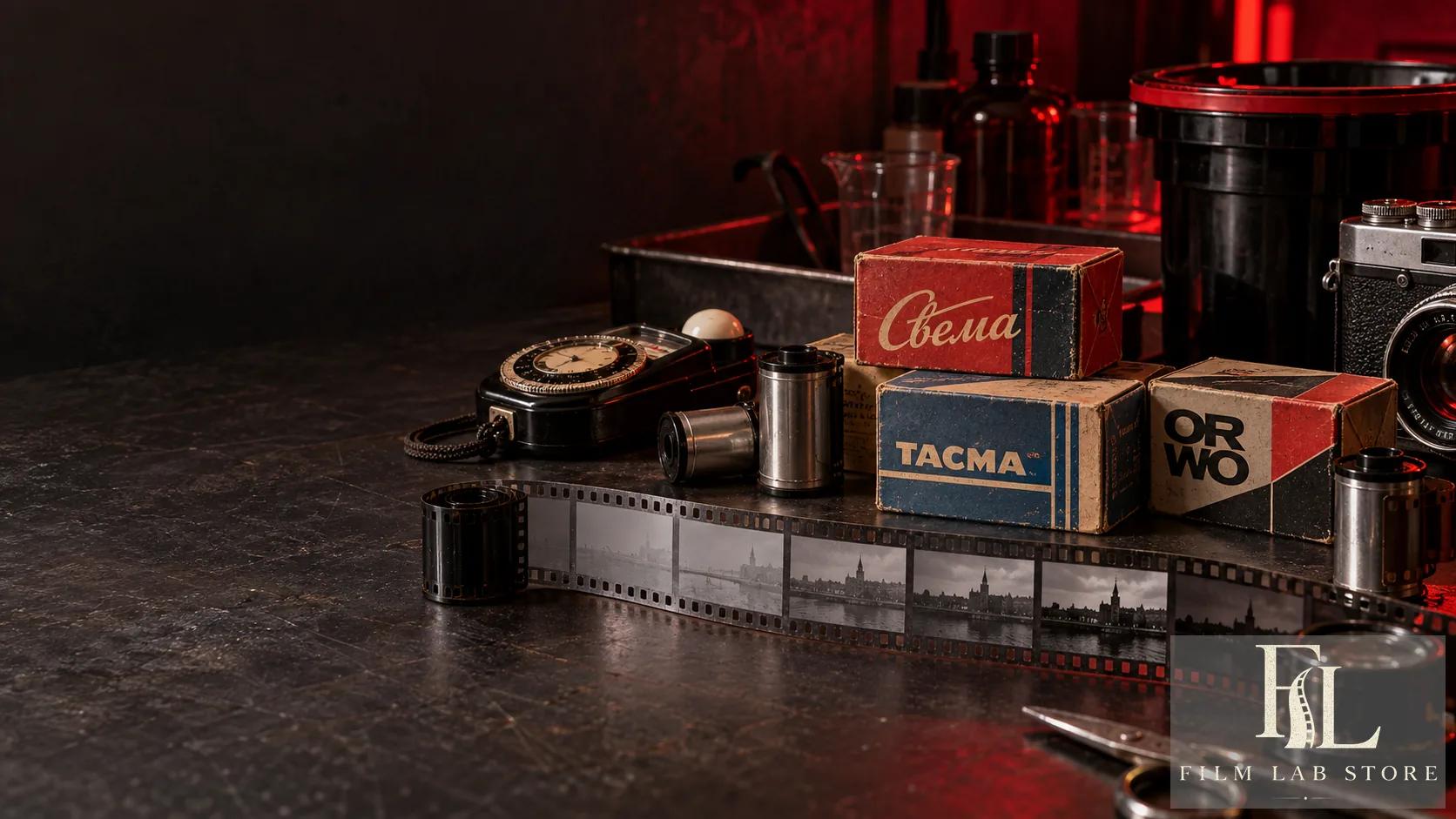
An old roll marked Svema, Tasma or ORWO may turn out to be perfectly usable film. It may also be a technical stock with unusual spectral sensitivity, a colour material made for a process that disappeared decades ago — or a roll that has already been shot and still holds someone's pictures.
That is why "what ISO should I set?" is the wrong first question. First you need to know what material you are holding, which generation it belongs to, whether it may already have been exposed, and which process it was made for. Only then does it make sense to choose an EI, run a test or talk to a lab about development.
It also helps not to lump different historical groups together. Svema and Tasma were Soviet manufacturers. Historical ORWO was an East German brand. Modern films sold as Svema, Astrum or ORWO are a separate story again: a familiar name does not prove the emulsion is the one made decades ago.
In short: what to do with old film
- Could the film have been shot? Do not open the cassette or the camera in the light, and do not try to "give it a new ISO". The exposure has already happened. The job now is to preserve whatever latent image is left and choose a sound way to develop it.
- Is the film definitely unused? Identify its exact designation and original process. If it is an ordinary black-and-white negative, test several EIs on one batch. That is more reliable than calculating speed from age.
- The "one stop per decade" rule is only good as a rough starting guess for some negative films. For slide film, technical stocks and anything with an unknown storage history it is close to useless.
- Does the box say ORWO NC, ORWO UT, NK-2Sh, A-2Sh, 25L, 42L or Mikrat? Find out the purpose and the process first. "Old", "colour" or "motion picture film" is not enough to choose chemistry.
The first question: are you sure the film was never shot?
This matters more than age or box speed.
Take two identical-looking rolls of Foto-64. The first sat sealed in its factory box. You can experiment with it: shoot a series at different exposures, develop it and find a working EI for that batch. The second turned up inside a camera in a cupboard, and it may hold pictures thirty or forty years old. Shooting test frames on it or opening the camera back is out of the question — that is the easiest way to destroy what survived.
If the film may have been shot
Treat it as exposed if:
- it is inside an old camera;
- the cassette's history is unknown;
- the roll was ever loaded or rewound;
- there is any doubt at all whether it was used.
In that case no new EI is chosen: the light reached the film in the past, and no "age correction" changes that. Do not pull the film out into the light to look at the emulsion, the edge markings or the perforation. Photograph everything readable from the outside instead — the cassette, box, can and any markings on the camera — and show those photos to the lab before development.
I walk through what to do with a found camera step by step in Found old film — what to do?
If the film is definitely new
Then you can move on to identification and testing. But "new" here only means unexposed. A 1985 roll that nobody ever touched is still an aged material.
How to identify the film in your hands
The best source of information is not an internet table but the original packaging and data sheet. The Soviet standard GOST 24876-81 required the insert to state the nominal speed, exposure advice, filters, processing and storage. A surviving insert can be worth more than a dozen forum threads.
What to copy from the packaging
- the full name of the material, with every letter and index;
- the manufacturer, if stated;
- the batch number;
- the production date and expiry ("process before");
- the GOST number;
- the speed and the system it is given in: ASA, DIN, GOST or ISO;
- the stated process;
- the format, width and type of perforation;
- any additional codes.
Copy the designation in full. NK-2 and NK-2Sh cannot be treated as one material just because the names look alike, unless it is proven otherwise. The same goes for the Mikrats: Mikrat-negative (orthochromatic) and Mikrat-Ortho direct-positive are different materials, and the parameters of one do not carry over to the other.
How to read the ASA, DIN and GOST systems themselves is covered in How to determine the ISO of old film. What matters more here is which version of the designation you have and which period it comes from.
Why the year and the GOST number really help
Soviet black-and-white films of one standard family changed names. Under GOST 24876-81:
- in 1987 Foto-65 and Foto-130 were renamed Foto-64 and Foto-125, and the standard states explicitly that the new designations correspond to the old ones;
- in 1991 the family name "Foto" was replaced by "FN".
So Foto-65, Foto-64 and FN-64 are not random spellings but different eras. The date, the standard number and the designation together tell you far more about the generation than a single number on the box.
It follows that the marking FN-64 on its own does not prove the film was made by Svema. Designations like this were written into a union-wide standard. To identify the factory you need other evidence: the packaging, the insert, the batch.
Svema, Tasma and ORWO are not one category
"Old Soviet film" is far too blunt a label here.
Historical Svema
Svema made a wide range of photographic and special-purpose materials. For a specific roll, the brand is only part of the picture. What matters is the whole chain: who made the emulsion → who coated it → who cut and packed it → who sells it. Sometimes that is one organisation, sometimes several.
Historical Tasma
Tasma was a separate manufacturer, not "another Svema". Old cans and bulk rolls often contain special materials — NK, A-2Sh, Tip-17 and others. Attributing them to Tasma or Svema simply because those are the two names photographers have heard most is not justified. If the factory cannot be established from the packaging, a data sheet or another reliable source, the honest answer is "manufacturer not established".
ORWO from the GDR
ORWO is not a Soviet brand. Historical ORWO was made in the German Democratic Republic. A documented example of ORWO NP15 (ASA 25), for instance, was produced by VEB Filmfabrik Wolfen. Soviet standards do not apply to it, and it should not be confused with modern products sold under the same name.
Modern ORWO
Today ORWO/WOLFEN makes, among others, UN54 and N74 plus, and publishes current processing regulations for them. UN54 alone has separate black-and-white negative and reversal procedures, so even within modern ORWO there is no single process.
That is why modern UN54 is not "old ORWO under a new name" but a current material with its own documentation. Advice for forty-year-old NP, NC or UT does not transfer to it, and vice versa.
Modern Svema/Astrum
Foto-32, 64, 100, 200 and 400, 25L, 42L, NK-2Sh, A-2Sh and both Mikrats are on sale again under their historical names. I sell them too — here is the current Svema range. The brand on the box confirms the trade name, but it does not answer:
- where the emulsion was made and where it was coated;
- who made the base;
- who cut and packed the film;
- whether it matches the historical material with the same index.
If a specific material has no confirmation from its manufacturer, the right thing is to treat the emulsion's origin as not established, rather than filling the gap from the packaging.
A quick map of designations
| What it says | What you can assume | What to check next |
|---|---|---|
| Foto-32, 65, 130, 250 | Soviet black-and-white negative family (before 1987) | Year, GOST, factory, batch |
| Foto-64, 125 | The same family after the 1987 renaming | Year and manufacturer |
| FN-32, 64, 125, 250 | Black-and-white negative designation after 1991 | The factory cannot be read from the index |
| ORWO NP… | Historical black-and-white ORWO | Exact type, year, data sheet |
| ORWO NC… | Historical colour negative | The original colour process |
| ORWO UT… | Historical reversal (slide) film | The original reversal process |
| ORWO UN54, N74 plus | Modern materials | The manufacturer's current documentation |
| NK, A, 25L, 42L | Special-purpose material | Purpose and data sheet |
| Mikrat | Technical family | The full index and image type |
The main rule of this table: the number in the name is not always a modern ISO.
Can you identify film by how it looks?
Appearance sometimes narrows the search, but it will not reliably tell you the process. Format and perforation hint at the purpose. Edge markings, after development, can confirm the stock. The base colour is an indirect clue. But none of these signs confirms the popular shortcuts:
- 35 mm motion picture film does not mean ECN-2;
- motion picture film does not mean it has a remjet layer;
- colour negative does not mean C-41;
- colour slide does not mean E-6.
And that is why an unknown cassette should not be opened in the light just to take a look.
Box speed, ISO and EI are not the same thing
This is the key technical point of the whole article.
- Box (rated) speed describes the material when it was fresh. The manufacturer determined it by its own method and for its own process. It tells you what the film was like then.
- ASA, DIN, GOST, ISO are systems for expressing speed. For Soviet materials the production period matters: identical numbers on boxes from different eras do not always mean the same modern ISO.
- EI (Exposure Index) is the number the photographer actually sets on the meter. If a film is rated 100 and after testing I shoot it at EI 25, that does not mean it has become ISO 25 by the standard. I have simply found a practical exposure for that batch and that process.
- The practical speed of an old batch comes from its age, storage conditions, original speed, base fog, spectral sensitivity, the light, the developer, the development regime, and how much shadow detail you need.
Even the Soviet standard treated speed and fog as separate parameters. GOST 24876-81 allowed speed to fall by up to 30% and fog density to rise by up to 50% by the end of the guaranteed shelf life — and that was within the guarantee, under standard storage at 14–22 °C and 50–70% relative humidity. So an exact EI cannot be calculated from the production year alone.
What about "one stop per decade"?
As a mnemonic it is useful; as a formula it is poor. In the article on expired film I give it as a starting point for ordinary film. For historical and special-purpose materials it has limits.
Picture two rolls from 1985. One spent decades somewhere cool and dry, the other spent several summers in an attic. Same age, radically different condition. Ageing is also more than "lost ISO": fog rises, contrast shifts, and in colour films the balance between layers drifts. Extra exposure can pull more shadow detail out of an old negative, but it will not remove chemical fog or rebuild a damaged colour layer.
| Material | How to treat "one stop per decade" |
|---|---|
| Black-and-white negative | As a rough starting hypothesis, followed by a batch test |
| Colour negative | Not as a formula: overexposure does not fix aged layers or an incompatible process |
| Slide film | With particular caution: reversal film has little room for error in the highlights |
| Technical and aerial film | Almost meaningless without knowing the purpose, spectral sensitivity and gamma |
| Film already shot | Not applicable: the exposure happened years ago |
How to choose a starting EI for old black-and-white film
If you have an ordinary black-and-white negative that has definitely never been exposed, the best route is to test one batch. The ranges below are not manufacturer data but my suggested range for a first test.
Let the rated speed be N.
- Known, good storage: test N → N/2 → N/4.
- Several decades old, storage unknown: widen it to N → N/2 → N/4 → N/8.
The extra exposure in stops is ΔEV = log₂(N / EI). For a film rated 100:
| EI | Extra exposure |
|---|---|
| 100 | 0 EV |
| 50 | +1 EV |
| 25 | +2 EV |
| 12.5 | +3 EV |
This does not mean an old ISO 100 film must be shot at EI 12.5. It is just a grid that shows how much light a particular batch needs.
For slide film use finer steps, such as 0, +½ and +1 EV, and judge highlights and colour separately. For a technical film with no known rating, do not invent an "ISO": shoot a stepped series under your real light and process, and pick the working index after development.
If exposure still feels uncertain, start with How to shoot film.
How to run the test properly
The main rule: change one thing at a time. If you change the EI, developer, time, temperature and agitation all at once, the result explains nothing.
- Keep an unexposed control. A short piece is not shot but goes through the same development. It shows base plus fog. Without it you cannot tell whether a grey negative is exposure or age-related and chemical fog.
- Shoot one scene under constant light. You want deep textured shadows, midtones, light textured objects and a grey scale if you have one.
- Shoot an EI series. Only the exposure changes: 100 → 50 → 25 → 12.5.
- Develop the whole series the same way. One developer, one dilution, one temperature, one agitation scheme.
- Look at the negative first, the scan second. Judge the fog, shadow detail, midtone and highlight density, evenness and the condition of the emulsion.
Why a scan can mislead you
Scanner automation can make four very different negatives look alike. It lifts a thin frame, darkens a dense one, and moves the black point, white point and contrast. Then EI 100, 50 and 25 seem to "look the same" — but the software levelled them, not the film.
For a test, scan every frame with identical settings: one scanner exposure, one inversion, one curve, the same black and white points, no per-frame auto exposure. A nice-looking JPEG is not proof that the EI is right.
Can you carry the result over to another roll?
Confidently, only to film from the same batch, the same year, the same packaging and with a shared storage history. If one roll lived in a fridge and the other came from a flea market, that is a new experiment. The same name on the box does not guarantee the same condition.
How to choose the development process
The main rule: the process is chosen by the material, not by age, country or format.
Ordinary historical black-and-white negative
Standard Foto and FN films, suitable Tasma materials and historical ORWO NP can be developed in modern black-and-white chemistry. That is an adaptation, not the factory regime, so test the developer and time on an unexposed piece first. You will find starting times in my development library — but for an old batch a reference time is where the test starts, not a finished answer.
Historical colour negative
This is where it gets difficult. Old ORWO NC or Soviet colour film does not become C-41 just because it produces a colour negative: these materials were made for their own processes. Without the original instructions, modern development will be one of these:
- a reconstruction of the historical process;
- an adapted process;
- a deliberate cross-process;
- an attempt to get at least a black-and-white image.
None of these can be called standard processing.
ORWO NC and C-5168
Historical ORWO colour negative film is associated with the C-5168 process family. But finding a recipe table online is not enough: you need to establish the exact NC variant, its generation and the process documentation. So old NC should not be sent to C-41 by default. Identify it precisely first.
ORWO UT and reversal processes
UT is ORWO's historical reversal line. References to the C-9165 process turn up for it, but compatibility for a specific type has to be confirmed by documentation from its generation. E-6 does not become a standard substitute just because you are holding a colour slide film.
Motion picture film
"If it is motion picture film, it needs ECN-2" is a myth. ECN-2 is for the specific colour cine stocks designed for that process. Black-and-white cine films use other schemes. Modern ORWO UN54 is a good example: a cine material for which the manufacturer publishes its own black-and-white regulations. It is equally wrong to assume every cine film has a remjet layer.
Standard process, adaptation and cross-processing are different things
- Standard processing — the process the manufacturer designed the material for.
- Adapted processing — a modern scheme used instead of an unavailable historical process and verified by testing.
- Cross-processing — deliberate development in "foreign" chemistry, out of technical necessity or for the look.
- An attempt to recover the image — when accurate colour is no longer the priority and the goal is to get any surviving information off a unique roll. This most often applies to film from a found camera.
Which developer to choose for old black-and-white film
There is no universal "best developer for expired film". It is more useful to know which variable each developer changes and to compare it against a control.
| Developer | Role with old film | What not to expect |
|---|---|---|
| D-76 / ID-11 | A good neutral control that everything else is compared with | That it will remove age fog |
| D-23 | A simple formula for a comparison test | That a simple recipe makes it a rescuer of old film |
| HC-110 | Convenient for repeatable tests thanks to the concentrate | Dilutions from old tables do not fit every commercial version of the concentrate |
| Rodinal / R09 | Shows a different character of grain, sharpness and local contrast | That sharpness means better handling of a heavily fogged emulsion |
| Microphen | When effective film speed matters | That it will restore speed lost to ageing |
| Perceptol | When fine grain and detail come first | It was not designed to "restore expired film" |
| XTOL | A modern option for comparing shadows, grain and tonality | D-76 times do not carry over to it |
| D-96 | A logical candidate for a number of black-and-white cine films | "Cine film = D-96" is as wrong as "cine film = ECN-2" |
| Pyrocat HD | A specialist option for experienced users | Not suitable as the first reference for finding an EI: staining makes densities hard to compare |
I have collected formulas and dilutions in the recipe reference. For an old batch, two or three approaches are sensible: D-76/ID-11 as the control, one alternative developer and, if needed, a specialist one.
Why development time cannot be derived from the EI
Say a film is rated 100 and looks best at EI 25. That does not mean it needs longer development. Exposure and development control different parts of the result. If the shadows got no light, longer development will not create detail there — it will only raise contrast, highlight density and fog.
So "the film lost two stops → I shoot it at 25 → I develop X% longer" is wrong: there is no universal X. First you find the useful exposure; then, if needed, you adjust contrast through development. I cover the difference between underexposure and pushing in Push and Pull film processing.
What about stand and semi-stand development?
Strong dilution and minimal agitation can give interesting results, but they make a poor first reference for an unknown batch. With very long development, concentration, the minimum amount of developing agent per film area, temperature, local exhaustion and agitation all become critical. Unevenness and other effects are then easily mistaken for properties of the film itself. Get a repeatable control result first.
Benzotriazole and potassium bromide against fog
Both are used as anti-fogging restrainers: they hold back unwanted development and in some conditions reduce fog. But they are not a cure for age. They will not restore a damaged emulsion, bring back lost speed, create a latent image that has faded, or repair aged colour layers.
Strong restraint also suppresses useful shadow image, so "more is better" does not hold. A recipe like "add 1 ml of benzotriazole" without the stock concentration, the developer volume and its composition is technically incomplete. That is why there are no doses here: they call for a separate article and controlled tests.
A few practical examples
Svema with clear markings, unknown storage. The box reads Foto-64 or FN-64. Check the year, GOST, manufacturer, batch, expiry and the state of the packaging. If the film was definitely never exposed, bracket one batch. Do not decide in advance that "it is forty years old, so divide the ISO by four": age tells you a test is needed, not what it will show.
Tasma in a factory can of bulk film. A convenient case: you can sacrifice a short length without risking the whole roll. But copy the whole label first, especially if it is NK, A, Tip, aerial film or another special material. The number in the name is not necessarily an ISO.
ORWO NP20. Do not apply UN54 instructions to it just because both are called ORWO. NP20 is a historical material from another generation. Establish the period and rated data from the packaging, and run a black-and-white exposure test on an unexposed batch.
ORWO NC. The main question here is no longer the EI but the original colour process. Choosing C-41 by default is not an option. If the historical chemistry is unavailable, you can discuss an adapted process or an experimental attempt with the lab — but the result should not be presented as ORWO's intended colour rendering.
ORWO UT. This is a reversal material, and "slide → E-6" logic is not enough. Determine the exact type and historical process first. Any modern substitute is more honestly called an adaptation or a cross-process.
25L, 42L and other technical or aerial film. The main mistake is treating it like ordinary still film just because it fits in the camera. Technical materials can have unusual spectral sensitivity and contrast. For them it is more honest to talk about a working EI under specific conditions than to assign a universal ISO.
Fresh modern Svema/Astrum. Do not lower the EI because of the brand's historical name. This is a current product, not "expired USSR stock": start from the rated speed and the documentation for that batch.
Unknown film inside a camera. No test EI, no bracketing, no "maybe I can finish the roll". Better not to open the camera. First preserve whatever may be on the film, then discuss with the lab everything known about the camera and its history.
What to tell the lab
The more unusual the material, the less a note saying "old Svema" on the cassette helps.
Photograph: the front and back of the box, the end flaps, the cassette or can, the insert, the batch number, the date, the GOST number and the process designation.
And write down separately:
- whether the film is definitely new or may have been shot;
- where it came from and roughly how it was stored (what good storage looks like);
- whether the packaging was opened or the film rewound;
- whether any tests have already been done.
For a rare historical material this information can matter more than an assumed "ISO".
Why even a test development of a shot roll is risky
When a roll with possibly unique pictures turns up, it seems logical to cut off a small piece and test the process. But the first few centimetres may hold a frame too, and different parts of the film may have suffered differently from light and heat. So a destructive test on a unique roll is acceptable only after the risk has been discussed with its owner.
A lab can choose the most justified way to develop the film and try to recover the surviving image. Nobody can guarantee before development that old frames will be recovered.
When to develop it yourself and when to go to a lab
Yourself — when the film was definitely never exposed, it is a clear-cut black-and-white negative, you have several rolls from one batch, you can spare a test piece, the process is under control and you are ready to keep notes. A good home experiment gives you a useful working EI. It is not a standardised ISO determination, though.
A lab — if:
- the film may have been shot, or the frames are unique;
- the process is unknown;
- it is a historical colour material, especially ORWO NC or UT;
- it is a technical, aerial or unusual cine film;
- the emulsion looks damaged;
- you are unsure between C-41, E-6, ECN-2, C-5168 or another process.
The right question for a lab is not "Do you develop old film?" but something like:
"I have this material — here are photos of the packaging and the batch, and here is what I know about how it was stored. Which process can reasonably be considered, and what are the risks?"
I develop black-and-white negative and positive, C-41, E-6, ECN-2 and ORWO C-5168. If the process is unclear, start by sending a photo of the packaging or cassette — I will help you work out what the material is first, and then suggest how to develop it.
Details and prices are on the film development and scanning page.
The main rule for old film
- Identify the material and its generation.
- Establish whether the film may already have been shot.
- Find the original speed and standard process from the documentation for that exact material.
- For an unexposed old batch, find the working EI by bracketing.
- Choose and test the development separately.
- Do not carry results between batches without good reason.
- Do not present an adaptation or a cross-process as standard processing.
Sometimes the best answer is "shoot it at EI 25". Sometimes it is "test first". Sometimes it is "do not open the cassette — take it to a lab". And for some rare materials the most accurate answer for now is: the origin or the regime has not been established — you need the data sheet for that material or a test of that batch. That is more useful than a convincing recipe that was, in fact, a guess.
Frequently asked questions
Can you work out the EI of old film from its production year?
No. Age is only one factor and storage matters just as much, so the working EI is found by testing the batch.
Is Foto-65 the same as ISO 65?
Not necessarily. It is a designation in the Soviet system of its period: in 1987 Foto-65 was renamed Foto-64 without any change to the material itself.
Is FN-64 always Svema?
No. FN-64 is a film type from a union-wide standard; the factory has to be identified from the packaging, the insert or the batch.
Is ORWO Soviet film?
No. Historical ORWO was made in the GDR, for example at VEB Filmfabrik Wolfen. Modern ORWO/WOLFEN films are separate materials with their own documentation.
Can ORWO NC be developed in C-41?
C-41 is not the standard process for historical NC. Any modern substitute is a separate experiment, and the colour result is not guaranteed.
Does all motion picture film need ECN-2?
No. ECN-2 is for specific colour cine stocks; ORWO UN54 and N74 plus, for example, are black-and-white cine films with their own black-and-white processes.
Can longer development make up for underexposure of old film?
No. Development cannot create shadow detail that never received light — it only raises contrast and fog.